• Skip to primary navigation
  • Skip to main content
  • Skip to primary sidebar
DW Angola

DW Angola

Development Workshop Angola

  • Home
  • About DW
  • Programs
  • Partners
  • Publications
  • Community Media
  • Forums
  • Events
  • Contact
  • Concurso
  • Show Search
Hide Search

First Year Interim Report: August 2010 to July 2011

The project has already achieved some significant successes and is generally on schedule, and on some milestones ahead of schedule. We have a very active Partner Onganization base that meets on a very regular basis, to address the issues faces by the urban poor in Luanda. The constraints we face were already anticipated at the beginning of the program. The cooperation with the local and national government bodies has been positive but dealing with Angolan bureaucracy which is often slow to respond has obliged us to adjust  timeliness on some outputs. An unanticipated factor has been the Government’s plan to change the borders of Luanda’s municipalities and several senior staff changes in Municipal Administrations and maybe more significantly two changes of Luanda’s Governor and several of the cities top officials. The rotation of senior Government officers has meant that we will plan to give even more attention to training and supporting the newly appointed Municipal Administration staff in the development and execution of the Municipal Plans and Budgets. However in general we will continue implementing the program as planned. 

DOWNLOAD DOCUMENT:

Executive Summary

Click here for a list of abbreviations used in this report.

Progress and Results

Below you will find the Project Progress and Results for the 1st year
of the program. The Voices of Citizens for Urban Change program focuses
on 6 municipalities in the Luanda Province:

  • Cazenga
  • Cacuaco
  • Sambizanga
  • Rangel
  • Viana
  • Kilamba Kiaxi

Each municipality consists of several comunas, and each comuna consists of several bairros.

Each municipality consists of several comunas, and each comuna consists of several bairros.

Interesting background documents on the Angolan context:

  • See annex Angola historic background document on politics, economy and finance by the Bertelsmann Institute
  • See annex Water service provision for peri-urban poor in post-conflict Angola – Cain – IIED 2009
  • See annex Access to water in Luanda
  • See annex 2007 CMI Report on Budget process, civil society and transparency in Angola


Key Milestones Tab

Timeline year 1: Start 1st of August 2010, end 31st of July 2011. Total 12 months.

Milestones 1st annual Interim Report

Objective 1 – To influence public policy through the participatory monitoring of the MDG urban poverty indicators

Activity/Milestone 1. Baseline diagnostic studies carried out and MDG maps produced.
Target months: 7, 19, 31

New questionnaire has been developed, based on the urban poverty indicators adapted from the UNHabitat MDG recommendations. See annex sample questionnaire. Each questionnaire is filled by a focus group. Each focus group was composed of 10-20 selected residents and slum dwellers in the specific bairro indicated – influential individuals and members of community groups (church leaders, presidents/representatives of key associations such as the OMA, JMPLA, resident’s committee, “coordenadores de bairro e dos sectores”). They represent their bairro, and answer on behalf of their bairro. So the answers show the average level of access to and quality of services, constructions, etc. for their bairro. See annex Sambizanga questionnaire (filled). We have done the baseline questionnaires in 5 of the 6 municipalities.

Kilamba Kiaxi will be done soon and will be reported on in the next report. Gender issues are always mainstreamed in all DW programs. The questionnaire has specific questions to assess the position of women and girls. The baseline questionnaire shows the # of women consulted on the current level of services and other indicators in their neighborhood.

11 questions in the Questionnaire cover the access to, price of, time to collect, etc. of water. As the provision of water to the household is mainly a female responsibility the data coming from these answers gives us a good indication of the current situation. See annex DW gender strategy. From a recent WORLD BANK research that DW has done: we have discovered that now 46% of households are female headed! See annex World Bank Luanda Land Markets Final Report, page 80 & 81.

As the same questionnaire will be used annually throughout the runtime of the program, it will show improvements and/or deterioration on all the researched fields through the years. Each year we will ask our current and to be established focus groups to answer the questions again, so we can measure the improvements or deteriorations in the Municipalities throughout the 5 years leading up to 2015 (the target year for achieving the MDGs). Each questionnaire is entered in a database. The database has the ability to run QUERIES on all different indicators. From the database you can also import/export to excel. It allows us to analyze the information and share with our Partner Organizations and feed the updating of the Municipal Profiles.

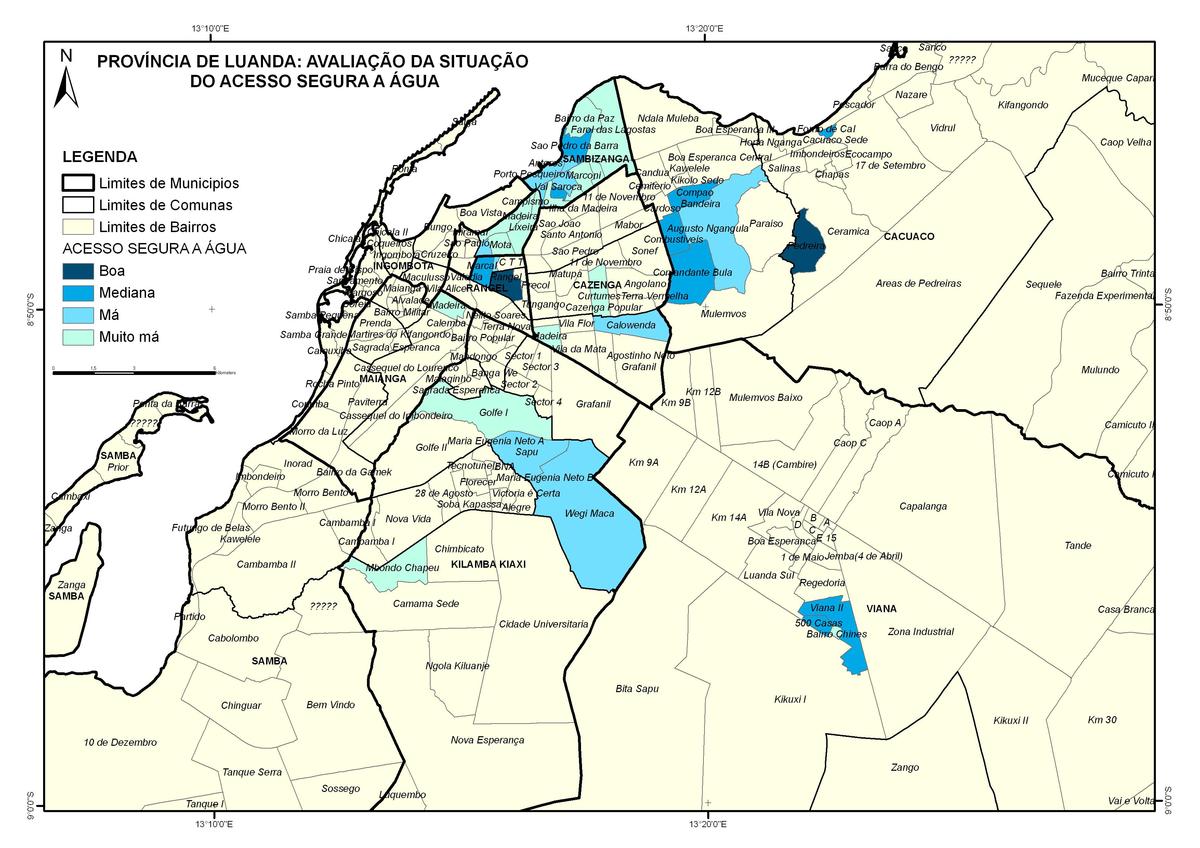
The information from our research is entered in MDG ‘poverty indicator’ maps. This research is based on several sources: the questionnaires, GIS mapping, geo-referencing, other DW research and research reports done by other stakeholders, such as NGOs and organizations (UN, WB, the Angolan Government). These maps show per municipality the information per indicator; access to potable water, costs of water, population density, construction materials, road conditions, health services, educational services, etc. See annex Sambizanga MDG maps as an example.  The maps for Cacuaco, Sambizanga and Cazenga are done. The others are in the process.

We have used the information from the baseline study to update the Municipal Profiles. DW involves the Municipal Administrations and their staff in the production and updating of the Municipal Profiles. But because poverty is a sensitive issue, we have used the language that the Government uses in the IBEP (Inquérito de Bem-estar da Populacao) the well being indicators.       
See annex Municipal Profile Sambizanga 2011
See annex Municipal Profile Cacuaco 2011
See annex Municipal Profile Kilamba Kiaxi 2011
See annex Municipal Profile Cazenga 2011

The Municipal Profiles (MP) for Viana and Rangel will be developed in the second year of the program. But DW is dependent on the Municipal Administrations’ cooperation to come to a satisfactory level of the MPs. We share the information from the baseline and the MP with the CSO and Municipal Administrations in workshops, CACS, MCACS and forums.

Activity/Milestone 2. Five ACOs trained in monitoring tools in each municipality.
Target months: 10, 22, 34

The focus groups that filled the questionnaires were trained on how to collect the information and make sure that their questionnaire represents the situation in their bairro as accurately as possible. From each newly established focus group the leaders were trained. At one of the trainings we trained 60 focus group leaders, municipal CSO leaders and administrative staff from the government from Kilamba Kiaxi, from different comunas and bairros. This training started in August 2010.

In Cazenga we trained 15 people, in Sambizanga 10, Viana 8, Rangel 8, and Cacuaco 9. Trainings were carried out in the period from 15 November 2010 to 30 March 2011.
Cazenga : 9–13 August, and 16 – 19, 25 November 2010
Sambizanga: 22–25, 29 November 2010
Cacuaco: 1–03, 08 December 2010
Kilamba Kiaxi: 16-20 August 2010, 13-17 December, 2010
Viana: 11–14 de Janeiro, 2011
Rangel: March 2011 
110 people were trained in total, all in leading positions in their bairro, comuna or municipio or part of the municipal or comuna administrative staff.

DW has trained members of local organizations in collecting and analyzing poverty indicators from their communities so that they can testify on the findings to the MA, media and service providers. See annex Standard DW training guide on Advocacy to CSO.

The CSOs then use their (new) network and knowledge to engage in the meetings of Municipal Forums and Councils, CACS and other meetings. We work with many CSOs at all levels in Luanda. Some represent their bairro, comuna or municipality, some represent a certain cause or concern such as HIV, youth or gender issues, some residents’ commissions or water committees, etc. See annex VCUC Partner Organization details for the growing (we engage with more CSOs throughout the years and new CACS and ACAs are formed) list of partner organizations. In this contact information sheet we also assess the strength of the partner organization (PO). So we can follow up on capacity building with the weaker Partner Organizations. We have indicated where available the disaggregated numbers of males and females in the POs, and the same for the management level of the organizations. The list is not complete in this sense yet, but we see already a rather evenly representation of men and women (887 men and 788 women members; 78 men and 54 women in management structures). Considering the Angolan context that is a very high score on female participation. 

Activity/Milestone 3. Training conducted for municipal administrations in using MDG indicators & mapping.
Target months: 11, 23, 35

See our answer in Milestone 2. We have combined the trainees to come from both the CSOs and the MA. We do this for a reason: networking is a very important part of influencing the MA and their work. So if we can bring the groups together in trainings and workshops, it brings down the barriers already. There is a curriculum for training for municipal administrators under development, we had already several meetings with IFAL training institution held and proposed training modules have been submitted.

In preparations for the updating of the Municipal Profiles, we had meetings with Municipal Administrations. Not really training, but more workshop-like. The planning dept of each MA should coordinate data collection for the Municipal Profiles. But only in Kilamba Kiaxi and Cazenga this is partially happening now. DW together with the Poverty network takes care of the rest with the focus groups collecting the needed information via the database questionnaire. Part of the reason why DW has to provide extra support on the data gathering is the low staff availability at the Municipal Administrations. The MA should have 716 staff members each, but are seriously understaffed (only about 150 staff members in average) hence they experience difficulties to allocate time for trainings. Interest is great, but actual time is limited.

Activity/Milestone 4. Results of MDG mapping presented at annual Municipal Forums.
Target months: 14, 26, 38, 50

This milestone was to be reached in month 14 only, but we have achieved early success and have been using the Municipal Profiles already, and at all levels, not only at the Municipal Forums. Meetings take place at every level, bairro, comuna, municipality, province and national. Some meetings are with and by CSO only, some with CSO and MA or other government representatives. All of them lead up to and influence the agenda at the Municipal Forums. The pre-MF meetings lead to a more focused agenda, and strategy on how to present the struggles in the bairros and comunas. The CSO groups meet each other on a regular basis to talk about the issues they want to address at the Municipal Councils, CACS, MF and other meetings. The media is also targeted to write and broadcast about the issues of the community concern.

An example of this: The 4th Civil Society Conference in Huambo in November 2010. At this annual conference CSOs from the whole country come together to share information and find their shared focus. Before the national conference there were local and provincial conferences where the agenda for the national conference was decided on. The annual conference is organized by a different Angolan NGO every year. Development Workshop was elected by the national CSOs to organize the 4th CS conference. An example from one of the provincial meetings before the national conference:
See annex 2010/10/28-29 Program IVth Provincial CSO Conference Luanda
See annex 2010/11/08-09 PP used at IV CS Conference Province of Luanda
See annex 2010/11/08-09 Final Report CS Provincial Conference Luanda
See annex 2010/11/08-09 IV CS Conference Province of Luanda Conclusoes e Recomendaçoes Final
All those separate meetings resulted in the National Civil Society Conference on 19 and 20 November 2010 in Huambo.
See annex 2010/11/20 PP IV CS Conference WP Rede Contra Pobreza Urbana Contexto das SADC
See annex 2010/11/18 IV CS Monitoria Participativa da Pobreza Urbana MDGs
See annex Final Report CS National Conference 2010 Huambo

The DW staff gives presentations to different stakeholders at different levels. With these presentations they spread knowledge about the current situation in the municipalities and strengthen the name of Development Workshop as a leader and a serious and supporting partner in the fight against urban poverty.

See annex 2011/01/15 PP by WP explanation cooperation Muni Admin and CSO
See annex 2010/09/13 AC presentation to Ministry Urbanism & construction on work DW
See annex 2010/08/27 AC presentation on DW method of Participative Monitoring of Urban Poverty
See annex 2010/11/10 AC Seminar on Kilamba Kiaxi Master Plan with analysis of problems and solutions
See annex 2010/10/22 DW Advocacy team Presentation in Pretoria
And we receive international acknowledgement for our work, such as the UNDP Habitat price. See annex UNDP on LUPP price UN HABITAT.

Our trainings focus on action oriented problem assessment. We encourage CSO’s and CBOs to engage Government on key issues of better service provision. We see a lot of youth turning to crime, so there is need for better schools and more possibilities to find employment and improved livelihoods opportunities. When existing water stand posts are not functional anymore, CSOs, representing the interests of consumers ask for repairs and maintenance. An example of a CSO meeting last April, with media present, on social housing and the influence on poverty. See annex 2011/04/09 Minutes plenary discussion CSO Kilamba Kiaxi.

CACS are organized by the government. They invite CSOs to meet the Municipal Administrative staff to talk about the problems and plans for the area. The CACS are a platform for citizens’ engagement in municipal upgrading, participatory planning and budgeting. They meet with the MA staff and talk about the problems and the possible solutions for their bairro, comuna and municipio.

The main issues discussed at CACS meetings include: 
I) to discuss all social, infrastructural and economic issues neighborhoods face; 
II) identify possibilities for local solutions to problems in the neighborhood or municipality and identify issues that require additional resources and need to be taken to the next level; 
III) receive information about decisions and activities carried out at higher levels;
 IV) make decisions on issues and resolve conflicts that can’t be resolved at lower levels;
 V) cooperate in the development of and approval of the annual plan of the municipality and ideally, give feedback to their implementation, monitoring and evaluation.

See one example: annex 2011/05/14 Report CACS – SAMBIZANGA

On the Municipal Forums (MF) there is more space for citizens gathering. The CSOs organize the MF.

The MDG mapping information and the Municipal Profile information are used at all levels by all stakeholders.

The CSOs that were trained use their network and knowledge to engage in the CACS and other meetings. An example from Kilamba Kiaxi: To improve the cooperation between CSO and the Municipal Development Forum of Kilamba Kiaxi the focus was on influencing the establishment of municipal Consultative Councils (CACS). The first session was attended by the provincial Governor of Luanda. The CACS was made possible by various consultation meetings held between members of CSOs, with support of our advocacy team, which culminated in the drafting of a proposal that was submitted to the city manager on municipal improvements. The same letter and the proposed operation of CACS were sent to the provincial governor of Luanda, as the city manager was late in responding to the request of the network. At the meeting the network members expressed their concerns about the quality of social infrastructure works in progress in the city, particularly in relation to roads. Network members complained about the lack of systematic process of consultation and dialogue to find solutions to the problems facing communities. The provincial governor appreciated the contributions of network members and urged the city manager to take greater advantage of the availability of civil society in the city to find solutions to problems.

Municipal Councils (CACS) are convened on the initiative and creativity of each municipal administrator. The Ministry of Territorial Administration, responsible for monitoring and ensuring that each MA works in compliance with the law, does not have the capacity to oversee the work of the MA. As a result some MAs have Municipal Councils 4 times per year, others 2 times, and some only one meeting per year. The law foresees two meetings a year. Part of the work of DW is to influence citizens, CSOs and the MAs to see the advantage of having the meetings in acordance with the law.

DW has trained members of local CSOs in collecting and analyzing poverty indicators from their communities so that they can testify and speak with authority on the findings to the MA, media and service providers.
DW also provides CSOs and other stakeholders with the monthly CEDOC Media Scan. See Milestone 9 on the CEDOC media scan. The local organizations use the information to support and if necessary challenge their local governments during CACS meetings, forums and through the media. The issues that are mostly featured include water and electricity accessibility, basic sanitation, lack of or substandard sewage systems, garbage collection, flooding during the rainy season, birth certificate registration and crime.

See annex 2011/03/09 water access and plan for improvement Cazenga & Kilamba Kiaxi
See annex 2011/05/12 Launching of CACS Kilamba Kiaxi
See annex 2011/05/12 Provincial Governor & staff during the inception of CACS in Kilamba Kiaxi picture
See annex 2011/05/12 Audience in CACS Kilamba Kiaxi picture
They use, amongst other information, the Municipal Profiles (MP) based on the MDG urban poverty socio-economic and institutional indicators maps. We have 4 MPs: Sambizanga, Cacuaco, Cazenga, and Kilamba Kiaxi. MPs are always living documents, which get updated on a regular basis, as soon as information becomes available. The other two MPs, for Rangel and Viana, are being developed. The DW research unit has the lead on the continuation of the Municipal Profiles (MP). They coordinate the updates, and ask for new input. Some information needs to come from the MA. If they don’t give, or give too slow or substandard information, we have to add that to the risk assessment.

Municipal Forums:

During the reporting period municipal forums were held in the municipalities of Cazenga, Cacuaco, Sambizanga and Kilamba Kiaxi while initial work was started in the municipalities of Rangel and Viana. The four municipalities where the forums were held, community groups and associations engaged amongst themselves to discuss ways of building synergies and agree on best strategies to engage with service providers and the various provincial and central government working commissions that have been working in the respective municipalities. The forums were also used to strategize on ways each municipal CSOs can have a very invigorating poverty network that engage with the MAs and service providers on how joint cooperation between the various stakeholders can make poverty alleviation strategy more effective.

The municipal poverty networks also discussed ways of influencing local pro-poor policies at the communal and municipal levels. The LUPN promoted the organization of the municipal and provincial civil society conferences and was also presented in two other meetings other than the National Urban Forum organized by the Ministry of Urbanism and the Office of President dealing with Municipal Development and Poverty Eradication.

The last Municipal Forum held in the month of June in Cazenga. Invitations were sent to different stakeholders including the municipal administration, the representative of the electricity company, the police, etc. See annex Invitations to MA et al to Urban Forum Cazenga. The Municipal Forum was broadcasted by the municipal public radio (a branch of national radio) and the main issues discussed where the burdens for women. Proposals were presented that did not only reach the MA but the Minister of Justice herself who proposed to sit-down with the local CSOs to find solutions.  

Another example: The water association in Ngola Kiluange (Sambizanga Municipality) presented a proposal to their local administration on the potential risk of an informal dumb near a school and the local administration send a team to remove the dumb two days later.

There are municipal and community forums where the presence of a government representative is a must but the local CSOs do no always want them (the government) to be in their meetings when they discuss strategy issues or elect their leadership. Meetings aimed at building joint advocacy or policy influencing strategies do not have the presence of any government representative. The municipal forum in Cacuaco held in October 2010 discussed the municipal urbanization plan and the topic was presented by the vice-administrator. The municipal civil society conference in Cazenga, Kilamba Kiaxi and Cacuaco were attended either by the vice-administrator or by another representative of the administrator. 

In the Municipal Forum, meetings, and special meetings in Cacuaco and Cazenga we used the MP. Cacuaco used our MP for their MA Plan and Budget. Unfortunately we have not received the Plan and Budget from Cacuaco yet.

The combination of all these meetings, workshops and trainings gives a constant sharing of information and raising of expectations between stakeholders, and keeps the pressure on all of them to perform their duties.
An example of the meeting matrix of some of the project officers at DW Advocacy team:
See annex Project officer LG matrix for meetings & trainings
See annex Project officer TN matrix for meetings & trainings
See annex Advocacy team coordinator WP Advocacy at meetings matrix

We are in negotiation with IFAL, the Training Institute for Local Administrations, to develop several training modules on:
I)  Municipal Planning and Budgeting,
II) Community Water Management.
III) Land Management and Cadastre.
See annex 2011/04/00 cooperation with IFAL Área Temáticas de apoio ao IFAL

Objective 2 – To build an Urban Poverty Network to advocate for improved and equitable access to basic services.

Activity/Milestone 5: Organize Municipal Forums on 6 monthly basis

Target months: 7,14,19, 26, 31, 38, 43, 50, 55

During the reporting period municipal forums were held in the municipalities of Cazenga, Cacuaco, Sambizanga and Kilamba Kiaxi while initial work was started in the municipalities of Rangel and Viana. These Forums discussed the provision of basic services, road infrastructures, sanitation and housing. The conclusions and recommendations of the meetings were discussed taken to the CACS meetings which are led by the municipal administrators. The aim is for the municipal LUPN to meet on a monthly basis. But since there have been discussions on municipal and provincial civil society conferences, which are being promoted by LUPN, the meetings have been taking place more regularly. Some municipalities hold meetings every other week, while others almost every week. It is not our decision now to determine how often the LUPN will meet in the second year of the program. The LUPN leadership group decides what they think to be convenient for them. We provide technical assistance in terms of methodology but we try not to make any decision on their behalf. The city-wide LUPN continue meeting regularly on a monthly basis.

The four municipalities where the Forums were held, community groups and associations engaged amongst themselves to discuss ways of building synergies and agree on best strategies to engage with service providers and the various provincial and central government working commissions that have been engaged in the respective municipalities. The MF were also used to strategize on ways each municipal CSO can have a very active poverty network that engage with the MAs and service providers on how joint cooperation between the various stakeholders to make poverty alleviation strategy more effective. The municipal poverty networks also discussed ways of influencing local pro-poor policies at the communal and municipal levels.

The LUPN promoted the organization of the municipal and provincial civil society conferences and was also presented in two other meetings other than the National Urban Forum organized by the Ministry of Urbanism and the Office of President dealing with Municipal Development and Poverty Eradication. An example of such a meeting was held in May 2011 in the Commune of Camama, Kilamba Kiaxi. Participants included the provincial governor, the municipal administrator, all the six communal administrators, head of departments, traditional and community leaders and representatives of the municipal poverty network. See annex 2011/05/12 17 CSOs from 6 Municipalities information meeting.

Socio economic data captured through the baseline study is disseminated to MA through meetings such as forums and CACS. The provincial governor called for an emergence meeting in Kilamba Kiaxi to discuss some of the issues raised during the forum meetings. In Cazenga, special CACS meeting was called by the municipal administrator to discuss with the members the reliability of the data and the use thereof for the municipal development planning.

A DW field officer has continuously being working with the planning department in Cazenga to assist them making the most of the municipal profile. In Cacuaco, the planning department is continuously using the municipal profile to both furnish information to provincial government and to discuss priority projects with public and private service providers. Dissemination of municipal profiles were also carried out in a CACS meeting and in a special meeting organized by APRODEC last year. The meeting was held in December 12th 2010 in the main meeting room of Municipal Administration. Participants included the municipal administrator, CS representatives, head of departments and traditional leaders.
Examples from the 2nd Municipal Forum in Viana:
See annex 2011/07/29 PP used 2nd Muni Conference CSO Viana
See annex 2011/07/29 2nd Muni Forum CSO Viana report

Activity/Milestone 6. Community media articles or broadcasts covering the Municipal Forum debates.
Target months: At least 10 x

DW has trained members of local organizations in collecting and analyzing poverty related indicators from their communities so that they can testify on the findings to the MAs, media and service providers. In addition to the indicators collected in the communities DW also provides community organizations with media scan produced on a monthly basis by the DW/CEDOC. See also milestone #9. The local organizations use the information to challenge their local governments during CACS meetings, forums and through the media. The issues that are mostly featured include water and electricity accessibility, basic sanitation, birth certificate registration and crime.

Three articles related to the municipal forums were published in Vozes of Cacuaco, InforSambila and Vida Kilamba municipal newspapers.
See annex AngolaPress Muni Managers on Budget Rules Seminar
See annex A Capital press clip – Sambizanga Forum da Pobreza
See annex A Voz de Cacuaco, Maio 2011
See annex
A Voz de Cacuaco editorial (No. 6 2010), DW at conference
See annex A Voz de Cacuaco, Novembro 2010

Extract from a group interview conducted by a British journalist to assess the impact of the work carried out by DW with the Kilamba Kiaxi water committee in January 2011: See annex press statement WP ACA report training . Municipal Forums of Sambizanga and Kilamba Kiaxi were broadcast live in Radio Ecclesia. The Kilamba Kiaxi Municipal Forum was on the 9th of April 2011. The issues and the quality of discussion were much appraised by the large population who were tuned to the radio station. Cazenga MF meetings were broadcast on Radio Cazenga and Radio Ecclesia in July and in August 2011. Kilamba Kiaxi MF were broadcast in March and August 2010.

Other radio broadcasts and TV networks and internet pages covering our work:

Activity/Mileston 7. Launch Luanda Urban Poverty Network (LUPN).
Target month: 6

The Luanda Urban Poverty Network (LUPN) is officially active and its members approved the terms of reference that will govern the network. Each municipal network is currently electing its coordination body so as to make sure that the issues that are discussed at the provincial level are based on the reality at the grassroots.
See annex LUPN Terms of Reference
See annex What is LUPN?
See annex Periodic Report of the LUPN

LUPN is leading in the organization of the 5th municipal and provincial CS Conference in the last months of 2011. The National 5th CS conference will be held later in 2011, but local meetings have already been held.

Activity/Milestone 8. Meetings of the LUPN held four times per year.
Target months: quarterly

The LUPN is currently meeting on monthly basis in order to follow the pace of the political and social changing context in which Luanda is going through. Main points of discussion has been on how to hold the government accountable to fulfill the 2008 election promises as we are entering in the final phase before the next elections.

The last National Urban Forum was held in August 2010 in Sumbe, Kwanza Sul. The forum tried to collect proposals on land delimitation and alternative construction techniques to be used for the government One Million Houses project. The Urban Poverty Network was represented by three members who presented proposals on how the government could involve the beneficiaries so as to have stronger and sustained community projects. They raised concerns on what they view to be an “infrastructure construction” kind of development model which does not seem to be worried about building social capital. Green spaces and playing grounds mainly for children and youth were advocated as necessary for the new urbanized areas in Luanda and across the country. The government representatives and the other participants took very good notes of the proposal presented by the LUPN.

The next National Urban Forum is scheduled for the first week of October in Cunene province. DW has been invited to do a presentation on Urban Mapping. Other members of the Luanda poverty network will be there also.

Activity/Milestone 9. Monthly and annual media scan monitoring review published.
Target months: 14, 26, 38, 50

The CEDOC research department of DW scans all the Angolan media for articles that connect to the work of DW or are about the work of DW. It covers all national, regional, local printed and most online media. It covers state owned, private and community based media. This milestone is to be reached only in year 2, but has been reached early in the program. Every month the newest CEDOC Media scan is sent to many stakeholders. A printed version is always available at the project office in Luanda. As the document averages 87 to 165 pages, we do not print versions unless requested. Every month the CEDOC team makes a PDF file that is sent to all the stakeholders and other interested parties. This monthly media scan is send to 588 people.

The links to the monthly media scan done during the runtime of the Gates program is from 2010/09 to 2011/06. Click here to see all CEDOC Media Scans. We are in the final stages of updating the DW website. All the media scans will be available via the website of DW also.

Objective 3 – To increase sustainable access to potable water through the promotion of community management models to ensure consumer voices are heard

Activity/Milestone 10. Base-line mapping of water services in the project municipalities.
Target months: 8, 18, 30, 55

We have the baseline questionnaires information in the DW Database as described in milestone 1. The questionnaire covers all MDG poverty indicators and collects answers on 11 questions regarding the access to, quality and price of water. This information is used for the updating of the MP and in the field by the WATSAN officers.

We carried out and completed a diagnostics on the Water and Sanitation situation in the municipality of Cacuaco and Viana. This produced thematic maps of municipalities, communities and neighborhoods; location of water tanks, location of pumps and fountains, the demarcation and mapping of sectors from each of the districts using GIS technology, have identified the key players involved in the marketing and distribution of water. An introduction and presentation in GIS technology is used to explain our way of working and collecting the data on which we base our knowledge and reports.
See annex PP introduction GIS technology
See annex PP Presentation of GIS technology

Initiated and ongoing update registration and mapping of existing stand posts in three municipalities (Cacuaco, Viana and Cazenga), especially their location, technical state, period of construction and environmental management. Detailed mapping of water services are being done in conjunction with the baseline for the other services. Mapping has been concluded for the municipalities of Sambizanga, Cazenga, Cacuaco and Kilamba Kiaxi. See annex Water pumps assessment 168 stand posts. This list is being geo-referenced and put into maps by our GIS assistant.
 A study was done on the level of participation of women in community management of water and sanitation in zones of the project. See annex 2011 WATSAN Women Research, done in Viana and Cacuaco.

Activity/Milestone 11. Training of stand post committee staff in maintenance and financial management.
Target months: 11,23,35

In the program we give several trainings and held several meetings. At the meetings we disseminate knowledge also, so a meeting is sometimes also to be considered as training or capacity building. We developed four training modules and community capacity building (management techniques and basic accounting, human relations and interpersonal and basic records, maintenance and minor repairs on the fountain, and cross-cutting themes on HIV-AIDS, Gender, Legislation, water, etc.).
See annex WATSAN training the ACAs pictures
See annex WATSAN functional water points and committees pictures

The WATSAN team works with 6 active MA and 6 ACAs already established, and 3 ACAs that are in the process of (re)starting, and approximately 10 neighborhood committees (ACOs). The WATSAN team conducted 12 seminars on various topics (Hygiene and Health, Associations and Leadership, Community Management of Fountains, Conflict Resolution, HIV/AIDS). The WATSAN team made 20 presentations (Hygiene and Health, Water Treatment and Maintenance and cleaning of fountains). We facilitate debates, and use leaflets we still have from our cooperation with UNICEF. We organized 15 community theater sessions: The actors show Good Customer Service, organization and management of fountains, water treatment and cleaning and maintenance of fountains. See annex WATSAN theater in the barrios pictures. We gave institutional support to 3 ACAs to develop themselves and three residents with offices and material improvement in physical facilities of two clubs. Training was given on a “computer user level” to 9 project beneficiaries (members of Associations). 


Training was given on “social mobilization techniques for the construction of improved household latrines”. The training was directed to members of associations of community management of water and sanitation in the neighborhood that will ensure the process of social mobilization in support of construction of latrines in one neighborhood (22 members). 
Training on “Mapping of Water Supply and Sanitation” (use of GPS, recording and analyzing data, preparing and sharing of the report). The training was attended by eight people, was aimed at sharing technical and location management for municipal water. It lasted 1 day (5 hours).
See annex 2011/05/20 Hygiene and sanitation seminar I
See annex 2011/05/20 Hygiene and sanitation seminar II

Organization of 3 workshops (one on “Gender and HIV / AIDS” and two on Community Development) – Each workshop lasted for two (6 hours / day) days, with target group members of associations, water committees and community in general. The average was 25 people per seminar.
See annex 2011/05/28 seminar on water management
See annex 2011/05/28 seminar on water management groups present
Realization of 14 lectures on hygiene and sanitation. The lectures were held just around the stand posts with concerns regarding the organization of users in search of water, and lasted up to 45 minutes. The goal of these lectures is to get to know possible members for new water management committees. 
An example:
See annex 2011/05/25 GPS training I
See annex 2011/05/25 GPS training II
See annex 2011/05/25 GPS training III

6 meetings held in the comunas on Water and Sanitation (Kicolo, Cacuaco Headquarters and Ngola Kiluanje) – These meetings are open to all citizens. So they can choose their representatives that will be working with the MA.
We created and launched three “Community Forum for Water and Sanitation in the municipalities of Cazenga (Ngola Kiluanje), Cacuaco (Kikolo) and Viana (Moxico) – as a community space for discussion and accountability of ACAs to consumers of water on a monthly basis. The meetings aim to provide accounting, joint planning and engagement of actors working in the water sector at the community level and participating ACAs, residents, church leaders, youth and the community at large. On average 35 participants. One example:
See annex WATSAN electing the water committee members pictures
See annex 2011/05/17 ACA preparation to election team
See annex 2011/05/17 ACA preparation to election team attendance list

Realization of 2 MA meetings on municipal water and sanitation (participation of the major key players in the sector of water at the municipal level). These meetings are chaired by the local municipal administration of Cacuaco and seek to meet the concerns identified at the level of communal gatherings. Members participating in meetings are the Municipal Administration, EPAL (public water company in Luanda), Representatives of Associations and representatives of residents’ committees. On average 25 participants.  


Backed with 175 boxes of the product SURE (a purifier recommended by the authorities for water treatment at household level) the associations of community management of water and sanitation in the project area received a training on how to use and sell the product. Each box contains 48 vials of the product and the associations will sell them at an affordable price and use the funds to replenish stock and creating a petty cash fund for preventive maintenance of the fountains. This product is funded by PSI, but it is good for the visibility of DWs work together with the MA.
 We had the 1st Workshop on Models of Community Management and Exchange of experiences between the associations. New committees were set up for 17 water points: in Cacuaco 12 and in Viana 5.
 Six New Water Consumer Associations were established. We legalized and promoted 4 Water Associations at the Municipal Administration of Cacuaco and the Provincial Government of Luanda (GPL). 


Table showing the direct and indirect beneficiaries of the work done by the WATSAN team and their Partner Organizations:


Directos


786

Homem

185

23,5%

Mulher

513

65%

Criança

90

11,5%


Indirectos


4716

Homem

540

11,5%

Mulher

3078

65%

Crianças

1110

23,5%

Activity/Milestone 12. Best Practice model tested and validated.

Not connected to the Gates Milestones, but a strong indicator of our impact: In the province of Cabinda the DW management model was used by the National Directorate for Water. The DW management model is based on participatory planning, as non-political and neutral as possible. See annex 2010 MoGeCA DW National Water Policy document.   

Several MA in Luanda (other than our target MAs) have asked for and received this model to use for their planning cycle. A monitoring system was set up and records the flow of water in stand posts. DW gave a public presentation of the Model of Community Management of Water, respectively, at the Workshop Ministry of Energy and Water in allusion to the World Water day, and Civil Society Workshop organized by the Angolan National Commission to Fight Poverty of the Government of Angola. See annex Cupi Baptista at Ministry of Water picture.

DW did a multi-stakeholder study on Luanda under the State of the World Cities to be published by UN Habitat, providing an opportunity for diagnostic of perceptions of Government, Private Sector & Civil Society. DW has been working closely with the Water National Directorate from the Ministry of Energy and Water in order to replicate the community management model to other communities across the country. There have already been some significant successes in Cunene, Huambo and Bie, but there is still a lot to do. One of the biggest difficulties faced here is not directly related to the government’s acceptance of adopting the model but the capacity of providing timely assistance in those communities where water services are being implemented.

The government led “Water for all Project”, for example, is trying to provide for water for nearly 75% of the population by the end of 2012 and most of services will be community related ones, that would require community management model. An attempt here is being made so as to enable Local Administration Training Institute (IFAL) to start delivering courses on water management models. The WATSAN team has done special meetings a.o. in Cacuaco. They created a space to talk about water with all the top people from EPAL (National Water Company), the Municipal Administrations, and all the OCAs. The MA recognized the good work that DW is doing in this field and will support the dissemination of the model to other areas and new water points, and DW’s involvement in that.

PROGRESS

  • General Progress:

We believe that the project has already achieved some significant successes and is generally on schedule, and on some milestones ahead of schedule. We have a very active Partner Onganization  base that meets on a very regular basis, to address the issues faces by the urban poor in Luanda. The constraints we face were already anticipated at the beginning of the program. The cooperation with the local and national government bodies has been positive but dealing with Angolan bureaucracy which is often slow to respond has obliged us to adjust  timeliness on some outputs. An unanticipated factor has been the Government’s plan to change the borders of Luanda’s municipalities and several senior staff changes in Municipal Administrations’ and maybe more significantly two changes of Luanda’s Governor and several of the cities top officials. The rotation of senior Government officers has meant that we will plan to give even more attention to training and supporting the newly appointed Municial Administration staff in the development and execution of the Municipal Plans and Budgets. However in general we will continue implementing the program as planned. 

  • Key Milestone Deviation:

We are meeting all milestones.

  • Course Correction: 

At this moment we are not planning any course corrections.

  • Plans for Next Reporting Period:

Not applicable. We will continue as planned.

RISK

Most if not all risk were already identified before. Below you find an update on our risk assessment and strategies:

Risk 1: Lack of a serious commitment by the Government and/or abandonment of the promises made in relation to poverty reduction may affect the results of this project.

Situation at moment of reporting:
 During 2010 and the first half of 2011, the Angolan Government has made a renewed effort,  to deliver on its ambitious agenda promised during the election campaign of 2008. This includes the construction of:


• One million houses: In the first phase of this project 710 buildings and 3000 houses (apartments) were built. The forecast through 2012 is to build another 82,000 apartments. The government already acknowledged they will not reach the total of houses promised before the next elections. The costs for one of these houses (between US$126.000 to US$200.000) is out of the reach of most Angolans, and especially the most needy. This has created widespread discontent contrary to the expectations created. The clearing of land for housing and the demarkation of housing land reserves has also involved the forced removal and in some cases demolitions of existing ‘informal’ housing, whose owners often are not properly compensated (in terms of resettlement and availability of social services). The division of land reserves for residential purposes is is rarely done with prior consultation with local residents. The current program Voices of Citizens for Urban Change aims to influence municipal administrations involved in the housing program to employ participatory planning methods of negotiation with the communities.


• Water for All: This program it is also very ambitious, aiming to reach 80% water coverage by 2012. See annex Program Agua Para Todos. Despite having reached improvements in the  richer commercial housing areas in the south of the city, in old informal settlement areas and the peri-urban peripheries, where the lack of water is higher, this program has not (yet) met its objectives. 


• The Municipal Integrated Program to Combat Poverty and Rural Development for the entire country was launched in January 2011, with a clear aim of delivering results before the 2012 elections. Interestingly, this major Government “integrated” program organized under the auspices of the State President’s own Civic Office, has appropriated much of the language and (to some extent) policy mission statement of DW and civil society’s pro-poor advocacy platform. This “poverty eradication” public policy vision must be recognized as a shift away from the official “trickle-down” approach that has been predominant for most of the last post-war decade. DW and its local community partners have been welcome participants in several of the Government public forums. DW sees the Integrated Program as being a strategic opportunity to not only influence Government’s jargon but also planning policies and introduce good practice on delivering services on the ground.

Challenges that need to be addressed in the new Integrated Program include:
I) Adapting municipal budgets to local priorities;
II) Introducing a balance approach to investments in both infrastructure and the promotion of local economic development;
III) Increase the autonomy of municipal administration to run the programs locally; (Presently there is incoherence between the central government discourse and practice, in terms of decentralizing the power from the centre to the municipal administrations on one hand and centralizing control of finances by central government)

• There is a need for updated survey data on how many Angolans live in which areas, and on the real levels of poverty. The survey of population welfare (IBEP) carried out by the Angolan Government in 2009, claim that poverty reached a reduction to 36.6%. See annex 2010 IBEP versão resumida, page 14.

The baseline poverty data using UNHabitat recognized indicators collected by the program Voices of Citizens for Urban Change demonstrates a different pattern of high levels of local poverty in the musseque areas where the program is working. The official Government data is also being questioned by academics and other independent centers for studies and scientific researches, like CEIC from Catholic Church, and some international insitutions.

The Parliament is responsible for overseeing the implementation of the actions of the Angolan Government, has difficulties and limitations to perform this duty.
• The programs get mentioned in many speeches and media outlets. However progress against targets set by the Government rarely gets tracked. We have the plans, but the detailed budgets and the results on these plans are rarely published. This provides an opportunity for our project in getting the local communities and the designated consumers of the planned basic services to monitor the delivery and eventually also influence the budgeting process.
• And this leads to one of the greater risks. The Government treats municipal budgets as restricted internal documents and rarely produces the level of detail that Municipal administrations need. An example from Cacuaco: We needed to have access to the planned 2011 budget for the MA annual plan. A training/workshop was planned by DW to assist the Municipal Administration in developing their planning and budgeting capacity. We were able by creating this training opportunity to get access to the Municipal Plan but were disappointed to see that it was little more than a sort of shopping list. The information is very outdated or even obsolete. Municipal Administration staff demonstrated their willingness to upgrading their levels of skills in budgeting and planning.

Mitigation Strategies: The Voices of Citizens for Urban Change Project will continue to carry out studies and monitoring of progress or lack of policies and programs around the Angolan Government. The results of these studies of monitoring will be shared through the media and CSOs. That will lead to pressure on the government to improve the implementation of the policies. The Project will be part of the initiative to create the National Observatory for monitoring the progress of implementation of national strategies to combat poverty in light of the ratification of the Government of Angola to the Declaration of the MDGs. The project team will continue to train MA staff and CSO organizations to improve their capacities.

Risk 2 A: The Government does not provide sufficient funding to local authorities.

Situation at the moment of reporting:
 Although the Angolan Government has provided its policy agenda in the administrative and fiscal decentralization to the level of Municipal Administration (MA), the allocation of roles/ functions has not been accompanied by an adequate allocation of financial resources and capable human resources. See annex 2010/06/22 AngolaPress on Reduction Municipal Budget. 
MAs have the status of autonomous units in the state budget, but they still have not assumed  the full autonomy to control their own resources permitted by law. MAs are in practice still dependent organs of the Provincial Government. The MAs have to send their plans and budgets to request for funds. They do not have access to a sufficient funding every year to fully implement their plans. The Provincial Governador determines the monthly amount of funds available to each municipality.

Based on the Decree 17/10 on the organization and operation of the MA, the MAs and communities come together in Consultative Municipal Councils (CACS). There are important Councils that the residents  can use for discussion and resolution of local problems. The project gives great importance to the CACS and promotes public education about its potential through the dissemination of information. Some CSOs still see the CACS as just a place of “approval” of what has been decided, suggesting another role of public communication of a consultative forum for citizen participation. See as back ground document annex 2009 World Bank report on Angola Municipal Accountability.

Risk 2 B: Successive changes of directors and governors of Luanda.

This leads to MAs that are busy with the consequences of the change in leadership. As people are not elected but appointed a new leader could lead to shifts in staff positions. The focus will not be on building capacities of staff of MA. The Watsan team raised the concern about the high staff turnover in the management positions in the various MA’s that they work with.

Example: In the last 2 years in Cacuaco, the Municipal Administrator was replaced 3 times. The last time was 3 months ago. That leads to extra time needed to develop new working relations with the new administrator. In Cacuaco we are involved in the management of 60 water points so we can’t afford to loose too much time. In Luanda a Provincial Management Committee is busy to install the new Governador. Will that again lead to a change in Municipal Administrators? In Angola having personal relations with the stakeholders in any situation is very important.

Mitigation Strategies: The Voices of Citizens for Urban Change Project continues to provide training and capacity building in the field of municipal participatory planning, to enable the creation of an environment of mutual trust and relationship within the CACS. DW invests a lot of time in getting to know all the ‘movers and shakers’ in the Angolan Administrative structures, at all levels.


Risk 3: The government sometimes accuses  civil society organizations to be spokesmen of political opposition and introduce restrictions on their activities.

Situation at the moment of reporting:
 This risk remained and increased somewhat for some CSOs, especially those who advocate aggressively on human rights, land tenure and asymmetries in the distribution of income in the country and corruption.
 Some NGOs and CSO have criticized individual government leaders personally expounding political party positions. Public space tends to close for these organizations. The CSOs in the CACS are not fully able to expose their views freely. It is supposed to be a very democratic space, but there is room for improvement. 

Mitigation Strategies: The Voices of Citizens for Urban Change Project will continue to work with the Institute for Local Administration Training (IFAL) to train the government and CSOs on how to best use the CACS as spaces to promote a constructive dialogue between governments and CSOs.


Risk 4: Leadership challenges within civil society.
I) Reduced space for CSOs in the public sector, due to stricter legal control by the government of CSOs.
II) Drastic reduction of donor funds to Angola.
III) Strong staff members of NGOs move to the public or private sector, as NGOs are struggling to compete with salaries offered. 

IV) The State sometimes fails to recognize the role of some CSOs, especially those who criticize government programs.

Example: The independent Radio Ecclesia still being stopped from broadcasting nationally, being a very critical station.

Mitigation Strategies: The Voices of Citizens for Urban Change Project will invest in the promotion of relevant training workshops for CSOs, forums and CACS to promote participatory and democratic elections of representatives to public spaces, inclusive and participatory municipal planning and leadership activities in CSOs and MAs.


Risk 5: Changes in the borders of MA lead to delays and unclear structures.

Luanda is in a process of changing some of the borders of the MA. Plans will be submitted later, and plans in process will cover old boundaries. As consequence of the expansion of the city to new areas that were very recently used as agricultural and grazing land, the government claimed that they were no longer able to make a proper planning for the city. Luanda has been extended in the northern east part. The parliament has approved the annexation of one municipality of Bengo to Luanda and the restructuring of the province of Luanda. Thus, Luanda will have seven municipalities instead of the current nine. Six municipalities (Samba, Ingombotas, Maianga, Sambizanga, Rangel and part of Kilamba Kiaxi) will be merged to become one (the municipality of Luanda). Four new municipalities have been created: Belas, Icole e Bengo, Quissama and Luanda. These four municipalities will be added to Cazenga, Cacuaco and Viana. There is a possibility that some of the former municipalities will become communes.

Mitigation Strategy: Our principal institutional counterparts in the MA and Central Government appear to still be in place at the time of reporting. Our CSO focus strategically focuses on working with bairro level community based organizations who will still be active and vital even if municipal boundaries are re-configured. We will therefore keep our ongoing work focused on the  bairros, irrespective of which municipality they belonged to or are becoming a part of at a future point.

Risk 6: Municipal Elections were expected in late 2012.

No date has been set, but we expect them only in 2013. This could influence the speed of the MA development of Plans and Budget. And this could lead to the rapid building of water points without proper management and maintenance structures developed. Water points are a very visible and important improvement in most areas. But without proper management of the water points, that will lead to water points that will function only for a short time, if at all. The DW management model is based on participation of all stakeholders. In a highly politicized society, under the pressure of upcoming elections we have to be aware of and vigilant of the neutrality of DW.

Mitigation Strategy: Make sure DW keeps her independent image, and promotes civic education and the importance of proper water management systems. While there are some expected challenges requiring re-adapting the approach to engage with the new governance structures at the municipal and provincial levels, the project does not foresee any major changes in its operation.

SUSTAINABILITY

The Voices of Citizens for Urban Change (VCUC) Program is part of and scaling up of a long-term cooperation between DW, many Angolan and international CSOs and NGOs, and the Angolan Government at all levels, national, provincial, municipal and comunal. DW is able to execute the Voices of Citzens for Urban Change program, because of the long standing cooperation between DW and all the other stakeholders. We have supported the development of ACAs we in the past that have been operational for many years without further operational of financial support from DW. We have long term cooperation with EPAL, IFAL, several ministries and other government bodies. And of course with our CSO and NGO partners in Angola. One of the aims of the program is to facilitate and support the growing cooperation between all stakeholders in the improvement of the living conditions in Angola, and in the case of this program, in Luanda. But we disseminate our knowledge and information throughout the country and share information with, and learn from (inter)national partners as often as we can. This is one of the main tasks of Allan Cain, supported by Belisario dos Santos, Cupi Baptista and Willy Piassa. They often join (inter)national conferences and workshops to strengthen the cooperation with other organizations.
See annex 2010/08/27 AC presentation on DW method of Monitoria Participativa da Pobreza Urbana
see annex 2010/09/13 AC presentation to Ministry Urbanism & construction on work DW
see annex 2010/10/22 DW Advocacy Team Presentation in Pretoria
see annex 2010/11/08-09 IV Civil Society Conference Province of Luanda
see annex 2010/11/10 AC Seminar on Kilamba Kiaxi Master Plan with analysis of problems and solutions
see annex 2011/01/28 AC presentation to World Bank on Urban Land markets
see annex 2011/05/26 Situational Report of World Cities by AC on Luanda
see annex 2011/06/00 AC PP Urban Environment & Research informal markets assessment Luanda (given in Nairobi)

As the Angolan government is keen on continuing the cooperation with the CSOs and NGOs (including DW) we expect the continuous development of this cooperation to continue after the grant period has ended.

SCALABILITY

We aim to increase the influence of the citizens on the development of their bairros, comunas and municipalities. And that work is not restricted to the 6 municipalities of the Voices of Citizens for Urban Change program. Our work spreads throughout the whole city, and where possible also outside Luanda and through the National Urban Forum and the Annual Civil Society Conferences the lessons learned from the programme are shared and replicated at a national level. Due to the visibility of DW in Angola, we often get invited to share our work and our research in other parts of the country, and even abroad. During the current reporting period DW has had the opportunity of sharing the experience of the Voices of Citizens for Urban Change program in China, South Africa, Sweden, Kenya and Mozambique.

LESSONS LEARNED

We are very aware of the importance of working with and partnering with the key people in the strategic institutions. We continue to develop functional working relations with all stakeholders in this program. Especially the continuous changes in the Municipal Administration staff leads to some extend to extra work, but that has to be accepted. Training of all stakeholders at all levels remains vital to the program. The sharing of all available information in an action oriented format is crucial. Doing research and sharing the outcome leads to better knowledge and decisions. That helps the program to come to results that all will benefit from. The population because their needs are met, the municipal administrations because they improve their capacities and strength to influence the situation in their municipalities. It is not a lack of will to improve the lives of the poor, but sometimes the problems, needs and demands are so overwhelming and complex they lead to in-action or fear to take decisions. The Program supports all stakeholders to keep moving in the right direction.

Second Year Interim Report: August 2011 to July 2012

In its second year the program has achieved some significant successes and is generally on schedule, and on some milestones ahead of schedule. We have a very active Partner Organization base that meets on a very regular basis, to address the issues faces by the urban poor in Luanda.

DOWNLOAD DOCUMENT:

Executive Summary

Click here for a list of abbreviations used in this report.

In the second year of the program:
    • The government has reaffirmed its intentions to move toward the creation of a new level of Municipal Governance (at least in Luanda) by restructuring administrative divisions of the city, arguing that this will facilitate elected “autarquias”. Autarquis is the term used in Angola to describe the municipal level institutions that are being planned as part of the state’s decentralization strategy. Autarquis will be a new autonomous level of local governance. They are likely to be composed of elected municipal or district councils and elected mayors. Autarquias are likely to replace the nominated CACs and mayors are likely to replace appointed administrators. The Autarquia will have its own charter or legal mandate and regulations and will take over the primary role of financial and budgeting units. They are likely to continue to be financed through transfer-payments from the state budget, but are likely to take over the right designated in Law 04/07 to generate their own income from local taxes or service fees. It is hoped that
the new Law on Autarquias will reverse the 2010 Law and allow locally generated funds to remain in the hands of the municipality (without reverting local income to the state budget). Autarquias are likely to
be able to pass local by-laws, set up municipal public enterprises to manage utilities and make municipal development plans. The Ministry for Territorial Administration who has been given the responsibility
for developing the Law on Autarquias has advised the first municipal elections will happen in 2015 once the national census has been concluded.
    • The President’s office set up an Anti-Poverty Commission that borrowed much of it’s platform from the Civil Society Poverty Network that our project supports.
    • Some significant improvements to water coverage has resulted from the project’s partnership with the Luanda Water Company EPAL and the National Water & Sanitation Directorate (DNAAS) in urban bairros where the program is engaged. Significant funds from the Water for All Program have been leveraged since the beginning of the project to bring water to approximately 157.000 people.
    • Development Workshop’s advocacy for a strategy of community water management that builds community financial capacity to sustain and maintain water infrastructure, has been officially adopted by the Angolan Government in May 2012. DW has been commissioned to develop an operations manual for distribution across the country.
    • Despite progress on the policy development, the project’s participatory monitoring of urban indicators demonstrates that the poor’s access to services remains below the targets promised by Government through their ‘Water for All’ and ‘One Million Houses’ programs.
    • Urban civil society remains disenchanted with the slow pace of poverty reduction and the increasing gap between those elites who have benefited from Angola’s rapid economic growth and the majorities who have seen only slow improvements.
    • Urban civil society however has become more articulate and effective in making their voices heard, through municipal forums, community and social media channels and demands for more accountability on how public budgets are developed and spent.
    • The program has been engaging with Luanda’s Special Office for Urban Upgrading to promote good international practice and encourage more participatory approaches to planning. Consultation with civil society through the Municipal Forums has been one of the key outcomes.
    • Frustrated youth are increasingly making their voices heard through street demonstrations and direct action. Opposition political parties have not effectively transformed these concerns into their policy agendas. The results of the recent national elections demonstrate this. In a country known for a high rate of participation in elections, the largest block of urban voters chose to abstain or spoil their ballots in last months election.
    • The program’s key strategy remains targeting local Government and contributing to the process of creating elected municipal councils that are promised before the end of the current program.

 In general we will continue implementing the program as planned.

Progress and Results for the 2nd year of the program – Introduction

The Voices of Citizens for Urban Change program focused on 6 municipalities in the Luanda Province:

  • Cazenga
  • Cacuaco
  • Sambizanga
  • Rangel
  • Viana
  • Kilamba Kiaxi

A new administrative division of the province of Luanda has been approved in parliament. Luanda has claimed land from the province of Bengo to accommodate its growing population. The government has decided to create three new municipalities and merge six others in one. Out of the six municipalities that have been merged a mega metro municipality has been created, the municipality of Luanda. Rangel, Ingombotas, Maianga, Samba, Sambizanga and Kilamba Kiaxi are the municipalities that have been incorporated. Cazenga, Viana and Cacuaco have been joined by the municipalities of Belas, Kissama Icolo Bengo and Luanda. Thus, the province will from now on have seven municipalities instead of nine.

According to the Ministry of Territorial Administration, by creating the mega municipality in Luanda, the government is trying to prepare the governance structure that will be formed when local elections take place in 2013. The government also justifies this change alleging that the former administrative division made it difficult for municipalities to implement their development strategies when boundaries between them were not very clear.

The law which backs up this administrative division is not clear yet about what form of leadership will exist in the districts and what roles they will play. This poses a challenge on the level of engagement or participatory governance processes that can be undertaken with government. As such, pending clarity on the government structures within districts, the project has focused more on working at the commune level and to provide support for CSOs strengthening and promoting engagements at communal level as these are the building blocks for engagement at higher levels.  The project activities are thus not affected by the change. It is expected that CSOs will have the capacity to promote new engagements and leverage on their established links with existing structures which will be incorporated into the new structures once finalized.

The municipal administrator of the old Sambizanga municipality has been appointed as the “president” of the new municipality of Luanda (as from February 2012) although he still operates from his old office. While Sambizanga is now a district, there is still no clarity on what the governance structure will be and how this will relate to the municipal and communal level structures.  For now, the “president” of Luanda municipality continues to oversee the affairs of Sambizanga (as was the case before the administrative change).

DW met with the director of the National Directorate for the Territorial Organization from the Ministry of Territorial Administration (MAT) to discuss potential points of cooperation within the new administrative division of Luanda. MAT recommended DW to continue producing municipal diagnosis so as to help the new administrators to produce consistent municipal plans. DW will continue (co-)producing maps and Municipal Profiles, and adapt them to the new boundaries.

Despite this new administrative division DW’s programs in Luanda will not be affected. The municipalities of Sambizanga and Kilamba Kiaxi will be districts which will also remain administrative entities. The active citizenship organizations that DW has been supporting in those places will continue engaging with the local administrations to promote participatory governance.

Due to the administrative changes in the municipal borders in 2011, we are now officially working with 4 municipalities:

  • Luanda (the municipality, not the city at large)
  • Cacuaco
  • Viana
  • Cazenga

See the larger versions of the maps attached in annex old municipal borders and annex new municipal borders. Each municipality consists of several comunas, and each comuna consists of a number of bairros. See annex map with bairros.

Progress and Results – The Angolan Context

Our Program Director, Belisario dos Santos, has left DW in May 2012 to become the new National Director of the Ministerio da Administração Territorial, Local do Estado, MAT. We miss him, but are also very happy that he has been able to increase his influence on the very important decentralization process in Angola. Belisario remains a very important adviser of DW and he will continue to support the mission, vision and programs of DW. He also gives us excellent access to this very important and high level in the Angolan government structure. Belisario has written an excellent report on the decentralization process and local governance development in Angola, see 2012 BdS Report on decentralization in Angola. For another analysis from his hand is about the Origins of Urban Poverty, see 2011/09/14 BdS Risk analysis of urban poverty and fast growing cities.

Evolving Urban Governance Environment in Angola
The reporting period up until the end of July 2012, coincided with the lead-up to Angola’s second post-war elections. The constitution had been modified in early 2010 to do away with presidential elections, while at the same time significantly strengthening the executive powers of the President. The constitution however did reaffirm that Municipalities were to become autonomous democratically elected units of local governance but the date for municipal elections was not fixed. The Presidency is assumed by the leader of the party winning parliamentary elections on the basis of a proportional system, which are now held every 5 years.

The reporting period also corresponded to a period when Presidential commissions to combat poverty took a strong intervention role in local development. The “anti-poverty commission” appropriated much of the language of civil society organizations (particularly the platforms of our current project partners in the “Voices of Citizens for Urban Change”). The influence of the project on the setting the agenda for urban poverty reduction is evident.

The elections in Angola
The elections have taken place one month after the timeframe covered by this report, on the 31st of August 2012. The preparations, after continuous postponing the planned elections, have influenced the last few months of this reporting timeframe. Tensions and opportunities arose from it.

It has been a time of massive (and biased) media attention, building tensions between the different parties, small but rather violently stifled protests, and some accusations of unlevel playing field. It also led to renewed promises to the citizens, more attention to service provision, and more active engagement of public servants with their constituency. The result of the election (72% MPLA, 18% UNITA, 6% CASA CE) leads to a continuation of the MPLA stronghold on Angola. The voter turnout, 63%, was significantly lower than in 2008, 87%. Significant in this is that fact that Luanda was heavily canvassed by the MPLA, but the voter turnout was even lower than the nationwide turnout, only 56%. And of that 56%, only 59% voted for the ruling party. See attached annex 2012 Elections results.

International institutions, such as the Human Rights Watch, the EU and African Union formally assess these elections as free and fair, but made several (in)formal reservations. See annexes 2012 EU formal statement on Elections Angola, 2012/08/01 HRW Report on Upcoming Elections Angola and www.bbc.co.uk/news/world-africa-19460914. MPLA had much more access to financial resources and the (state owned) media. In general many observers considered the opposition too weak to be a viable alternative. International observers do acknowledge improvement in the electoral process in Angola.

The local elections that were initially planned for 2013 are now scheduled for 2014 (by September). The change is due to the plan to conduct a national census between July and August 2013. The delay in holding local elections will have implications on how long it takes for municipalities to be financially autonomous. Municipal administrations continue ot depend on budgetary decisions of the central government thereby affecting how locally priortized projects are funded.

Other important background documents
Other interesting new and latest background information and documents on the Angolan context: Angola and especially Luanda is still one of the most expensive places to live and work in the world. See www.mercer.com for the statistics and www.bbc.co.uk/news/business-16815605 for a few good examples.

On the general developments in Angola, the economy, the state of the country at large:
See annex 2012 Chatham House Indicators Angola
See annex 2011 Transparency International report on corruption Angola ranks 168/183
See annex 2011 Transparency International Angola report
See annex 2012 Bertelsman Institute Angola Country Report, important sections highlighted (DW mentioned p.45)
See annex 2012 HRW report on Angola
See annex 2011 UNDP Human Development Report PT

The main issue, coming from international research institutes, is the lack of transparency in Angola. People protest more openly and it has been a big topic in the election campaigns.

Progress and Results – the Angolan National Budget

One of the early steps in 2007 in moving towards decentralization was the empowerment of Municipal Administrations by making them local “budget units”. This step was called “deconcentration” rather than “decentralization”. The Law 07/04 gave municipalities the right to manage allocations from the state budget and also the responsibility to develop annual municipal budgets. The Law also created consultative councils (CACs) where civil society representatives were able to influence the processes of municipal planning and budgeting. The current project Voices of Citizens for Urban Change built much of its strategy around making these instruments work to promote pro-poor urban development. The project promotes the collection of data, its transformation into information and uses the mechanisms of local forums to use knowledge to influence the CACs and local Government administrations. Poverty indicator monitoring and the creation of municipal profiles are parts of this process.

Annual state budget data published by the Ministry of Finance has not been shared in a disaggregated format with the CACs or civil society institutions. In fact, the lists of data and figures are daunting for even local Government authorities to understand and use in planning their local programs.  Development Workshop and several other civil society organizations argue that this information needs to de-mystified so that it can be understood at both the national and local level. DW therefore took on the task of disaggregating the 2012 state budget in order to abstract local budget information applicable to the urban municipalities where we are working and making it available to local stakeholders. We feel that this is an essential first step towards creating a process of “participatory municipal budgeting”.

DW analysed the Angolan National Budget 2012, as it was published on the website of the Angolan Ministry of Finance (www.minfin.gv.ao/docs/dspOrcaCorren.html)

The original goal of DWs’ disaggregation of the Angolan National Budget (OGE) was to clarify the municipal budgets available for the municipalities of Angola where most of our programs are implemented. So we could address the government structures with facts and figures when we address the levels of access to services and basic human rights. If only that was possible. Several NGOs have tried to access and assess the budget, and especially the pro-poor approach and ongoing decentralization process the government claims, received special attention.

In general there is a growing tendency to publicize governmental information. More and more ministries are posting information online, and have websites with general information. The Ministry of Finance website is growing fast. That is part of the political wish for more transparency and an indicator for growing capacities and interest in supplying information to the constituency.

In this analysis we wanted to look at the build-up in the budget, how does the budget reflect the statements made in de political arena, how much money is actually planned for highly visible programs, such as the ‘Agua Para Todos’ and the ‘1.000.000 houses’. How pro-poor is the budget? How transparent is the budget? Can we easily access and assess the information? Is the decentralization process reflected in the budgetary planning? 

The budget is made in Angolan Kwanza’s and has not been published in a reader friendly way. The total amount of the OGE is 4,501,106,290,500.00 Akz. An amount most people can’t even pronounce, let alone grasp. It would have been better to present the entire budget with 6 numbers dropped, by explaining all amounts are x 1,000,000.00 Akz. If you can’t read a budget properly because the amounts are just too big, it does not aid in understanding it. Most amounts do not even fit on a calculator. So people are struggling to comprehend the amounts presented.

Angola government budget

This excel version of the OGE has been made by DW. It has been made available to other NGOs and interested parties, for their own analysis.

Angola government budget

On the income side the government demands that local tax income needs to be transferred to the central state coffers. There is a new regulation on decentralisation:
 The Presidential Decree No. 307/10 is a major reversal of the decentralization process begun in 2007, (Law 07/04) when Municipalities were identified as “autonomous budget units”. The new decree’s requirement that all revenues from fees, licenses, fines levied by local government offices and their agencies should be compulsorily deposited in the State Treasury Single Account. The decree undermines any initiative of municipalities in generating their own finances through local taxes, service fees or rates since local income will not be retained but be reverted to the State’s National Budget. The Minister states that he wants to prohibit the creation of two budgets, suggesting (which is necessary if Municipalities are to gain any level of autonomy). By this decree, Municipal Authorities will become completely dependent on transfers from Central levels of Government.

That means municipal budgets are not disbursed as budgeted. The municipalities have to prepare plans and budgets and request the funds from the central state coffers. This leads to delays, or even no requests made, as capacities for operational planning, project proposal writing, preparing budgets, etc, are still rather low (although improving) at the Municipal Administration level. Another problem is that the Municipal Administrations in general are understaffed, and many positions are politically appointed, not based on skills.

Angola government budget

The total percentage managed from the centre is 86,50 %. How does that relate to the decentralization process? Especially if all the funds received in the decentralized structure need to be transferred to the central state coffers?

As we are still waiting for Municipal Elections, until today the motivation for local political leaders to perform, and thus secure future elections, is low. Leaders have been appointed from higher in the party structure, not chosen by the constituency. When these highly awaited elections will happen, the local leaders will have to shift their attention more to the local inhabitants. 


In the OGE large amounts are budgeted under ‘on-going activities’, ‘not specified expenses’ or ‘other costs’. Quite often the biggest amount will be booked under these budget lines. You can’t monitor these expenses through the year, as it is unclear what falls under these lines. A budget is as transparent as its biggest amount that is unclear to the reader of a budget. This budget is unfortunately full of large, unclear budget lines.

21.28 % of the OGE is used for debt management. This is probably a result of the massive infrastructural work done since 2008. The state is still paying for these works. If Sonangol would fill the state coffers in a timely manner, according to their actual profits, based on the real oil prices, would these debts be needed? As was stated in the IMF and other reports, there is room for improvement there?

In total there are 90 different programs, many of them installed and/or managed by the Presidents’ office, outside the ‘normal’ ministerial responsibilities. That probably means 90 different organizations, all with their own overhead, offices, paper pushing and reporting. That is fragmented and will not aid an efficient and lean government, working towards servicing the population. It could be perceived as job creation for party affiliates.
 The press uses the term “Executivo” in a rather vague way. It is my understanding that the term should be used when referring to the State President as opposed to Government Ministries, the Parliament or other levels of Government. We should be very precise when we talk about Government and if we refer to a decision or a decree from the President we call it that and avoid the use of “Executivo”. Again the absolute main part of the budget, 72.35 % goes to ‘on-going activities’. Not transparent, or to be monitored.

The other main point of attention is that there are several programs working on water related issues, but the famous ‘Agua para Todos’ program is budgeted for a meagre 0.23 %. The government puts a lot of emphasis on the ‘Agua para Todos’ program, but the budget does not reflect that. See 2012/05 Agua que futuro – Africa Today – Maio 2012.

The ‘1.000.000 houses’ program is not mentioned. A development of housing program gets 1,07 % and a relocating/population resettlement program 0,39%. See for the full DW analysis: 2012/09 DW Analysis of the Angolan National Budget 2012.

In September 2012 we found on the website of the Angolan Ministry of Finance new information on the expenses made against the budget (www.minfin.gv.ao/docs/dspRelExecOGE.htm).

This is the first time we found publicly available information on expenses against the National Budget. That does not mean it was not available before, but an earlier serious research online and via our network (mid May 2012) resulted in nothing. On 2011 the information covers only the first 6 or 9 months. On 2012 only the first 3 months are available. No information has been posted on the years 2010, 2009 and 2008. There is however new information on 2007. The information is delivered without explanation on the breakdown of costs, or why budget lines are over or under spending. The information is available, though incomplete, but not in a form that allows the general public to access or assess the data.

DW has made a Media Scan on the State Budget OGE since 2008. See 2011 Media Analysis on Angolan National Budget. It shows the relation the press has with the government and the sometimes seriously different tone between the state media and other actors in the public domain.

Timeline year 2: start 1st of August 2011, ends 31st of July 2012. Total 12 months

Key Milestones Tab

Or as annex for easy reference: 2nd year milestones

Addendum to the program: The China Africa Workshop

In 2012 an addendum was made to the contract. The BMGF asked DW to participate in a new activity, the organization of the China Africa Workshop, hosted in Nairobi. The idea for a workshop bringing together Chinese and African experts and thinkers on how urbanization is affecting the poor came from observations in Angola last year. The question of what effects super-fast development was having on people arose in discussions between Prof. Liu Haifang, General Secretary of the Centre for African Studies at Peking University and Allan Cain, the Director of Development Workshop. Both China and Angola have urban growth rates among the fastest in the world, so joint development of informed strategies for the urban poor can be beneficial. Following a presentation by DW about urbanization at Peking University African Studies Center in November 2011 it was decided to draw in a wider community of expertise on China and Africa.

Allan Cain held a presentation; see PP 2012/07 Participatory Mapping of Urban Poverty – Nairobi AC for Gates China Africa. A report on the workshop has been made, see Pro-Poor Urban Development- China and Africa Workshop Report- 25th Sept 2012 report.

The workshop shared experiences and best practices in pro-poor urban development in both China and Africa, focusing on Chinese involvement in African urbanization, and promoted the development of concrete and actionable ideas for pilot projects to enhance the pro-poor impact of external Chinese investments in Africa. A select group of participants was mobilized from influential Chinese and African institutions, based on their experience of Chinese urban development, assistance in African urban development through Chinese aid and trade or African urban development and the situation of urban poverty in the region. Apart from a group of notable academics from China, officials of key government institutions dealing with China’s international aid and trade were present. Participants from Africa included senior representatives of notable urban research and development institutions and diplomatic representatives of the Republic of Angola.

Small working groups were tasked to prepare concept notes for submission by the end of October to other potential collaborators and funders after the workshop. It is anticipated that the high level of engagement of the participants will lead to realistic and effective interventions that will improve the pro-poor urban development impact of future Chinese activities in Africa. A table of project concept ideas that are under development follows here:

Project Concept 1 – Research project on land and housing finance: This project would bring together Chinese and African academics, practitioners, and policy makers to research good practices in provision of land, housing finance, and other support services to the urban poor. These could be practices in China, in Africa, and/or of Chinese projects in Africa.

Project Concept 2 – Pro-poor African Urban Road project: This project would bring together Chinese transport experts and construction firms, and African transport experts and NGOs/community groups.  The idea would be to develop a concept and design for a pro-poor road, and then identify a location in Africa where this can be piloted by a Chinese construction company. The lessons learned could then be distilled into guidelines / good practices.

Project Concept 3 – Developing a course for Chinese and African urban experts: This project would develop a course, targeting Chinese and African urban practitioners, aimed at building their capacity to work together in Africa; incorporating good practices for participatory planning, implementation, and evaluation; and integrating pro-poor elements into their work. The course would then be piloted and revised/refined accordingly.

Project Concept 4 – Vocational training in sub-Saharan Africa: This project would include research on best practices on vocational training by Chinese companies in urban Africa, and networking with existing associations of Chinese companies to create a vocational training platform.

Project Concept 5 – Research & recognition of Chinese Corporate Social Responsibility (CSR) in Africa: This project would identify good practices within the Chinese corporate community that has investments and projects in urban Africa. In addition to disseminating those practices, an award/prize scheme is envisaged to highlight good projects and create incentives for a greater pro-poor orientation.

Project Concept 6 – Affordable clean technology transfer: This project would seek to identify selected low-cost Chinese technologies (energy, housing, etc.), with a strong potential to improve the lives of Africa’s urban poor, that have yet to penetrate the African market. It would then pilot technology transfer in one or more countries.

PROGRESS AND RESULTS – THE VOICES OF CITIZENS FOR URBAN CHANGE PROGRAM

In this report we try to focus more on results. Our last years’ report was the first report with an emphasis on processes and how we do our work, this year we want to focus on why we do it this way, and what the results are.

MILESTONES, SECOND ANNUAL INTERIM REPORT:

Objective 1 – To influence public policy through the participatory monitoring of the MDG urban poverty indicators

Activity/Milestone 1. Baseline diagnostic studies carried out and MDG maps produced.

Target month: 19

In the second year we have conducted a new round of focus group meetings, to establish the current situation in our municipalities. We have used the same questionnaire as last year, based on the urban poverty indicators adapted from the UNHabitat MDG recommendations. Each focus group was composed of 7 to 15 selected residents (strategically chosen people; influential individuals and members of community groups (church leaders, presidents/representatives of key associations such as the OMA, JMPLA, resident’s committee, “coordenadores de bairro e dos sectores”) and slum dwellers, including women, men and youth, in the specific bairro indicated. They represent their bairro, and answer on behalf of their bairro. So the answers show the average level of access to and quality of services, constructions, etc. for their bairro.


Training the focus group leaders in Viana, 2012

We always advise the Municipal Administration the questionnaires will be done again, and get their approval to collect the data. See 2012/05/23 MA Kilamba Kiaxi request to do Questionnaire. By doing this we ensure buy-in from the MAs, so we can influence their work after with the results from the questionnaires.

As examples, two of the new questionnaires filled out by focus groups from Rangel, now part of the Municipality of Luanda. See annex 2012/05/21 questionnaire Y2 Rangel and annex 2012/05/22 questionnaire Y2 Rangel.

In the 2nd year we have done a total of 222 questionnaires. Due to the change in the municipal borders, we have decided to enlarge the catchment area of the questionnaires. So we have added 3 ´former´ municipalities (Maianga, Samba and Ingombota) that were not part of the previous baseline study, but that are now part of the municipality of Luanda. We gave extra attention to the former municipality of Kilamba Kiaxi, as we did not cover that area in the previous round of questionnaires.

As the same questionnaire will be used annually throughout the runtime of the program, it will show improvements and/or deterioration on all the researched fields through the years. Each year we will ask our current and to be established focus groups to answer the same questions again, so we can measure the improvements or deteriorations in the Municipalities throughout the 5 years leading up to 2015 (the target year for achieving the MDGs). Each questionnaire is entered in a database. It allows us to analyze the information and share with our Partner Organizations and feed the eventual updating of the Municipal Profiles.

The information from our research is entered in MDG ‘poverty indicator’ maps. This research is based on several sources: the questionnaires, GIS mapping, geo-referencing, other DW research and research reports done by other stakeholders, such as NGOs and organizations (UN, WB, the Angolan Government). These maps show per municipality the information per indicator; access to potable water, costs of water, population density, construction materials, road conditions, health services, educational services, etc. 

DW makes an important distinction between Coverage levels and Access levels. You can have water points all over the city, but if they are not functional, or deliver not enough water to satisfy the needs of the population, there is still an underperformance. The government only collects data on coverage; we are more interested in access. Do you have to wait in line for a few hours to have your turn at getting water? What are the consequences for the lives of women and girls because of that? Giving up school? Not enough income generation? 

2011 DW MDG map Access to Water

2012 DW MDG map Access to Water

For bigger maps, see annexed:

2011 DW MDG map Qualidade Habitaçao
2011 DW MDG map Acesso Saneamento
2011 DW MDG map Densidade
2011 DW MDG map DireitoTerra
2011 DW MDG map Acesso Agua

2012 DW MDG map Qualidade Habitaçao
2012 DW MDG map Acesso Saneamento
2012 DW MDG map Densidade
2012 DW MDG map DireitoTerra
2012 DW MDG map Acesso Agua
The analysis after the second round of questionnaires gave us the following information:

Neighborhood Sanitary Conditions/Situation
Graph 1 shows a comparison of the 2011-2012 sanitary conditions in the neighborhoods compared to other areas of the city. We can note that Cazenga improves from 100% bad in 2011 to 15% good, 30% acceptable, and 55% bad in 2012. Cacuaco and Kilamba Kiaxi also register some improvement. On the other hand Rangel’s Sambizanga’s, and  Viana’s sanitary situation has degraded a little in 2012 as compared to 2011.

Graph 1: Sanitary conditions in the neighborhoods (2011-2012 comparison) 

Representing the percentage of respondents who have garbage
collection services in the neighborhoods comparing 2011 and 2012, graph 2
shows tremendous improvement in Cazenga, Sambizanga and Viana with
Kilamba Kiaxi showing a slight improvement. Cacuaco shows no change, but
Rangel goes slights negative. The situation in Ingombota, Maianga, and
Samba is not surprising, as those are well developed areas where the
rich(er) people live.

Graph 2: Existence of garbage collection services (2011-2012 comparison)


Household Sanitary Conditions

Graphs 3 and 4 below show an approximation of households who have lavatories inside their house as represented by the Focus Groups in 2011 and 2012 respectively. In 2011 52% of Cacuaco’s FGs said none of them had a lavatory inside the house, 40% said few of them had, and 8% said half the group had. Whereas in 2012 all of Cacuaco’s FGs said few of them had. Cazenga and Kilamba Kiaxi show very slight changes over the two years. Viana shows a good shift for the better. In 2011 50% of Viana’s FGs said none of them had a lavatory inside their house, 38% said few had, and 12% said many of them had, whereas in 2012 32% said few of them had, 29% said many had, and 39% said all of them had at least one lavatory inside their house.

Graph 3: Households that have lavatories inside their house (2011)

Cost of Water
Graph 5 below shows the average cost of 20 liters of water per Municipality in Angolan Kwanzas – Kz (AOA) as indicted by the Focus Group Discussions (FDG) for the two years, 2011 and 2012. Rangel and Viana registered a decrease with 20Ltr of water going at 50Kz and 49Kz in 2011 compared to 23Kz and 39Kz respectively in 2012. On the other hand Cacuaco, Cazenga, and Sambizanga show a rise for 2012.

Graph 5: Average cost of 20Ltrs of water (2011-2012 comparison)

Water Sources
Graphs 6 and 7 below show an approximation of households with canalized running tap water connected to their houses as represented by participants of the (FGD) in 2011 and 2012 respectively. For 2011, all the Focus Groups – FGs (100%) in Cazenga said there were few households in their neighborhoods with running tap water connected to their house, whereas in Rangel 32% of the FGs said none of the households had water connections with 68% saying a few houses were connected. In Cacuaco, Kilamba Kiaxi, and Sambizanga, there is slightly less households with connections compared to those without connections. Viana presented a fair distribution with 25% of the FGs saying all, and 38% many, houses in the neighborhood are connected. It seems that in 2012 the number of households with water connections have reduced while those without connections have become more in 2012 than in 2011.

Graph 6: Households with canalized tap water connected to their house (2011)

Gender issues are always mainstreamed in all DW programs. The questionnaire has specific questions to assess the position of women and girls. The baseline questionnaire shows the # of women consulted on the current level of services and other indicators in their neighborhood.

We have used the information from the baseline study to update the Municipal Profiles. DW involves the Municipal Administrations and their staff in the production and updating of the Municipal Profiles. The Municipal Profile for Viana has been updated this year and awaits the approval from the Municipal Administration. See annex Municipal Profile Viana 2012.

For the other municipalities we are still using the versions from last year.
See annex Municipal Profile Sambizanga 2011
See annex Municipal Profile Cacuaco 2011
See annex Municipal Profile Kilamba Kiaxi 2011
See annex Municipal Profile Cazenga 2011

Last year we indicated we would also make a Municipal Profile (MP) for Rangel, but Rangel is now part of the municipality of Luanda, so it is not very useful to make a separate one for Rangel.

We are not sure yet if it will be useful to make a new Municipal Profile for the Municipality of Luanda. That municipality is massive in every aspect, number of inhabitants, levels of service provision and very divers. Common sense is to keep working with the municipal profiles we have already, but start to refer to them as district of Sambizanga, etc. DW is dependent on the Municipal Administrations’ cooperation to come to a satisfactory level of the MPs. We share the information from the baseline and the MP with the CSO and Municipal Administrations in workshops, CACS, MCACS and forums.

Municipal atlas
DW started the development of Municipal Atlases, based on the MGD monitoring tools. They will be turned into printed books, but mainly used on a online platform, the forum.angonet.org. Each municipality will have its own online platform, with all useful information to advocate for better living standards in their areas.

See attached a first mock-up of what the atlases will look like!

See 2012 GPIMG Cazenga Atlas draft Typical Spread.

Activity/Milestone 2. Five ACOs trained in monitoring tools in each municipality.
Target months: 10, 22, 34

In the second year of the program we have done several trainings. The trainings and workshops focused on using the monitoring tools, but also on network development, establishing new ACO’s and communicating with the service providers. It is very important to understand the collection of data on poverty indicators, but much more important to use that information in the most useful way. We teach and support the local groups in the whole cycle.

The focus groups that filled the questionnaires were trained on how to collect the information and make sure that their questionnaire represents the situation in their bairro as accurately as possible. From each newly established focus group the leaders were trained. The LUPN got 7 day training, especially for CSOs on Network Development, Advocacy and Policy Development. 16 trainees, from different backgrounds and focus. Only 5 females in this group, below our normal target.
 
Giving these trainings on network development and how to manage such a network, leads to an active civil society, that is pro active in engaging in the political arena and demanding and defending their rights. Not only at the municipal forums, but also in getting their stories in the municipal and other media. They address their challenges by calling in to the local radio stations that hold debates, or where politicians are being interviewed, talking about it after church services, etc.

In Cazenga a commander of the police force was so inspired after the meetings with the local network at the forums that he has now opened his office for a monthly meeting with the network to come and talk about the situation in the neighborhood. He build a lot of credit by doing this, and it greatly improved the trust between the police and the neighborhood. They are now working together in fighting crime and nuisance in the area. This is a very important development as in Angola at large the police are not necessarily seen as a service provider that is there to serve and protect, but as something to stay away from as they have been known to abuse their position and are seen as highly corrupted.

We have made a few case studies of the cycle of events:
See annex 2012 DW Case Study Ngola kiluanje Sambizanga PT
See annex 2012 DW Case Study Cacuaco access to water and other services
See annex 2012 DW Case Study Tala Hady on lack of local elections
See annex 2012 DW Case Study Cazenga Access to water

For the municipalities of Cacuaco, Cazenga and the District of Sambizanga, ACOs members received refreshing trainings for baseline updating. More than ten ACO representatives were trained in monitoring tools in the municipality of Viana and the district of Kilamba Kiaxi.

Technicians from the municipality of Cazenga participated in a joint MDGs indicator & mapping training with the poverty network. In addition each municipal head was part of the commission of updating the information that was used to update the MDGs indicator & mapping.
 
The Cazenga and Cacuaco Municipal Administration staff participated in trainings promoted by DW and the Poverty Network partners. The training in Cazenga was directed for the Tala Hady Communal Administration staff who had difficulties in assisting the communities in the various tasks that they are demanded for. DW trained the staff on how to use basic computer software, such as Microsoft office packages in order to be more efficient in catering for the communities and avoid unnecessary delays. In the municipality of Cacuaco the poverty network trained the staff of the commune of Funda on how to carry out a proper community mobilization and consultation before approving a development project.

Municipal profiles produced through the MDGs Indicator & Mapping have become very important working tools for the municipal administrations of Cazenga and Cacuaco. The Cazenga municipal administrator said in a meeting in parliament that he was very happy to be working with partners like DW that have been equipping his staff to be more effective. The inclusion of municipal head of partitions helped the Cazenga municipal administration to own the MDGs Indicator & mapping produced and present the tool as their own.

While there are many demands for the services rendered by municipal and communal administrations, their staff is rarely trained on how to manage essential tools that can help them do their work more effectively. With the training provided by DW, the administrative staff from the Cazenga municipal administration is now able to produce documents such as residence certificates and land titling quicker. This has helped reduce the work load and the waiting list.

3 trainings on community development and leadership benefiting community leaders and senior staff from the communal administration from Kicolo (Cacuaco), Funda (Cacuaco) and Ngola Kiluange (Sambizanga) were carried out to enable the participants to lead effective participatory processes through the use of the spaces of engagement and dialogue. Each training session was attended in average by 18 people. 2 trainings on mobilization principles suitable for informal settlements was delivered to representatives from local NGOs and associations from the municipalities of Cazenga and Sambizanga. An average number of 25 people participated in each training.

DW facilitated training on electoral systems and local elections aimed at municipal CSOs in order to help them understand how electoral period can be used to bargain about the changes needed in communities and also to prepare them for the local elections in two years time.

In Cazenga, DW provided trainings for the newly created local associations on participatory management and spaces of engagement. More than 25 community meetings were organized in the municipalities of Cazenga, Sambizanga and Cacuaco, Kilamba Kiaxi, Viana and Belas to raise awareness on active citizenship and rights. DW trained members of local organizations in collecting and analyzing poverty indicators from their communities so that they can testify on the findings to the MA, media and service providers. The CSOs then use their (new) network and knowledge to engage in the meetings of Municipal Forums and Councils, CACS and other meetings. 

We work with many CSOs at all levels in Luanda. Some represent their bairro, comuna or municipality; some represent a certain cause or concern such as HIV, youth or gender issues, some residents’ commissions or water committees, etc.

See annex 2012/10/02 VCUC-Gates Partner Organization details for the growing (we engage with more CSOs throughout the years and new CACS and ACAs are formed) list of partner organizations. In this contact information sheet we also assess the strength of the partner organization (PO). So we can follow up on capacity building with the weaker Partner Organizations. We have indicated where available the disaggregated numbers of males and females in the POs, and the same for the management level of the organizations. The list grew in the last year.

In 2011 we had 88 organizations, 887 men and 788 women members; of them 78 men and 54 women were part of the management structures. In 2012 we had 116 CBO/CSO/ACAs, with 2721 male and 1166 female members; of them 146 men and 189 women were part of the management structures. Considering the Angolan context that is a very high score on female participation. 

Activity/Milestone 3. Training conducted for municipal administrations in using MDG indicators & mapping.
Target months: 11,23,35

DW continued carrying various capacity building sessions involving community members, resident commissions and staff from municipal and communal administrations. DW gave a GIS training to architects from the Gabinete Tecnico da Requalificacao do Cazenga e Sambizanga. See also Milestone 4, for more information about this cooperation between DW and this Special Office of the GoA.

DW has provisioned maps of the political administrative division of Luanda to the National Statistical Institute (INE) to be used for the coming Census in 2013. Further cooperation is being discussed. See also Milestone 4.
In January 2012 we held a presentation on how to build a network, how a group of people can combine their forces and address the challenges they face. See 2012/01/31 DW Workshop how to develop a network.

In March 2012 we held a week long intensive training on ‘Managing Active Networks’. An international consultancy group with extensive experience in partner organization development came to Angola to conduct this training. Both representatives of the Municipal Administration and Civil Society Groups joined the training. See 2012/03 MDF workshop Report.

The municipal administration of Cacuaco sought DW technical assistance to continue setting up community water management systems in the newly built water points. The administration is now working more closely with the communities to plan and set up water community management systems.

The DW research department gave 4 trainings on MDG indicators, mapping and data collection, in the months of April and May 2012, to the leaders of the Focus Groups and the municipal administration staff. The trainings took place in Cazenga, Kilamba Kiaxi, Sambizanga and Viana. We trained the CACS, and together with the MA we organized trainings in Cazenga, Cacuaco and Sambizanga.
 
This relates to our answers in Milestone 2. We always try to combine the trainees to come from both the CSOs and the MA. We do this for a reason: networking is a very important part of influencing the MA and their work. In the Angolan context it helps a lot to know the people working in service provision personally, to get things done. So if we cna bring the groups together in trainings and workshops, it brings down the barriers already.

DW has been seeking cooperation with IFAL, the national training institute for municipal administration staff. Proposals have been send in, and we hope to start cooperation soon. See 2012 cooperation plan IFAL/DW and 2011/09/12 DW Training proposal on CACS IFAL. The case studies mentioned in Activity/milestones 2 show clearly the cycle of actions and the improving cooperation between the MA and the CSOs.

Activity/Milestone 4. Results of MDG mapping presented at annual Municipal Forums.
Target months: 14, 26, 38, 50

The DW staff gives presentations to different stakeholders at different levels. With these presentations they spread knowledge about the current situation in the municipalities and strengthen the name of Development Workshop as a leader and a serious and supporting partner in the fight against urban poverty.

The program does an annual review using the community diagnostic tools to measure poverty indicators in the municipalities across Luanda. The program focuses on building communications and synergies with the aim of reinforcing the Angolan local governance process and through that improve service provision to all, especially the citizens living in the musseques. We promote the effective implementation of urban public policies, acting as a facilitator of the planning processes and encourage the municipal participatory planning. This catalyses more informed debate, more collective organization and practical actions in the monitoring of public policies at the provincial, municipal and communal levels. Strategically, this includes technical assistance to organize events such as Municipal Forums, supporting the implementation of the “Water for All Program” (Programa Água para Todos) and engaging in the National Urban Forum. The opportunities include promoting participatory planning in consultation with communities in compliance with the Millennium Indicators which the Angolan Government has ratified.

We are using the Municipal Profiles at all levels, not only at the Municipal Forums. We share them wherever we see fit. Several meetings brought together the same stakeholders that would also meet on a Municipal Forum. So the meeting may not be called a Municipal Forum, but it would have the same impact.

Meetings take place at every level, bairro, comuna, municipality, province and national. Some meetings are with and by CSO only, some with CSO and MA or other government representatives. All of them lead up to and influence the agenda at the Municipal Forums. The pre-MF meetings lead to a more focused agenda, and strategy on how to present the struggles in the bairros and comunas. The CSO groups meet each other on a regular basis to talk about the issues they want to address at the Municipal Councils, CACS, MF and other meetings. The media is also targeted to write and broadcast about the issues of the community concern.

To give a few examples:

The Technical Office for Urban Upgrading (Requalification)
Allan Cain and Willy Piassa have established close working relations with the special technical department in charge of the upgrading (requalification) of the (former) municipalities Sambizanga, Rangel and Cazenga. They want to work in a strong participatory way, and have sought DWs’ technical assistance in reaching that.
See 2012/05/09 Aid Memoir Gabinete Tecnico Caz Sam Rangel
See 2012/05/28 presentation AC WP Gabinete Técnico Assembleia Nacional on requalification
GTRUC is active online and has posted their work on Facebook: www.facebook.com/GTRUCS
See also the annex PP 2012/05/08 GTRUCS FB reconstruction plans Cazenga Sambizanga Rangel

INE
The program offered to the INE, the National Institute for Stastics to help with the mapping of Luanda, following the new municipal borders and the upcoming census, planned for 2013. See 2012/02/29 letter to INE on support mapping Luanda. One of DWs’ employees, Katulozo Sanza Paulina, our GIS mapping specialist, is seconded to the INE and works together with their teams to turn statistical data into useful presentations and maps. DW has made maps of the new municipal borders, those have also been shared with the INE.

University Augustino Neto
Allan Cain held a speech at the Augustino Neto University in August 2011 on the costs of water for the rich and the poor in Luanda. Based on the MDG mapping he was able to explain the students how prices vary throughout the city, and what could be done about that. See annex 2011/08/19 AC Speech on preço da água at Agostinho Neto University.

National Urban Forum 1
We actually had two National Urban forums; this may be the result of the planned elections. At the National Urban Forum, held in August 2011, DW played a large role in setting the agenda, and being in the frontline where it comes to community participation in urban planning. The network members were clear in stating that one of the major problems we face today with the urban redevelopment of the territory, especially in Luanda is the fact that urban plans are produced without consultation or participation of local communities. This causes people not to take ownership of the processes and the projects become unsustainable. The network argues that it is necessary for people to be involved in projects that have to do with the improvement of the conditions of their lives, in all processes.
 The Luanda Urban Poverty Network, the LUPN, in Luanda, was positive the government recognizes that DW should continue to present the system of urban indicators / national urban observatory. See 2011/08/19-20 National Urban Forum Experiencias da Participacao.

  • National Urban Forum 2
    The second National Urban Forum (NUF) was held in October in Cunene, on World Habitat Day. The theme for this year was “Cities and Climate Changes”. The Ministry of Urbanism and Construction invited DW to make a presentation on people settlement in urban areas in Angola. Members of the urban poverty network were also present in the event, where they presented proposals on how to improve the environment in the musseques. See annex 2011/10 NUF Cunene AC presentation Mudancas Climaticas e Assentamentos Humanos.

    Media outlets
    In the different newspapers DWs work is mentioned on a very regular basis. This is one of the best ways to spread our knowledge and influence the service provision levels in the city. See activity/milestone 6 and 9 on the Angolan Media Scans and other media proofs.

    The 5th Civil Society National Meeting
    The 5th National Civil Society Conference was held in the province of Malange in the end of November 2011. Ten members of the Luanda Urban Poverty Network (LUPN) were present in the meeting. The LUPN are representatives of the provincial conference in the province of Luanda that happened before the national meeting. They were responsible for taking the conclusion and recommendations of the Luanda conference to Malange. The CS movement is growing at a very rapid pace in Angola. The Malange conference had an attendance of over 1000 people for the three days. The Poverty Network will ensure that recommendations and follow up points are taken seriously in Luanda. See the 2011/12/12 Trip Report on 5th CSC Conferencia Nacional da Sociedade Civil 2011.

    Provincial Meeting for Water Associations
    Development Workshop’s advocacy for a strategy of community water management that builds community financial capacity to sustain and maintain water infrastructure, has been officially adopted by the Angolan Government in May 2012. DW has been commissioned to develop an operations manual for distribution across the country. The strategy is based on the more equitable distribution of stand posts in the large musseque settlements of Luanda where household water connections have not yet reached. Individual stand posts are managed by elected water care-takers (zeladores) who are grouped together on bairro or comuna basis into Water Associations (ACAs) which are legally registered, keep accounts of water-user fees and negotiate with the Provincial Water Company (EPAL) for the purchase of bulk piped water for distribution to stand posts within their jurisdiction. Water Associations are emerging as important representative civil society organizations that speak with the legitimacy of urban water consumers. Through their fee-for-service, cost-recovery strategies they have put together their own local development funds that are invested in small-scale priority projects identified by their constituents. Some of the ACAs have become strong advocates on community issues that go beyond just water service delivery.

    A provincial water association Annual Meeting was held in the municipality of Cacuaco. This meeting was attended by Water Associations (ACAs) from the municipalities of Cazenga, Cacuaco, Viana and Sambizanga (the district of Sambizanga is now part of the municipality of Luanda). This forum was used to evaluate activities carried out by each association in 2011 and set up goals for the next year. Since the forum was held in Cacuaco, the municipal administrator sent the head of the water and electricity department to be present in the meeting and express the administrations’ commitment to continue working with the municipal water associations to ensure that water services are available and sustainable. The various associations have expressed the desire to organize a national community water management forum in the end of 2012.

    Municipal Forums
    Two Municipal forums sessions were held in Cazenga, two in Cacuaco, one in the District of Sambizanga and two in the District of Kilamba Kiaxi. The average participation in the municipal and the district forums were of 90 people each and the main issues discussed were the upgrading processes in the municipality of Cazenga and district of Sambizanga.

    Communal forums are now established and operational in Ngola Kiluange and Funda (Cacuaco), Ngola Kiluange (Sambizanga) and Tala Hady (Cazenga). Their secretariats are regularly present in the CCACS. These forums opened ways for communes to engage in dialogue with their administrators and service providers before submitted their recommendations to the municipal forum. Issues discussed during forum meetings included problematic supplying of water, electricity, rubbish collection and child registration.

    Some photos from a Cazenga Forum:


    The Tala Hady Communal Administrator invites the Civil Society members to come and participate as often as possible in the CACS.


    Active citizens are demanding their rights, and local service providers and representatives from the municipal administration making promises and explainign the plans.


    Civil society members explain to the Communal Administrator of Tala Hady, Cazenga, how the delivery of electricity and water is influencing their lives in the bairros. These pictures were taken at one of the forums held in the municipalities.


    Women are getting more and more active in the forums

    DW stimulates in all trainings and in these meetings the women to claim their space. Some more picture proof of meetings. During the reporting period municipal forums were held in all the municipalities. Community groups and associations engaged amongst themselves to discuss ways of building synergies and agree on best strategies to engage with service providers and the various provincial and central government working commissions that have been working in the respective municipalities.

    The combination of all these meetings, workshops and trainings gives a constant sharing of information and raising of expectations between stakeholders, and keeps the pressure on all of them to perform their duties.
    An example of the meeting matrix of some of the project officers at DW Advocacy team, see annex 2012/09/23 Partner Organization and Meeting Matrix Sheet Cazenga Simao. In milestones 2 we already gave a few examples through case studies on the chain of events.

    Objective 2 – To build an Urban Poverty Network to advocate for improved and equitable access to basic services
    Activity/Milestone 5: Organize Municipal Forums on 6 monthly basis.
    Target months: 7,14,19, 26, 31, 38, 43, 50, 55

    As explained in Activity/Milestone 4 we have had many meetings, that are not necessarily called Municipal forums, but bring together the same stakeholders and have the same goal and impact. We try to get as much exposure for the LUPN as we can, in all possible forms and shapes.

    During the reporting period several municipal forums were held in all the municipalities. These Forums discussed the provision of basic services, road infrastructures, sanitation and housing. A lot of attention is also given to the social fabric of the society. There is a lot of attention of youth, crime levels, lack of access to decent work, domestic and gender based violence. DW believes strongly all these issues need to be addressed, and will participate in these debates also as much as possible. If people, and especially women are not safe in their own homes or neighborhoods, that will affect the service delivery also. The conclusions and recommendations of the meetings were discussed taken to the CACS meetings which are led by the municipal administrators. 

    The aim is for the municipal LUPN to meet on a monthly basis. But since there have been discussions on municipal and provincial civil society conferences, which are being promoted by LUPN, the meetings have been taking place more regularly. Some municipalities hold meetings every other week, while others almost every week. The LUPN leadership group decides what they think to be convenient for them. We provide technical assistance in terms of methodology but we try not to make any decision on their behalf. The city-wide LUPN continue meeting regularly on a monthly basis.

    A few examples of Municipal Forums that took place:
    See annex 2012/04/13 6º Municipal Fórum Kikolo Cacuaco
    See annex 2012/04/24 3º Comunal Forum Ngola Kiluangi Sambizanga
    See annex 2012/07/31 report on 4 forums Cazenga & Sambizanga

    Friday debates – Debates de Sexta Feira

    Every Friday, DW’s research department organizes the Debate de Sexta Feira. The Friday Debate. Every week we have a speaker, or a group of speakers, and we have presentation with a debate afterwards. These debates have been gathering media attention and we have more and more regular visitors to the debates. We try to react to current affairs, and always try to link the debate issues to our work in the communities. We received some media attention also. The Friday Debate  is published on our Facebook Website and the invitation is send to the same group of people that have subscribed to the monthly CEDOC Angolan Media Scans. The focus on the Friday Debate is to have a more academic approach to poverty eradication. We have many speakers with an academic background and view on the matters at hand.

    To give 2 examples: See annex PP 2012/02/03 Friday Debate on CACS functionality. See annex PP 2012/02/01 Friday Debate OGE DW by BdS.

    An overview of all speakers and subjects in the reporting time frame:

    Other advocacy activities:

    Allan Cain, DW director has written a Monograph that is to be published shortly in a Peer Review Journal. The Monograph is about the developments in the Urban Land Markets. See annex 2012 Allan Cain on Urban Land Markets Luanda peer review journal.

    Willy Piassa is part of several work groups and joins meetings at all levels. See chart below for several examples.


    Activity/Milestone 6. Community media articles or broadcasts covering the Municipal Forum debates.
    Target months: At least 10 x.

    DW supported Radio Ecclesia, a local radio station. Radio Ecclesia broadcasts in the wider Luanda area and has approximately 3.000.000 listeners (www.france24.com/en/20090323), one of the few critical radio stations, in a series of broadcasts. Radio Ecclesia held 9 debates on service provision and the decentralization process. In each radio show a guest is interviewed and then the public is invited to call in, live on the radio, to ask questions or challenge the speaker in to a debate. Very lively shows and people call in frequently.

    We have the MP3s from all radio shows available. And short transcripts have been made.

    See annex 2012/05/02 Radio Ecclesia on decentralisation process
    See annex 2012/04/04 Radio Ecclesia Importance of paying fee to improve services to citizens
    See annex 2012/04/14 Radio Ecclesia Importância da participação do cidadão nas eleições

    In the Voz de Cacuaco, one of the community newspapers, supported by DW, there are always stories about service delivery. See annex 2012/06 A Voz de Cacuaco – Julho 2012 for the highlighted examples.


    DW has trained members of local organizations in collecting and analyzing poverty related indicators from their communities so that they can testify on the findings to the MAs, media and service providers. In addition to the indicators collected in the communities DW also provides community organizations with media scan produced on a monthly basis by the DW/CEDOC. See also milestone #9.

    The local organizations use the information to challenge their local governments during CACS meetings, forums and through the media. The issues that are mostly featured include water and electricity accessibility, basic sanitation, access to work, especially for the youth, gender based and domestic violence, birth certificate registration and crime.

    Municipal and provincial representatives of the Urban Poverty Network were invited to participate in Radio and TV programmes to discuss and present proposals on effective urban poverty issues. Because of the way the poverty network members presented their cases in the radio and TV programmes, they have been sought after to give their opinions on issues related to poverty and community development. TV and Radio stations are more open to attend meetings organized or promoted by municipal CSOs and the poverty network.

    For more examples of media attention to our work, the program, and the state of affairs in our municipalities:

    DW in the media

    2011/08/19 Novo Journal ACain interview on water justice

    In milestone 9 we have the Angolan Media Scans, many of the articles there will mention DW also.

    Activity/Milestone 7. Launch Luanda Urban Poverty Network (LUPN).
    Target month: 6

    The Luanda Urban Poverty Network (LUPN) is officially active. The Poverty Network was formally established  in 2009, growing out of  an informal network  of groups  and individuals active since early 2001. It is a membership organisation  with a range of varied  experience in addressing issues related to poverty and social exclusion. The membership is made up of a wide range of organisations including grassroots community groups, individuals facing poverty, voluntary organisations and statutory organisations in the province of Luanda.

    Membership is open to all organizations that share the desire to tackle poverty and social inequalities in Luanda. The current membership of the poverty network include women associations, organizations working on child protection, HIV/AIDS, informal vendors, environmental issues, education, health and water and sanitation.
    LUPN is non-party political, and will work with all organisations that support our aims and our values.

    The poverty network has been engaged in solidifying its membership base at the commune and municipal level whereby various organizations have attended the meetings and events held. Although many have showed interest in what the network does, we cannot consider them all as members as yet. The municipality of Cazenga has had an increase of four solid/committed organizations, while Cacuaco has had two, Viana one and Kilamba Kiaxi two. Sambizanga has not had any increase in recent months. There are currently 125 organizations affiliated to the poverty network. However, there is a process of assessing these 125 members spread out in six municipalities to see which ones are still very committed/solid. This assessment may increase or decrease the total number of members.

    The Poverty Network seeks to influence policies at local, provincial and national level that will have an impact on poverty in the musseques and tries to create the conditions for a more socially just Angola.  LUPN carries out this work through a range of activities: campaigns, advocacy, networking, project work.    Central to the approach is working alongside people experiencing poverty to have their voices heard.

    Members are primarily members of the municipal civil society networks from the musseques of Luanda, namely Sambizanga, Cazenga, Rangel, Viana, Kilamba Kiaxi and Cacuaco.  Members of organizations are encouraged to participate in the municipal meetings and each municipality (or now district) sends its elected representatives to participate in the provincial meetings that are held once a month. The Poverty Network is governed by a board which is elected by full members  each year at the AGM. The board sets the strategic direction of the organisation and meets regularly. Each municipality has four members in the board, thus totalling 24 members. The network aim is to combat poverty by working with others to empower individuals and communities to affect change in the distribution of power and resources.

    The LUPN has four objectives for the period 2010-2013:

    • To work with people and communities experiencing poverty to empower them to address poverty
    • To work with organisations to build a strong anti-poverty network in Luanda and scale up to other provinces
    • To influence decision makers at the local, provincial and national levels for the development of policies which promote social justice and combat poverty
    • To raise awareness about poverty and encourage debate about solutions. 
    • Implement on an annual basis community based social researches in order to carry out an evidence based advocacy.

    Services: Most people living in the musseques among the poorest of the poor in the Luanda, yet they spend more of their incomes on public services such as water, electricity, health and education than those who are better paid and who live the urban centres. A key policy focus over the next three years will be to ensure that people living on low incomes have access to high quality public services. Over the coming three years we will work to ensure that services used by and targeted at people experiencing poverty are defended and improved.   

    Participation: The participation of people experiencing poverty is central to developing better policy solutions.  To ensure that more participatory spaces of engagement, negotiation and consensus building are developed in each municipality where network members operate. The primary focus is on the municipal level, but will also seek policy change that ensures that people are able to have their voices heard at the provincial and national levels.    Municipal and communal forums involving local authorities and public service providers will be organized in each municipality. Once a year, the Poverty Network promotes municipal and provincial civil society conferences in Luanda. Empowerment is a process whereby people can have more control and influence over the decisions that affect their lives. Despite some progress in reducing inequalities between different groups, poverty remains a phenomenon that some people are more likely to experience than others.   

    In carrying out our work we recognise that some groups; for example, disabled people, people living with HIV/AIDS, women and children are more at risk of living in poverty. The cause of this inequality has its roots in  both direct and indirect discrimination as well as  structural causes. We seek to bring an understanding of the impact of inequality to our work in addressing poverty and ensuring that the work we do reflects the differing experiences that people have of poverty.

    Despite the economic growth Angola has experienced in the last ten years, the population of the musseques is still living in precarious conditions. The basic forms of poverty manifestations, such as inadequate housing, inadequate sewage and drains, inadequate health and education facilities are almost as visible as they were a decade ago.  Cases of forced eviction and demolition of houses people have built are still happening. Main points of advocacy with municipal, provincial and national governments will therefore be to ensure that people’s right for tenure are respected and the current upgrading and regeneration projects in some musseques is carried out using more human and pro-poor approaches. The results of diagnosis and community researches will be the produced in policy briefs that will be published in community newspapers and copies sent to relevant government institutions.

    Activity/Milestone 8. Meetings of the LUPN held four times per year.
    Target months: quarterly

    The LUPN is currently meeting on monthly basis in order to follow the pace of the political and social changing context in which Luanda is going through. In the period being reported the main issues discussed included the slum upgrading process for the municipality of Cazenga and the district of Sambizanga and the strategy to educate communities to participate actively in the elections.

    Seven representatives from the Poverty Network (three women and four men) participated in the National Urban Forum held by MINUC in the province of Cunene. The Poverty Network organized an extraordinary municipal forum in Cazenga to discuss the municipal upgrading program. The Program was presented by the architects from the Provincial Upgrading Office established by the President. The municipal forum was attended by representatives from municipal and communal administrations, churches, local communities, residence commissions and NGOs.

    The Poverty Network promoted municipal and provincial civil society conferences in the municipalities of Cazenga, Viana, Cacuaco and in the districts of Kilamba Kiaxi and Sambizanga. These conferences were an opportunity to bring together CSOs operating in the same municipalities to discuss ways of coordinating their advocacy and policy influencing strategies on common issues.
     
    An inter-municipal water forum was promoted to discuss ways of promoting actions that envisage better access and water and sanitation services. Beside representatives from water associations, the forum was also attended by the representative of EPAL and municipal administrations; Poverty Network members were trained on how to interact with media and participated in Radio and TV programmes to present their proposals on how to improve living conditions in the musseques; Policy briefs produced by members of Sambizanga municipal CSOs were much debated in communities and in the Radio Mais. 

    The representatives of the Poverty Network who participated in the National Urban Forum raised their concerns about the way the government led upgrading process in some municipalities in Luanda are not respecting local way of living. The focus is much more on concrete and walls while recreational spaces are being destroyed. The minister promised that at the end they will make sure playgrounds are available in the musseques and he vowed to work closely with the community to ensure this happens.

    As a result of the various meetings held by the poverty network and their active participation in some government led meetings, the Network has raised attention from other organizations willing to work with them. The network has secured funds from the Norwegian People’s Aid to carry out an active election education campaign in the musseques to ensure that people’s choices are rational. Some members of the Network have also been invited to participate in Radio and TV programs to express their views on poverty reduction strategies.

    The Cazenga upgrading program presented by the Upgrading Office was highly criticized for proposing to construct buildings that are not in accordance to people’s habits. The technicians of the Upgrading Office valued the contribution of the participants and established strategic consultative areas where they are interacting with the community to get more inputs on the plan. 

    The strengthening of the participation of women in participatory governance has contributed to improved responsiveness of the government. Women have been an integral part of project activities and they have been encouraged to take a lead in processes of engagement and participation with service providers and local government authorities. Women-led CBOs and groups have also been linked to provincial and national women networks working to advocate on women related issues. There have been specific trainings aimed at building the capacities of both men and women in addressing gender issues.

    Advocacy on water provision has focused on the need to reducing the burden on women and young girls who lose out on livelihoods and education a a result of long hours spent in search of water. As a result of the active engagement of local government representatives in municipal and communal forums and in civil society conferences, community leaders and civil society representatives at the communal and municipal levels in Cazenga, Sambizanga and Cacuaco are more confident in voicing their concerns in CCACS and MCACS.

    The municipal administrator of Cazenga has publicly recognized that unless community organizations are active in articulating their concerns and proposals with the municipal and communal administrations, it will be very difficult for development to take place. The administrator has been inviting community representatives to take part of the MCACS meetings.

    Activity/Milestone 9. Monthly and annual media scan monitoring review published.
    Target months: 14, 26, 38, 50

    The CEDOC research department of DW scans all the Angolan media for articles that connect to the work of DW or are about the work of DW. It covers all national, regional, local printed and most online media. It covers state owned, private and community based media. This milestone was to be reached only in year 2, but has been effectively reached since the beginning of the program.

    Every month the newest CEDOC Media scan is sent to many stakeholders. A printed version is always available at the project office in Luanda. As the document averages 80 to sometimes more than 200 pages, we do not print versions unless requested. Every month the CEDOC team makes a PDF file that is sent to all the stakeholders and other interested parties. This monthly media scan is send to 527 people. All the monthly media scans done during the last program year of the Gates program have been made. We attach here just one example: See annex 201206 CEDOC media scan.

    All the monthly Angolan media scans are available via the website of DW. See https://dw.angonet.org/pt-pt/cedoc. All the Angolan Media Scans can be downloaded from the website. Many articles, reports and other sources of information are uploaded to the website. DW has decided to focus more on online activities, to invest in upgrading the website, and is now active on Facebook. See www.facebook.com/DWAngolaCEDOC.

    Objective 3 – To increase sustainable access to potable water through the promotion of community management models to ensure consumer voices are heard

    Activity/Milestone 10. Base-line mapping of water services in the project municipalities.

    Target months: 8, 18, 30, 55

    We have the baseline questionnaires information in the DW Database as described in milestone 1. The questionnaire covers all MDG poverty indicators and collects answers on 11 questions regarding the access to, quality and price of water. See also the information already given in milestone 1. This information is used for the updating of the MP and in the field by the WATSAN officers.

    In the first year we worked on 168 water points with fountains and other weaknesses that did not work or not work sufficiently. With public investment through EPAL we supported the rehabilitation and improvement of the main “Wastewater Treatment and Water Distribution” system in the province of Luanda, from September 2011 to July 2012. Over 95 new fountains were built and in operation, totaling about 263 fountains in operation in the program area. See annex 2012/08/07 DW WATSAN Database water points Luanda.

    It is important to mention that in this last period mentioned above, EPAL has built and put into operation about another 250 new fountains. Although they are not specifically located in the program area, EPAL recognizes and calls for collaboration from the DW WATSAN team to support the program to establish the model of community management in the area. This is, however, an issue that is under discussion and negotiation between EPAL and DW.

    So far we are doing a calculation based on the estimated coverage of services, taking into account that a fountain supplies around 100 families and a family can be estimated at 5 to 7 people. Thus, the actual number is above the target of 80.000. We are estimating reaching approximately 157.000 people within the program area, and many more outside.

    DW WATSAN began to introduce the approach of the estimated calculation based on access to services (analyzing different quality indicators). This information will be collected and analyzed from the monitoring sheets completed by the janitors at each water point. This set of activities is part of the business plan of the project team for the period that we are starting.

    In the last 2-3 years, the Community Management Model of Water (MOGECA) scheme was implemented in pilot projects; one component in the peri-urban towns of Luanda (with EPAL) and Huambo (with DPEA), and in the rural areas around Huambo, Huila and Cunene. In the year 2012, the MINEA – Ministry of Energy and Waters officially adopted the Water Management Model MOGECA to be replicated throughout the country. This recognition and achievement are satisfactory, but at the same time is a major challenge to the main actors with responsibilities for its implementation.

    The official MOGECA Agua Manual has gone to print. The book will be distributed to all provinces and is to be used as the Policy and How-To on community water management systems. See annex 2012 MOGECA Agua Manual.

    Activity/Milestone 11. Training of stand post committee staff in maintenance and financial management.
    Target months: 11,23,35

    DW developed a guide for development of municipal plans for water and sanitation. The result has been used in the “Training Course for Facilitators for the Preparation of Plans Municipal Water and Sanitation”, administered by the DW Watsan team in November last year (2011). Participants were members of the administrations, EPAL, Associations and Technical Sectors in Watsan. The manual is a comprehensive 62 page document, that explains the history of water committee development and management. But its main strength is that is serves as a how-to guide for Municipal Water and Sanitation Planning. See 2011/08 DW CB Municipal Water & Sanitation Plan. The WATSAN team has created and supported 7 new ACA’s and approximately 168 stand post managers. They have supported legalization of 2 Associations, and another 4 are almost done with their process.

    Five associations have developed their capacities so well, supported and trained by DW, that they are now producing activity reports, prepare project proposals, liaise with the public and private service providers and institutions. We organized 4 communal forums on Water and Sanitation; 1 in Kikolo, 1 in Ngola Kiluanje, 1 in Cacuaco and 1 in Moxico. Several communities were consulted in the process of physical planning for the construction of new water infrastructure. Three communities show behavioral change: The have adopted the good practice to carry water `using closed containers in water transport`. This was the result of several sessions in their area, including street theater. Reportedly 580 people involved, including 422 women!

    Three training sessions took place: One on Community Management, one on Accounting, and one on Public Service and Conflict Resolution. In total 96 people were trained, including 49 women. We strengthened the cooperation with EPAL. We had 4 joint monthly planning meetings, 8 field visits, and 2 training sessions. We have registered improved cost recovery systems at the stand posts. From a reported 2000 US$ to 30.000 US$ 

    Activity/Milestone 12. Best Practice model tested and validated.

    DW’s mission envisions the organisation to become a “knowledge-based institution” with the aim of using research and practice to feed the national debate on poverty reduction and to bring advocacy to scale by influencing public policy. DW’s research team closely monitors the public media in Angola with the aim of monitoring the Government policies but also public perceptions of these policies. DW’s documentation centre CEDOC publishes a monthly bulletin tracking all media coverage related to the five MDG indicators as well as urban poverty generally. The CEDOC bulletin is distributed widely through an email-list server and published on the CEDOC website. DW has also created an on-line library on its website to publish research findings.

    The research results have allowed DW to feed national policy debates on urban poverty. Research findings have been fed directly to the Government partners of the National Institute for Urban and Territorial Planning and the Ministry Of Urbanism’s Territorial Information System. Early results were presented at the National Civil Society Conference in 2010 and at the National Urban Forums in 2010 and 2011. DW has joined several other civil society organisations in founding an Angolan Poverty Observatory where DW will focus on urban issues. DW’s director was invited in September 2011 to join the Minister of Urbanism’s expert advisory group on developing a national urban strategy and the results of the research were presented to that group. The Ministry of Environment has asked Development Workshop to prepare a background research study for Angola’s Climate Change Adaptation Strategy and include recommendations for mitigating urban environmental risks.

    DW has developed training materials for the use of GIS tools by municipal administrations. These tools are currently being used in Huambo to build capacities of five municipalities with an aim of developing their capacities in land mapping, cadastres and land tenure registration. In Luanda training of INOTU staff has been largely through on-the job internships with DW’s GIS and research units. About 30 university students were involved in the research project and some of them used their research findings in the preparation of their own dissertations.

    DW has also joined the steering committee of University of Cape Town’s African Cities Centre. Research results have been presented in conferences in Johannesburg, Addis Ababa, Mombassa, Durban and Nairobi.

    The MOGECA National Policy on Water has now been turned into a 420 page book. It will be published before the end of 2012, and will be distributed to all 18 provinces, and all municipal administrations. The so called ‘Water Manual’ can be seen as a policy document, a ‘how-to’ book, an Atlas, all in one. Its purpose is to help local Administrations and service providers to understand the context, goals, bottlenecks and solutions of sustainable water provision to the population, wherever they live.

    On the BBC world service Martin Mulenje explained the work of DW on Water and Sanitation. DW has started, together with Co-Water, cooperation with DNAAS, funded by the African Development Bank, continuing the work DW is doing on the Voices of Urban Citizens program.

    The first objective is to assess sector strategy and policy development, and sector planning and program formulation in the rural water and sanitation sector. The second objective is to develop a realistic  national  rural  water and sanitation program (NRWSSP), and to outline sample rural water supply projects to be implemented in the coming years (2012-2016).

    • Assessing the relevant water sector regulations and institutions, decision-making processes, roles and responsibilities in the sector
    • Assessing progress to date  in the rural water sector, in terms of policy towards sustainable water supply and sanitation for rural areas
    • Assessing the interaction between water supply, sanitation and related sectors and sub-sectors;
    • Assessing national indicators of water quantity and quality coverage and other relevant characteristics (e.g. sanitation, hygiene, etc.)
    • Assessing the “Water for All” program and identifying lessons learned
    • Assessing external support and programs
    • Defining and obtaining consensus from DNAAS on criteria for selection of new projects;
    • Identification and selection of new projects with DNAAS
    • Developing a program concept note (PCN) including well-defined performance indicators and an investment plan

    Our role, in providing services for the development of a comprehensive National Rural Water Supply and Sanitation Program (NRWSSP), as described in the TORs for the services, is to assist the National Directorate of Water Supply and Sanitation (DNAAS) of the Ministry of Energy and Water (MINEA) to develop the program. This is to be done within the context of a rapidly changing sector as service provision progresses from emergency rehabilitation to meeting national and MDG targets, while at the same time it is being devolved to provincial governments. We will support government in its planning, managing, monitoring, policy development, program preparation, etc. The goal of the technical assistance is to provide project management support and expert inputs to the assessment of the sector and development of the NRWSSP. The output of the program will be a comprehensive national rural water  and  sanitation program, including investment plan, and manual for implementation of the program to assist the GoA leverage more resources for the RWSS sector and meet the MDG targets.
     
    DW has been working closely with the Water National Directorate from the Ministry of Energy and Water in order to replicate the community management model to other communities across the country. There have already been some significant successes, but there is still a lot to do. One of the biggest difficulties faced here is not directly related to the government’s acceptance of adopting the model but the capacity of providing timely assistance in those communities where water services are being implemented.

    The government led “Water for all Project”, for example, is trying to provide for water for nearly 75% of the population by the end of 2012 and most of services will be community related ones, that would require community management model. An attempt here is being made so as to enable Local Administration Training Institute (IFAL) to start delivering courses on water management models.
     

    Progress

    • General Progress:

    We believe that the program is doing fine and in general has already achieved some significant successes and is generally on schedule, and on some milestones ahead of schedule. We have a very active Partner Organization base that meets on a very regular basis, to address the issues faces by the urban poor in Luanda. The constraints we face were already anticipated at the beginning of the program. The cooperation with the local and national government bodies has been positive but dealing with Angolan bureaucracy which is often slow to respond has obliged us to adjust timeliness on some outputs. We had a short period in which we had to slow down the visible part of the work, due to the elections, but we expect to be able to perform as planned in the 3rd year. In general we will continue implementing the program as planned. 

    • Key Milestone Deviation:

    We are meeting all milestones.

    • Course Correction:

    At this moment we are not planning any course corrections.

    • Plans for Next Reporting Period:

    Not applicable. We will continue as planned.

    We have started looking for our Midterm Review consultant. We would like to select Andy Rutherford. We have worked with Andy Rutherford before and he has been a great support to us. He is critical, action oriented and able to advise us on course corrections, if needed.

    • Risks:

    Luanda keeps growing at an almost unsustainable speed.

    That leads to an ongoing struggle to provide sufficient services to the population at large. The whole city, rich and poor areas, suffer from very frequent power failures and hampered water provision. Also in the areas where everybody is connected as a paying client to EDEL and EPAL. The reasons given by the service providers link to the level of water in the rivers and dams, and blame the massive use of air conditioners and the fast growing of the city. Many new shopping malls, massive condominios (gated communities) have opened, and continue to open. The influx of people, but mainly the natural population growth lead to potential sustainability problems.
    See 2011/09/14 Belisario risk analysis of urban poverty and fast growing cities. Most if not all risk were already identified before. Below you find an update on our risk assessment and strategies:

    Risk 1: Lack of a serious commitment by the Government and/or abandonment of the promises made in relation to poverty reduction may affect the results of this project.

    Situation at moment of reporting: 
During 2011 and the first half of 2012, the Angolan Government has made a renewed  effort to deliver on its ambitious agenda promised during the election campaign of 2008 and the elections in August 2012.

    This includes the construction of: (This section has not changed)

    • One million houses: In the first phase of this project 710 buildings and 3000 houses (apartments) were built. The forecast through 2012 is to build another 82,000 apartments. The government already acknowledged they will not reach the total of houses promised before the next elections. The costs for one of these houses (between US$126.000 to US$200.000) is out of the reach of most Angolans, and especially the most needy. This has created widespread discontent contrary to the expectations created. The clearing of land for housing and the demarkation of housing land reserves has also involved the forced removal and in some cases demolitions of existing ‘informal’ housing, whose owners often are not properly compensated (in terms of resettlement and availability of social services). The division of land reserves for residential purposes is is rarely done with prior consultation with local residents. The current program Voices of Citizens for Urban Change  aims to influence municipal administrations involved in the housing program to employ participatory planning methods of negotiation with the communities.

    • Water for All: This program is also very ambitious, aiming to reach 80% water coverage by 2012.
    Despite having reached improvements in the  richer commercial housing areas in the south of the city, in old informal settlement areas and the peri-urban peripheries, where the lack of water is higher, this program has not (yet) met its objectives. While the government is realizing the benefits of implementing projects using participatory approaches, there are still some entities who insist in implementing projects without consultation. Most of these projects have been raising people’s expectation but fail to deliver. This is happened to many water tap stands that were built in Cazenga and Cacuaco by BFA and other companies which have never worked. People expectations at local level have increased so much that the government at all levels are feeling the pressure of having to improve people’s living conditions immediately. This pressure sometimes makes the government to implement projects without giving enough time for consultation. As a result many of these projects are inefficient and do not produce the desired results. 

    The programs get mentioned in many speeches and media outlets. However progress against targets set by the Government rarely gets tracked. We have the plans, but the detailed budgets and the results on these plans are rarely published. Journalist are sometimes scared about inviting radical community leaders to be part of life TV or Radio programs with the fear that they can say things that can put the jobs of these journalist into danger. Many media stations are heavily controlled by the ruling party. 

    Mitigation Strategies: The Voices of Citizens for Urban Change Project will continue to carry out studies and monitoring of progress or lack of policies and programs around the Angolan Government. The results of these studies of monitoring will be shared through the media and CSOs. That will lead to pressure on the government to improve the implementation of the policies. The project team will continue to train MA staff and CSO organizations to improve their capacities.

    Risk 2 A: The Government does not provide sufficient funding to local authorities.

    Situation at the moment of reporting:
Although the Angolan Government has provided its policy agenda in the administrative and fiscal decentralization to the level of Municipal Administration (MA), the allocation of roles/ functions has not been accompanied by an adequate allocation of financial resources and capable human resources.

    MAs have the status of autonomous units in the state budget, but they still have not assumed the full autonomy to control their own resources permitted by law. MAs are in practice still dependent organs of the Provincial Government. The MAs have to send their plans and budgets to request for funds. They do not have access to a sufficient funding every year to fully implement their plans. The Provincial Governador determines the monthly amount of funds available to each municipality.

    Mitigation Strategy: Based on the Decree 17/10 on the organization and operation of the MA, the MAs and communities come together in Consultative Municipal Councils (CACS). There are important Councils that the residents can use for discussion and resolution of local problems. The project gives great importance to the CACS and promotes public education about its potential through the dissemination of information. Some CSOs still see the CACS as just a place of “approval” of what has been decided, suggesting another role of public communication of a consultative forum for citizen participation. See also our analysis of the Angolan National Budget 2012 in the first part of the report.

    Risk 2 B: Successive changes of directors and governors of Luanda.

    This leads to MAs that are busy with the consequences of the change in leadership. As people are not elected but appointed a new leader could lead to shifts in staff positions. The focus will not be on building capacities of staff of MA. Due to the elections and the restructuring of the municipal borders staff has been moving around again.
    In Angola having personal relations with the stakeholders in any situation is very important.

    Mitigation Strategies: The Voices of Citizens for Urban Change Project continues to provide training and capacity building in the field of municipal participatory planning, to enable the creation of an environment of mutual trust and relationship within the CACS. All trainings and meetings, if appropriate, are given to ‘mixed’ group, MA staff and CSO representatives, so there is always a change for networking. DW invests a lot of time in getting to know all the ‘movers and shakers’ in the Angolan Administrative structures, at all levels.


    Risk 3: The government sometimes accuses civil society organizations to be spokesmen of political opposition and introduce restrictions on their activities.

    This risk remained and increased somewhat for some CSOs, especially those who advocate aggressively on human rights, land tenure and asymmetries in the distribution of income in the country and corruption.
Some NGOs and CSO have criticized individual government leaders personally expounding political party positions. Public space tends to close for these organizations. The CSOs in the CACS are not fully able to expose their views freely. It is supposed to be a very democratic space, but there is room for improvement.

    Securing public television station’s coverage of major communal or municipal meetings has been very challenging. Public TV tends to favor the position of the government, and fear to broadcast issues that present a different picture of people’s living conditions from the ones presented by the government. As elections are drawing closer, journalists are scared to cover and publish events that will expose the government poor policies to tackle poverty. Journalists are scared that some people within the ruling party may want to get fired. 

    Mitigation Strategies: The Voices of Citizens for Urban Change Project will continue to work with the Institute for Local Administration Training (IFAL) to train the government and CSOs on how to best use the CACS as spaces to promote a constructive dialogue between governments and CSOs.


    Risk 4: Leadership challenges within civil society.

    I) Reduced space for CSOs in the public sector, due to stricter legal control by the government of CSOs.
    II) Drastic reduction of donor funds to Angola
    III) Strong staff members of NGOs move to the public or private sector, as NGOs are struggling to compete with salaries offered
    IV) The State sometimes fails to recognize the role of some CSOs, especially those who criticize government programs

    Example: The independent Radio Ecclesia still being stopped from broadcasting nationally, being a very critical station.

    Mitigation Strategies: The Voices of Citizens for Urban Change Project continues to invest in the promotion of relevant training workshops for CSOs, forums and CACS to promote participatory and democratic elections of representatives to public spaces, inclusive and participatory municipal planning and leadership activities in CSOs and MAs.


    Risk 5: Changes in the borders of MA lead to delays and unclear structures.

    Luanda has changed the municipal borders but new administrative systems are not all made and active yet.
    Plans will be submitted later, and plans in process will cover old boundaries.

    Mitigation Strategy: Our principal institutional counterparts in the MA and Central Government appear to still be in place at the time of reporting. Our CSO focus strategically focuses on working with bairro and communal level community based organizations who will still be active and vital even if municipal boundaries are re-configured. We will therefore keep our ongoing work focused on the bairros, irrespective of which municipality they belonged to or are becoming a part of at a future point.

    Risk 6: Municipal Elections were expected in late 2012.

    No date has been set, but we expect them only in 2013 or 2014. This could influence the speed of the MA  development of Plans and Budget. And this could lead to the rapid building of water points without propermanagement and maintenance structures developed. Water points are a very visible and important improvement in most areas. But without proper management of the water points, that will lead to water points that will function only for a short time, if at all.

    The DW management model is based on participation of all stakeholders. In a highly politicized society, under the pressure of upcoming elections we have to be aware of and vigilant of the neutrality of DW. Mitigation Strategy: Make sure DW keeps her independent image, and promotes civic education and the importance of proper water management systems. While there are some expected challenges requiring re-adapting the approach to engage with the new governance structures at the municipal and provincial levels, the project does not foresee any major changes in its operation.

    Sustainability:

    The Voices of Citizens for Urban Change (VCUC) Program is part of and scaling up of a long-term cooperation between DW, many Angolan and international CSOs and NGOs, and the Angolan Government at all levels, national, provincial, municipal and comunal. DW is able to execute the Voices of Citzens for Urban Change program, because of the long standing cooperation between DW and all the other stakeholders. We have supported the development of ACAs we in the past that have been operational for many years without further operational of financial support from DW. We have long term cooperation with EPAL, IFAL, several ministries and other government bodies. And of course with our CSO and NGO partners in Angola. One of the aims of the program is to facilitate and support the growing cooperation between all stakeholders in the improvement of the living conditions in Angola, and in the case of this program, in Luanda. But we disseminate our knowledge and information throughout the country and share information with, and learn from (inter)national partners as often as we can. This is one of the main tasks of Allan Cain, supported by Cupi Baptista and Willy Piassa. They often join (inter)national conferences and workshops to strengthen the cooperation with other organizations.

    As the Angolan government is keen on continuing the cooperation with the CSOs and NGOs (including DW) we expect the continuous development of this cooperation to continue after the grant period has ended.

    Scalability:

    We aim to increase the influence of the citizens on the development of their bairros, comunas and municipalities. And that work is not restricted to the 4 municipalities of the Voices of Citizens for Urban Change program. Our work spreads throughout the whole city, and where possible also outside Luanda and through the National Urban Forum and the Annual Civil Society Conferences the lessons learned from the program are shared and replicated at a national level.  Due to the visibility of DW in Angola, we often get invited to share our work and our research in other parts of the country, and abroad. During the current reporting period DW has had the opportunity of sharing the experience of the Voices of Citizens for Urban Change program in China, South Africa, Sweden, Kenya and Mozambique.

    Development Workshop is developing a partnership with the African Centre for Cities (ACC) based at the University of Cape Town. The DW Director is serving as a Board Member involved in the State of African Cities Project. The ACC wishes to extend the scope of their program to include Luanda, which is now recognized as Africa’s fastest growing city. In partnership with our project and the Cities Alliance we are exploring the expansion of our participatory urban indicator monitoring work to other municipalities and sharing the lessons with other cities within the African region.

    The Africa-China Workshop on Pro-Poor Urban Development Exchange, which DW has initiated in partnership with the Centre for African Studies at Peking University and support from BMGF, has great potential for significant impact on a large scale. The largest and most important investments in urban Africa today and for the foreseeable future are Chinese. The initiative aims to influence the direction of this financing and promote good practice so that these investments will positively promote pro-poor development.

    Lessons Learned:
      
        •    We are very aware of the importance of working with and partnering with the key people in the strategic institutions. We continue to develop functional working relations with all stakeholders in this program. Especially the continuous changes in the Municipal Administration staff, that already have a rather high staff turnover and now following the municipal restructuring due to the establishment of the new municipal borders, leads to some extend to extra work, but that has to be accepted.
        •    Training of all stakeholders at all levels remains vital to the program. The sharing of all available information in an action oriented format is crucial. Doing research and sharing the outcome leads to better knowledge and decisions.
        •    That helps the program to come to results that all will benefit from. The population because their needs are met, the municipal administrations because they improve their capacities and strength to influence the situation in their municipalities. It is not a lack of will to improve the lives of the poor, but sometimes the problems, needs and demands are so overwhelming and complex they lead to in-action or fear to take decisions. The Program supports all stakeholders to keep moving in the right direction.
       

  • Third Year Interim Report: August 2012 to July 2013

    In its third year the program has achieved some significant successes and is generally on schedule, and on some milestones ahead of schedule. We have a very active Partner Organization base that meets on a very regular basis, to address the issues faces by the urban poor in Luanda. We and our partners are however concerned with the continued postponement of the municipal elections.

    DOWNLOAD DOCUMENT:

    Executive Summary

    Click here for an explanation of abbreviations used in this report. We use a few ‘Angolan’ phrases, such as ‘bairro’, ‘comuna’, etc. They are also explained in this annex.
     
    As we explained in last years’ report: The government has reaffirmed its intentions to move toward the creation of a new level of Municipal Governance (at least in Luanda) by restructuring administrative divisions of the city, arguing that this will facilitate elected “autarquias”. (Autarquis is the term used in Angola to describe the municipal level institutions that are being planned as part of the state’s decentralization strategy. Autarquis will be a new autonomous level of local governance. They are likely to be composed of elected municipal or district councils and elected mayors. Autarquias are likely to replace the nominated CACs and mayors are likely to replace appointed administrators. The Autarquia will have its own charter or legal mandate and regulations and will take over the primary role of financial and budgeting units.)

    In the third year of the program:

    • The situation on the development of autarquias has hardly changed in the year. The Minister of Territorial Administration (MAT) has reaffirmed the target date of 2015 but made this conditional to the completion of the census by then. DW’s former Program Director, now the national director of MAT, has been seconded/recruited by the Minister to take charge of the Directorate for Local Government. Probably the most significant political issue is that the opposition parties in the Parliament have produced proposals for the autarquias. MAT has arranged a series of international consultations on local governance models and invited other countries to share their best-practice models.
    • The MOGECA book was published and printed. This is the result of DW for more than 30 years working in the water sector, together with government structures. The book is a manual on Community Water Management and has become the Angolan National Policy on sustainable water management. Each book comes with a set of cards to be used at training to explain the target groups how to reach sustainable water and waste management in their communities.
    • Some significant improvements to water coverage have resulted from the project’s partnership with the Luanda Water Company EPAL and the National Water & Sanitation Directorate (DNA) in urban bairros.  DNA is the former DNAAS. 
    • DW has expanded its support for water and sanitation committees to 258. 
    • Despite progress on the policy development, the project’s participatory monitoring of urban indicators demonstrates that while the service “coverage” has improved the poor’s “access” to services has remains below the targets promised by Government through their ‘Water for All’ and ‘One Million Houses’ programs.
    • The program has undertaken the first three Online Municipal Forums, for Cazenga, Viana and Cacuaco, using a social media-linked platform where the general public can find data on core poverty indicators and that serves as a public debating space for the voices of the urban citizens and the voices of the local administrations.
    • Urban civil society has become again more articulate and effective in making their voices heard, through municipal forums, community and social media channels and demands for more accountability on how public budgets are developed and spent.
    • Frustrated youth are increasingly making their voices heard through street demonstrations and direct action
    • The program continues to engage with Luanda’s Special Office for Urban Upgrading to promote good international practice and encourage more participatory approaches to planning. Consultation with civil society through the Municipal Forums has been one of the key outcomes.

    Delays by the government to plan the all important local elections have somewhat slowed the decentralization process and is hampering the scope for this project to fully achieve Objective 2: to promote the use of community monitored poverty indicators as a tool for the preparation of annual municipal plans and budgets. The actual production of development plans by municipalities through participatory processes.

    The level of independence that municipal administrations presently have (especially with respect to the management of funds and control over formulation of major municipal development plans) is not expected to change until after elections are held. Elections have been pushed back until 2014 or 2015  and we are hopeful that  the government will call the election before the end of this project. The elections were originally planned for late 2012 or early 2013 but it does not seem the government is in great haste as the moment. As a result it is unlikely that any municipality targeted by this project will be in a position to develop a major development plan during the remaining period of this project. Presently the current arrangement is that smaller budget and annual plans are being produced and presented to the central government for approval and allocation of funds. Significant progress has been made through the project to ensure that these annual plans and budgetary requests are done in consultation with civil society and incorporate their recommendations.

    In general we will continue implementing the program as planned.

    For an explanation of the abbreviations used, see annex abbreviations used. We use a few ‘Angolan’ phrases, such as ‘bairro’, ‘comuna’, etc. They are also explained in this annex.

    Progress and Results – Introduction

    Below you will find the Project Progress and Results for the 3rd year of the program. The Voices of Citizens for Urban Change program focused on 4 municipalities in the Luanda Province:

    • Luanda (covering the former municipalities of Rangel, Sambizanga and Kilamba Kiaxi)
    • Cazenga
    • Cacuaco
    • Viana

    MAT, the Ministry of Territory and Administration, recommended DW to continue producing municipal diagnosis so as to help the (new) administrators to produce consistent municipal plans. DW continues to (co-)produce maps and Municipal Profiles, and adapting them to the new boundaries.

    The main output in this respect in the 3rd year of the program is the production of the Online Cazenga Forum and the preparation for the launching of Forums for Viana and Cacuaco. This is an online municipal atlas, showing the current social and poverty indicators. It includes maps and statistics, from different sources, but mainly based on the questionnaires DW does every year, to feed into the baseline study and the progress reports per year.

    The new district divisions and changes in boundaries had not yet been formalized through legal
    regulations and laws (they have not yet been published in the Diario da Republica) meaning that they do not yet carry the weight of Law. They are just declared by MAT. There has been no formal indication of how and who should be in charge of the new districts. The former municipal administrators are still working as interim administrators.

    Despite this new administrative division DW’s programs in Luanda will not be affected. The municipalities of Sambizanga and Kilamba Kiaxi will be districts which will also remain administrative entities. The active citizenship organizations that DW has been supporting in those places will continue engaging with the local administrations to promote participatory governance.


    Luanda new municipal borders


    Luanda map with bairros

    Progress and Results – The Angolan Context

    Evolving Urban Governance Environment in Angola

    The cooperation between Civil Society and the local government structures continues to grow stronger and more accepted by all stakeholders.

    The reporting period corresponds to a period where several Presidential commissions to combat poverty take a strong intervention role in local development. The president started to do field trips to the less fortunate parts of the city. The “anti-poverty commission” appropriated much of the language of civil society organizations (particularly the platforms of our current project partners in the “Voices of Citizens for Urban Change”).  The influence of the project on the setting the agenda for urban poverty reduction is evident.

    For more background on Civil Society development in Angola Fernando Pacheco of ADRA, one of the other leading NGO practitioners in Angola writes of the contribution of Angolan CSOs to the  democratization process. His article illustrates the roles and interdependencies between the ruling and administrative structures, the decentralization process and the role of the Civil Society and (I)NGOs. He takes note of the new democratic spaces – consultation forums and councils to voice public opinion – are emerging to influence this process.

    See annex Fernando Pacheco ADRA on Angolan CS and role in the decentralization process (Fernando Pacheco’s paper was published on on the Web on 27 May 2011. It originally appeared as a chapter in the book edited by Nuno Vidal & Patrick Chabal (eds) Southern Africa. Civil Society, Politics and donor Strategies (Brussels & Luanda: Media XXI & Firmamento with Angolan Catholic University, University of Coimbra & Wageningen University, 2009), pp.123-134.)

    A critique of the Angolan Government’s sustained war against chaotic urbanization is presented in the following Blog: See annex 201308 Poverty Matters Blog: Angola’s poor people hit hard by urbanisation crackdown in Luanda (This blog is also supported by BMGF, not via DW)

    And a Human Rights Watch report on forced evictions: See annex 201302 HRW Angola_ Scores Detained, Convicted after Forced Evictions in Cacuaco

    As urban requalification programs are implemented in Luanda more and more eviction and resettlements that happen in a more organized way, more basic services reaching deeper and deeper in the musseques. Urban upgrading is proceeding relatively slowly but with he creation of the Special Office for Requalification of Sambizanga, Cazenga and Rangel the process is proceeding ithin a planning framework. Our program opens democratic spaces, the civil society is getting stronger and more vocal in their complaints and plans for improvement, and the Government authorities are listening more and more. The president has started to pay surprise visits to the musseques, with some interesting results. More on this later in the report.

    The national elections in Angola

    The elections have taken place in the first month of the timeframe covered by this report, on the 31st of August 2012. In last years´ report we gave already significant attention to the elections as they happened before the report was due.

    We held several Round Table meetings to assess the influence of the elections and search for strategic alliances.
    See annex 20120823 Round Table on Elections 60 pax
    Some background information:
    See annex 201208 HRW on the Angolan Elections 2012

    Forced evictions and weak compensation of demolitions in poor neighborhoods remain a serious problem very recently in Luanda. In the engagement and participation spaces that DW is promoting with the poverty network at the municipal and provincial levels, community residents have urged the government to carry out the upgrading in a more participatory manner and to negotiate with occupants. After the outcome of the 2012 elections in which the ruling party’s victory in Luanda was less than 56% of voters. There is a growing citizen conscience of their rights and entitlements. Attempts of forced evictions and demolitions in the neighborhood of Samba in the District of Maianga resulted in the people protesting in the streets for consecutive days and the government pledged to negotiate with them. This was possible due to the raising of awareness and sensitization of poverty network members living in Maianga who held various meetings with residents from Samba when it was known that the neighborhood was due to be demolished.

    The local elections that were initially planned for 2013 are now scheduled for 2015 (by September) but we are not confident about this date. The change is due to the plan to conduct a national census between July and August 2013, but the census has also been delayed to probably the beginning of 2014. The date of the municipal elections has again been postponed, and no formal date has been announced at the time of writing. The delay in holding local elections will have implications on how long it takes for municipalities to be financially more autonomous. Municipal administrations continue to depend on budgetary decisions of the central government thereby affecting how locally prioritized projects are funded.

    The government has just carried out seven national conferences on international models for local governance. Comparative discussions were presented of experiences of countries such as Brazil, Mozambique, South Africa, Spain, Uganda and Cape Verde. The government wanted to extract lessons and best practices that can contribute to the Angolan decentralization process.  DW has advocated for a “constituency-based” rather that a “party-list” form of local elections that would encourage legitimate community leaders to present themselves as candidates for municipal councils. One of the immediate outcomes of these conferences is there are some basic pre-requirements that need to be put in place so that Angola can implement effective local governments. One of these requirements is to conclude the national census. Nevertheless, the government has pledged to carry out the local elections by the end of 2015, as the next parliament and presidential elections will take place in 2017.

    Other important background documents

    Other interesting new and latest background information and documents on the Angolan context:
    Angola and especially Luanda is again the most expensive places to live and work in the world.

    See annex 20130723 MERCER Cost of Living Survey 2013
    See annex 20130724 Angolan Capital Overtakes Tokyo as Most Costly City for Expats – Bloomberg

    On the general developments in Angola, the economy, the state of the country at large:

    See annex 2012 DW Thematic Scan Governance & Decentralization
    See annex 2013 Angolan Ministry of Water Sectoral Report
    See annex 2013 Doing Business in Angola Ranking
    See annex Angola Economic Update – World Bank – June 2013
    See annex 20130215 HRW submission on Angola to UN Human Rights Committee
    See annex WEF_GlobalCompetitivenessReport_2013-14
    See annex Urban Landmark DW Angola informal land tenure case study
    See annex 2013 Angola ranks 26th on WATSAN in Africa

    The main issue, coming from international research institutes, is the lack of transparency in Angola. And the low impact the ongoing massive economic growth is having on the lives of the majority of the civilians.


    See also their 2013 International Human Development Indicators – UNDP


    Transparency International 2012, See also their 2012 CPI brochure

    Progress and Results – the Angolan National Budget

    As explained last year, but important to repeat here: One of the early steps in 2007 in moving towards decentralization was the empowerment of Municipal Administrations by making them local “budget units”. This step was called “deconcentration” rather than “decentralization”. The Law 07/04 gave municipalities the right to manage allocations from the state budget and also the responsibility to develop annual municipal budgets. The Law also created consultative councils (CACs) where civil society representatives were able to influence the processes of municipal planning and budgeting. The current project Voices of Citizens for Urban Change built much of its strategy around making these instruments work to promote pro-poor urban development. The project promotes the collection of data, its transformation into information and uses the mechanisms of local forums to use knowledge to influence the CACs and local Government administrations. Poverty indicator monitoring and the creation of municipal profiles are parts of this process.
    See annex 2013 PP of DSF Pedro Bramquima on CACS

    In one of our Friday Debates we had a very interesting analysis on the functionality of the CACS, and the recommendations for the future.
    See annex 2013 PP of DSF Pedro Bramquima on CACS

    Annual state budget data published by the Ministry of Finance has not been shared in a disaggregated format with the CACs or civil society institutions. In fact, the lists of data and figures are daunting for even local Government authorities to understand and use in planning their local programs. Development Workshop and several other civil society organizations argue that this information needs to de-mystified so that it can be understood at both the national and local level.

    To date it has not been possible to get access to current year municipal budgets. A lot of discussion on needs and possibilities for the municipal administrations on bairro improvement happens, and many plans get executed, but it happens in an ad hock way, not too transparent, and it is not always clear, what the chain of events has been.

    But what we do see is that even the president of the country shows more and more interest in the Voices of the Citizens. He has made a surprise visit to some of the worst parts of Cazenga and met with a large youth group to talk about the struggles they face in their lives. The president’s convoy got stuck in a really bad piece of road, that should have been finished already long before. The president then questioned the ministers in charge of the repair project. They blamed each other for the delay. After this very public altercation the president decided to relieve the Minister of Construction and the Minister of Finance from their functions.
    See annex 20130411 JORNAL DE ANGOLA Obras com nova dinamica
    See annex 20130412 CONTINENTE President-sai-do-Palácio-e-vai-para-Cazenga
    See annex 20130412 OPAIS President-avalia-obras-de-impacto-social-no-Cazenga

    In general there is a growing tendency to publicize governmental information. More and more ministries are posting information online, and have websites with general information. The Ministry of Finance website is growing fast. That is part of the political wish for more transparency and an indicator for growing capacities and interest in supplying information to the constituency. Unfortunately on the expense reports, several quarters per year are available, but until the date writing not a full years’ information since 2007. See the official website at www.minfin.gv.ao/docs/dspRelExecOGE.htm

    In order to be able to make a useful analysis of expenses versus planned, we need to have access to the full years’ data and means to check at least some of the actual expenses.

    The government has made a report on their public spending for the year 2012. It has some interesting statistics, especially on the level of dependence on oil revenues and the lack of female participation until date. See annexe 2012 Government Public Spending Analysis

    In the DW Angolan Media Scan (see also Milestone 9), made for every month, we collect press reports on the Angolan National Budget and its level of public investments and transparency. DW has made Media Scans on the State Budget OGE since 2008.

    It shows the relation the press has with the government and the sometimes seriously different tone between the state media and other actors in the public domain.

    For the year 2012 a thematic scan has been produced.
    See annex DW Thematic Scan 2012 Angolan National Budget Public Investment and Transparency
    DW supports several community newspapers, and several of them write critically about the budget development and the choice made. See annex 201302 INFORSAMBILA community newspaper, page 10 for a very good example.
    And within the Angolan Government the political parties are quite open in their critique. See annex
    20130227 GoA ignores opposition on accepting the National Budget

    At the DW headquarters we have the Debates de Sexta Feira (DSF), every Friday afternoon a debate. Some of them covered the Angolan National Budget, Tax Developments Inclusive Planning, and Budget Monitoring.

    See annex Anderson 2013_SAIIA_Angola tax policy brief

    One of our co-workers became part of an international group focused on Budget Monitoring, supported in part by OXFAM. She followed a workshop attended by approximately 25 people from 9 different African countries on budget monitoring. The group is still in very close contact and share lots of data and interesting developments with each other. The training was in Burundi, in French, but training material was translated from the earlier training in Maputo. For easy reference I have included the English version of the material:
    See annex OXFAM Training Material Budget Monitoring
    See annex INESC Brochure Budgetmonitoring (ENG)
    See annex OXFAM Ups and downs in the struggle for accountability

    The 2013 Angolan budget is made in Angolan Kwanza’s and has again not been published in a reader friendly way. The total amount of the OGE is 6.635.567.190.477,00 Kwanza, 6.635 billion (in American English) Akz. An amount most people can’t even pronounce, let alone grasp. It would have been better to present the entire budget with 6 numbers dropped, by explaining all amounts are x 1,000,000.00 Akz.

    This is an example of 2012. This way of budgeting is not easy to read, because you have to be very careful to see which amounts are parts of which calculation. See below the same part of the budget, now readable.

    For 2013, the lay out has unfortunately not improved. What we do see is that the overall amount has increased significantly. From 4,5 billion to 6,6 billion. Which can in part be explained by the growth of the economy and the increase in tax income, but the increase comes probably mainly from more complete budgeting.

    One of the main problems, faced by all stakeholders that have an interest is that it is still extremely difficult to get access to the Municipal budgets. At a recent EU delegation stakeholder meeting all NGO and CSO present told the same. They are asking and asking, but the local administrations are not delivering insight. The general consensus is that they are still too much looking up the power structure, as that is how they get appointed, and not down, to the people they should be providing services to. Nobody lower in the hierarchy wants to make the mistake of leaking the local budgets to ‘the public’. And unfortunately in these settings, doing nothing is always considered safer than taking a risk, or a decision.

    If we compare the OGE 2012 to the OGE 2013 we see that in 2012 the total percentage managed from the central structure is 86,50 %.  And in 2013 it is even more centralized: 87.85 %.

    How does that relate to the decentralization process? Especially if all the funds received in the decentralized structure need to be transferred to the central state coffers?

    The Presidential Decree No. 307/10 is a major reversal of the decentralization process begun in 2007, (Law 07/04) when Municipalities were identified as “autonomous budget units”. The new decree’s requirement that all revenues from fees, licenses, fines levied by local government offices and their agencies should be compulsorily deposited in the State Treasury Single Account.

    The decree undermines any initiative of municipalities in generating their own finances through local taxes, service fees or rates since local income will not be retained but be reverted to the State’s National Budget. The Minister states that he wants to prohibit the creation of two budgets, suggesting (which is necessary if Municipalities are to gain any level of autonomy). By this decree, Municipal Authorities will remain completely dependent on transfers from Central levels of Government. That means municipal budgets are not disbursed equally. The municipalities have to prepare plans and budgets and request the funds from the central state coffers. This leads to delays, or even no requests made, as capacities for operational planning, project proposal writing, preparing budgets, etc,  are still rather low (although improving) at the Municipal Administration level.
    Another problem is that the Municipal Administrations in general are understaffed, and many positions are politically appointed, not based on skills. This does not mean nothing happens. Lots of activities are happening, many improvements are made. But is not always clear how and when the budgets became available, and who is leading in the execution. We see a lot of different ‘Executive Programs’ that are managed by the Presidents’  Office, that circumvent the ministerial responsible structures.

    We have some plans as examples:
    See annex 2013 1st QRT Plan Municipal Administration Kilamba Kiaxi
    See annex 2012 Cacuaco Municipal Plan

    In the OGE large amounts are budgeted under ‘on-going activities’, ‘not specified expenses’ or ‘other costs’. Quite often the biggest amount will be booked under these budget lines. You can’t monitor these expenses through the year, as it is unclear what falls under these lines but staff costs are usually booked under these budget lines.  A budget is as transparent as its biggest amount that is unclear to the reader of a budget. This budget is unfortunately again full of large, unclear budget lines. Ongoing costs did, on a positive note, drop from 72.35% to 64.40%

    The other main point of attention is that there are several programs working on water related issues, but the famous ‘Agua para Todos’ program is budgeted for a meagre 0.28 %. That is an improvement from last years’  0.23%.
    The government puts a lot of emphasis on the ‘Agua para Todos’ program, but again the budget does not reflect that.
    We keep promoting more emphasis on the community level management of access to water. Public stand posts first, and only then a shift to private house hold connections. As a large part of the population still does not have access to water in a sustainable and affordable way. Research shows that that the use per capita from private household connections increases between 8 to 10 times.
    See annex 20130427 Newspaper on Agua Para Todos
    See annex 20130327 Journal de Angola Agua potável é distribuida a mais casas


    Budget Monitoring & Tax Justice

    More and more attention is raised to transparent budgeting and pro-poor and inclusive planning. Several NGOs and international institutions are raising the issue higher on the agenda.

    UNHCHR Human rights impacts of taxation, Human Rights Council set to examine

    The human rights impacts of fiscal and tax policy will be the subject of an upcoming report by the Special Rapporteur on Human Rights and Extreme Poverty. The report, to be presented in June of next year (at the 26th session of the United Nations Human Rights Council) comes on the throes of growing scrutiny of economic policies by human rights advocates and will likely be welcome not just by them, but also by organizations that work on tax justice and revenue transparency issues and will draw reassurance from seeing their concern become a human rights issue.

    The report offers a chance to develop further some of the contents of the Guiding Principles on Human Rights and Extreme Poverty ,adopted last year by the Human Rights Council. Principle 53 calls on States to make certain that adequate resources are raised and used to ensure the realization of the human rights of persons living in poverty. “Fiscal policies, including in relation to revenue collection, budget allocation and expenditure, must comply with human rights standards and principles, in particular equality and non-discrimination,” it reads.
    See for more information: www.rightingfinance.org/?p=567

    OPSA

    The Angolan OPSA (Observatório Político e Social de Angola), an organization that does Budget Monitoring and linking the results to the assessment of transparency, pro poor and participative planning states its concern.
    See annex 20130617 OPAIS Online Fernando Pacheco of OPSA on transparency

    And their analysis of the Angolan National Budget 2013.
    See annex 2013 Angolan Budget Analysis by OPSA & ADRA

    In the Angolan Media we also found several examples of critical analysis of the budgetary process.
    See annex 20130503 Expansão OGE not complete and late


    Timeline year 3: start 1st of August 2012, end 31st of July 2013. Total 12 months

    Key Milestones Tab – annex for easy reference:  3rd year milestones

    Addendum to the program: The Africa China Urban Initiative
    Status Report per 31st of July 2013
    Delivered on 20 August 2013

    Introduction

    The Africa-China Urban Initiative is a collaborative undertaking of African and Chinese academic and research institutions, nongovernmental organizations (NGOs), and urban development practitioners. It seeks to increase positive outcomes of Chinese engagements in Africa and African partnerships with China through better informed policy and decision-making and shared good practice on urban development.

    Overall Program Development

    Activities in Progress

    Beijing Follow up Conference

    1. Status: Conference originally scheduled for late fall 2013 has been postponed due to other competing activities at the Centre for African Studies, Peking University. New target date is early 2014.

    ACUI Website development  

    A website on the initiative has gone online recently. The site will be a means for participants to share information with each other regarding their work and serve as a vehicle for disseminating information about the project and its outputs. It will also be the information hub for policies, research, training, and projects related to developing Africa and China partnerships on key urban issues.

    The page can be found on http://urban-africa-china.angonet.org
    Or via de DW website: https://www.dw.angonet.org/content/voices-citizens-urban-change

    Cofinancing

    1. Forum on China-Africa Cooperation (FOCAC): Maribel Gonzales and Prof. Haifang worked on developing a proposal for Chinese funding of a 2014 Africa China Urban Conference. A Proposal for CNY 500,000 (the maximum available) was submitted in June 2013. A decision is expected late October or November 2013.
    2. Cities Alliance: Allan Cain met Billy Cobbett, director of Cities Alliance in Washington in April 2013 and discussed the ACUI. Cities Alliance expressed interest in becoming involved with the Initiative. Billy suggested that Cities Alliance may be interested in co-supporting some of the activities . There was a brief hiatus in engagement with Cities Alliance Secretariat with the changeover of the Secretariat host to the United Nations Offices for Project Services (UNOPS) and related changes. We expect this to resume in early September when the Secretariat’s physical move to Europe is completed.
    3. Carter Centre: Prof. Liu Haifang has met with the Carter Centre and is participating in developing a proposal on the theme of corporate social responsibility of Chinese companies operating in Africa. Discussions on financing are on-going.

    Thematic Program Development

    Housing Finance , Activities Underway:

    1. Exploratory research on Chinese investment Johannesburg (various sectors).  Mostly desk research reviewing Chinese language media and websites in Johannesburg coupled with some interviews with journalists.
    1.1.  Lead: Chinese intern from Peking University under the guidance of professors at School of Architecture & Planning University of Witwatersrand.
    1.2. Budget: $1512 (support for living costs of intern)
    1.3. Status: Data collection completed. Research generated information on spatial effects of Chinese investment in Johannesburg and the business organization of Chinese in South Africa. Preparation of joint paper currently under discussion.
    2.  Organizing panel discussion at the African Union of Housing Finance (AUHF) 29th Annual Conference on the theme Mobilizing Capital for Housing Finance  11-13 September 2013 in Mauritius
    2.1. Panel Discussion on Understanding (and harnessing) Chinese investment interest Discussants: representatives from the Export-Import (Exim) Bank of China, China Africa Development Fund (CADFund), and the Chinese Academy of International Trade and Co-operation, a local Chinese investor. Moderated by Center for Africa Studies, Peking University and Development Workshop. Note:  CADFund is very interested and is sending a delegation of three staff members (air fare costs at their own expense).
    2.2. Budget: $18,0000
    3. Organizing Small Group working meeting between ACUI and Chinese delegation at the sidelines of the AUHF Conference.
    4. Board of Investment Mauritius meeting with Chinese delegation to discuss private equity (sideline event during the conference).

    Urban Transport

    Activities Completed:
    1. Preparation of Concept Note on Pro Poor Roads  clarifies direction of Urban Transport WG’s activities, basis for proposal development
    2. Proposal for a Public Transport Policy Network – Sub-Saharan Africa submitted to the African, Caribbean and Pacific (ACP) Group of States and EU Secretariat Program in Science and Technology
    2.1. Objective:  Establish a SSA-based research, practice and public sector policy network equipped to contribute to more context-appropriate and energy-efficient public transport systems in SSA.
    2.2. Target Group(s): Organizations and individuals in research, the private and public sectors and civil society active in the public transport arena in 12 cities in SSA.
    2.3. Lead: University of Cape town, Centre for Transport Studies
    2.4. Budget: EU581,546
    2.5. Status: Unsuccessful
    3. Proposal for  Towards Poverty Alleviation: Chinese-African Understandings of “Pro-poor roads” in Africa  submitted to the Presidential Innovation Grant, Columbia University
    3.1. Objectives Develop a research agenda that addresses the current pressing need to ensure that large investments of road infrastructure in African cities draws on cutting edge, contextually sensitive engineering and social science knowledge and strives to improve conditions of urban life for the majority and the poor. Foster African-Chinese collaboration on important urban infrastructure questions
    3.2. Target Group(s): African and Chinese engineers, planners and social scientists and their students
    3.3. Lead: Center for Sustainable Urban Development (CSUD), Columbia University,  University of Cape town, Centre for Transport Studies and China Urban Sustainable Transport Research Center (CUSTReC)
    3.4. Budget requested: $100,000
    3.5. Status: Approval expected late August/early September. The plan is to leverage further funding from the Volvo Research and Education Foundations (VREF). Unfortunately the news reached us beginning September we were not selected.  It was very competitive but we will look for alternatives. In addition we will work on a revised version of this proposal to go to VREF and also have no problems if ACET would like to lead as the originator of the idea. The deadline for such a proposal is Sept 30th. There is no limit to the number of proposals each center can submit and this would be a wonderful opportunity to pull the 3 centers closer together and leverage the BMGF Funding.

    Activities Underway:
    1. Research on Savings and Credit Cooperative Organisations (SACCOs) as Operational Arrangements for Matatu Management: Case Studies from Kenya
    1.1. Objective: Research and compare cases of intra-city SACCOs and the more established inter- city SACCOs and their impact on rationalizing management of operations. (Note: SACCOs were organised in response to Government legislation requiring operators to form cooperatives)
    1.2. Lead: Institute of Development Studies, University of Nairobi
    1.3. Budget: $9, 997
    1.4. Status: ongoing  expected completion March 2014

    Urban Land Access

    Activities Completed:
    1. A panel on Africa – China urban land was held in Johannesburg in collaboration with Urban LandMark. Three Chinese delegates were invited but two were unable to attend at the last moment.

    Corporate Social Responsibility of Chinese Investors

    The potential cooperation with Carter Centre is still undergoing. Last November, the small workshop called upon jointly by me and Sean Ding, Representative of the Chinese Office of Carter, attended by 4 Chinese CEOs , some Chinese scholars, the Chief CEO of Carter, Johnson Hardman, and other Carter staffs, turned to be a very constructive one. The Chinese business sector representatives, varying from EXIM Bank, to big SOE investing in African agriculture, communicating facilities, and Private Chinese company, all expressed very useful ideas on how to address CSR issues and where they were at the moment. We identified a common need across most types of Chinese companies operating externally, and concluded that to open some workshops to organize more exchanges for mutual learning and generating knowledge for wider range usage would be very useful!

    Cooperation with Carter centre slowed down a bit due to their inner reorganization. However after May in which month they slightly finishing the process, new momentum is expecting to gain, and the Chinese office would still wish to focus on this theme jointly with PKUCAS. A meeting will be organized in November in Atlanta and substantial plan will be made during this meeting (academic workshop included).

    In early September, Liu Haifang met a delegation from Macau University to discuss how to upgrade Macau’s role in Chinese-Portuguese speaking Country’s cooperation Forum, and my suggestion to operate CSR workshop was accepted by the delegation sent by Macau Municipal Government. Ideally there could be cooperation if after a while their report is accepted by this municipal.

    The African Urban Transport Case Study

    The Mazingira Institute had $10,000 left over from the July 2012  Nairobi workshop it co-hosted. Rather than return the funds to DW, it was suggested to that the African Centre of Excellence for Studies in Public and Non-motorised Transport (ACET) at UCT and the Mazingira Institute in Nairobi explore a collaboration to adapt Mazingira’s work on the Matutu as a case study for the project proposed in the Concept Note “Chinese-African Understanding of ‘Pro-poor roads’ in Africa.” The concept note was prepared by Lisa Kane and Roger Behrens  in October 2012. ACET will guide the preparation of the update. It was further suggested to use the methodology in the tool kit for preparation of case studies being developed by Nancy Odendaal of the African Centre for Cities at UCT.

    Further discussion of the potential collaboration is expected. The plan is for Winnie Mitullah, ACET’s colleague in Nairobi, to meet with Davinder Lamba of Mazingira Institute. We look forward to this potential collaboration.

    Some background information and critical assessments

    See annex 2013 China Angola, a marriage of convenience? By Jon Shubert

    Strategy for engagement with the Cities Alliance

    Proposed cooperation

    The Cities Alliance has been asked to undertake the range of functions that are associated with the role of our program officer. They have expressed they are excited by the opportunities that this will provide for them to offer us their support and, hopefully, find ways of further strengthening the work program initiated by the Gates Foundation. Wherever possible, they want to work with us to provide linkages to other partners, and Cities Alliance members, who can benefit from what we are doing, and also offer us support and new opportunities. They look forward to developing a strong relationship with Development Works. Developing Lusophone linkages and exchanging experiences with Mozambique and Brazil is one area that has been discussed informally.

    The Cities Alliance Secretariat currently finds itself in a period of significant transformation, one which culminate in the relocation of the Secretariat from its current home in Washington DC to Brussels, Belgium, most likely during the first week of September 2013. Associated with this physical move will also be the changing of Trustee and host of the Secretariat, from the World Bank and the engagement of the United Nations Offices for Project Services (UNOPS), in providing administrative support to the program.

    The Gates Foundation has made an agreement with the Cities Alliance that will become fully effective once the Cities Alliance has the support of UNOPS, with whom the agreement has been signed.

    Allan Cain gave a presentation in South Africa for Urban Land Mark and Cities Alliance.
    See annex 201306 AC PP Improving Land Tenure Security in Huambo Angola – (English)

     End July 2013 Allan Cain participated in a World Bank meeting in South Africa in a teleconference on the Cities Alliance. See annex WB Cities Alliance teleconference Pretoria

    DW has also been invited to attend the Cities Alliance African strategy meeting in Johannesburg in October 2013.

    Scoping study for State of Cities in Africa Program (SOCA)

    The African Centre for Cities at the University of Cape Town has invited Development Workshop to prepare a scoping study on Angola and submit a proposal for the State of the Cities in Africa Report series funded by the Cities Alliance.  The State of the Cities in Africa Project is one effort to respond to the need for information, current data and timely evidence-based analysis on how cities in Africa function. Currently these processes have commenced in Botswana, Tanzania, Ghana and Ethiopia, and it is envisaged that the second phase of the project will include Angola and several other countries. The intent of this project is to support the preparation and development of State of the Cities reports based on the urban realities of Sub-Saharan Africa countries on a demand-driven basis. Angola, being one of the fastest urbanizing countries in the region will provide an interesting case study for SOCA.

    Some other background documents
    See annex 2010 UN State of the African Cities
    See annex 201307 SDI website Making Cities Inclusive

    African Urban Research Initiative (AURI)

    The African Urban Research Initiative meeting, to be co-hosted by the African Centre for Cities (ACC) and Cities Alliance (CA) in Addis Ababa, from 20 to 21 March 2013. The purpose of the meeting, was to enable the networking of key actors in the urban research and donor fields, and to help formulate a shared strategic vision of how best donors and African scholars can work together to establish a more expansive network of practice-oriented research centres across Africa. Development Workshop Angola was invited along with 15 other African institutions (mainly university-based) researching urban issues.

    The meeting noted that the volume of African urban research output has decreased significantly since the early 1980s. It was recognized that urban research on the Portuguese-speaking countries of Southern Africa (Mozambique and Angola) tends to be produced by a combination of international research centres (for example, the African Studies Centre of the Instituto Universitário de Lisboa), local university-based centres (CAP at Universidade Eduardo Mondlane, Maputo, as well as locally based NGOs. The issues of land markets and tenure security is also of particular interest in Angola, where Development Workshop (DW) has been involved in multiple research programmes to build municipal participatory planning and land reform capacity.

    The meeting concluded that there is significant potential for the establishment of a regional comparative research network dedicated to building local capacity for applied urban research. It was noted however that the initiative will face challenges with respect to financial sustainability, Development Workshop chosen to participate, along with two other institutions, in a steering committee that would work with ACC towards setting up an inception meeting in early 2014 to launch the AURI initiative.

    Tenure Security Facility Southern Africa Project

    Urban LandMark’s Tenure Security Facility Southern Africa project, supported by Cities Alliance and with
    co-funding from  UKaid, provided technical assistance  and  advisory services  on incrementally  securing
    tenure in slum upgrading. The work aimed to contribute to improved access to land for poorer people, which
    in turn would contribute to improved livelihoods, active citizenship and asset creation.  Five case studies were commissioned in the Southern Africa region including one that was implemented by Development Workshop on the issue of ‘administrative recognition’, which focused on the use of normative instruments that arose from policies or administrative practices to give residents more tenure security in the  form  of  municipal administrative  systems. A  ‘practice  note’  was by Development Workshop focusing on the development of the  occupation certificate and accompanying regulations. On 14th of June 2013 DW participated in  a  workshop, together  with the development partners for  each  of the  other  South African  sites. On the 29th of July a regional learning event was held by video conference (seen below) in five project countries with a link to the Cities Alliance at the World Bank in Washington.


    Program and Results – the Voices of Citizens for Urban Change Program

    In this report we focus on our progress and the intermediate results. In this 3rd  year we want to focus on the program implementation to date, the results are so far and our proposed adjustments to some of the strategies.

    Milestones 3rd annual Interim Report

    Objective 1 – To influence public policy through the participatory monitoring of the MDG urban poverty indicators
    Activity/Milestone 1. Baseline diagnostic studies carried out and MDG maps produced.
    Target month: 31

    Focus group meetings

    In the third year we have conducted a new round of focus group meetings, to establish the current situation in our municipalities of action. We have used an updated questionnaire, based on the urban poverty indicators adapted from the UNHabitat MDG recommendations.

    Each focus group was composed of 7 to 15 selected residents and slum dwellers, including women, men and youth, in the specific bairro indicated. Strategically chosen people;  influential individuals and members of community groups (church leaders, presidents/representatives of key associations such as the OMA, JMPLA, resident’s committee, “coordenadores de bairro e dos sectores”). They represent their bairro, and answer on behalf of their bairro. So the answers show the mean level of access to and quality of services, constructions, etc. for their bairro.

    See annex 2013 Revised Questionnaire Voices of Urban Citizens Project 3rd year database

    We always keep the Municipal Administration advised on the progress of the implementation of the monitoring study, and get their approval to collect the data. By doing this we ensure buy-in from the MAs, so that they have a sense of ownership of the information and can influence their work after with the results from the questionnaires are shared. We also take care to always invite the Sobas, the traditional leaders.


    In this picture the Soba is the gentleman in the khaki uniform.

    One of our interns was present during the Focus Group Meetings and wrote the following report on the discussions. See annex DW focus group minutes of the discussion

    As example: a filled out 3rd year questionnaire by a focus group from Cacuaco.
    See annex 20130321 Questionnaire focus group Cacuaco

    In the 3rd year we have done a total of 175 focus groups. The focus groups consisted in total of 1897 participants, 897 men and 1000 women, a 47%-53% ratio. A strong representation of women in the focus groups is considered extremely important, as they bear the brunt of the quality of service provision. In average there were 10.84 participants in a focus group meeting. They take several hours to discuss all the topics and decide which answers best represent their part of the catchment area.

    Due to last years’ change in the municipal borders, we have decided to enlarge the catchment area of the study. So we have again added 3 ´former´ municipalities (Maianga, Samba and Ingombota) that were not part of the first baseline study, but already part of the 2nd baseline study. In this 3rd year we have again added 3 new areas for our baseline study: Belas, Quissama and Icolo e Bengo. We gave extra attention to these 3 new municipalities/comunas, as we did not cover that area in the previous round of questionnaires. The 6 new areas are all part of the Municipio Luanda.

    Number of questionnaires done for the 3rd year presented per municipio/comuna

    Number of questionnaires done for the 3rd year presented per municipio under the ‘new’ borders.

    The partcipants per municipio / comuna; male and female.

    As the focus group questionnaires will continue to be used annually throughout the runtime of the program, it will show improvements and/or deterioration on all the researched fields through the years. Each year we will ask our current and to be established focus groups to answer the questions again, so we can measure the improvements or deteriorations in the Municipalities throughout the 5 years leading up to 2015 (the target year for achieving the MDGs). Each questionnaire is entered in a database. It allows us to analyze the information and share with our Partner Organizations and feed the eventual updating of the Municipal Profiles.

    Explanation of the focus group (questionnaire) format to database conversion

    The information from our research is entered into MDG ‘poverty indicator’ maps. This research is based on several sources: the questionnaires, GIS mapping, geo-referencing, other DW research and research reports done by other stakeholders, such as NGOs and organizations (UN, WB, the Angolan Government via INE and IBEP).

    These maps show per municipality or comuna the information per indicator; access to potable water, costs of water, population density, construction materials, road conditions, health services, educational services, etc (DW makes an important distinction between Coverage levels and Access levels. You can have water points all over the city, but if they are not functional, or deliver not enough water to satisfy the needs of the population, there is still an underperformance. The government only collects data on coverage; we are more interested in access. Do you have to wait in line for a few hours to have your turn at getting water? What are the consequences for the lives of women and girls because of that? Giving up school? Not enough income generation?).

    We used the information from the annual questionnaires and other studies to update the Municipal Profiles. DW involves the Municipal Administrations and their staff in the production and updating of the Municipal Profiles.

    We now have the maps for 2011, 2012, and 2013, so we can show you a few examples.

    2011 DW MDG map Access to Water

    2012 DW MDG map Access to Water

    2013 DW MDG map Access to Water

    Analysis of Water Sector

    We are covering an increasing number of administrative areas each year of the program, as we widen the geographic distribution of our data collection. The mapping of water indicators over the three years of the program illustrates a marked improvement in access in the areas where the project has been active in implementing the practice of community water management. In other parts of the  city the results are mixed. The Government has made significant investments in physical infrastructure through the “Water for All” program and a parallel provincial government program of making household water connections. The Government’s published figures measure “water coverage”. Using this methodology every household with a water connection and people leaving within a 200 meter radius of a standpost are considered to be “covered” by the service provided. Development Workshop bases its analysis on the concept of “access”. That means that data is validated by local consumers who verify their level of access to water as well as how much they need to pay for it (its affordability) and how much time they take to collect it. The measure of water access is therefore a participatory process and uses qualitative data collection tools. When the qualitative indicators are mapped over demographic information obtained by GIS remote-sensing information, quantitative estimates can be made with a reasonable level of accuracy.

    Differences in indicators of results are found when using measurements of “coverage”  vs “access” due to poor maintenance of water networks, the vandalisation of stand posts or the fact that systems serving many household water connections have not yet been commissioned. New water treatment plants and water distribution networks are still under construction and their impact on the consumers’ perception of “water access” has not yet been felt. However in the municipalities where the Voices of Urban Citizens Project has organised stand post committees and water associations the improvement of access for consumers is reflected in the indicators.

    The following maps show the variation of water prices across the city of Luanda based on a 20 liter bidon or bucket which is the common measure of sale at community stand posts or at the water tanks of private sellers. It can be seen that there is still a wide variation in water prices and that water is still a major financial burden on families in some parts of the city. However in areas that the project has introduced the community management system that water can be found at affordable prices. The coverage of community management MoGeCA has increased significantly in the third year of the program.

    Maps showing variations in the costs of 20 litre bidon/jerrycan of water across the city of Luanda in 2012 & 2013

    Cost of Water
    Graph 5 below shows the average cost of 20 liters of water per Municipality in Angolan Kwanzas – Kz (AOA) as indicated by the Focus Group Discussions (FGD) for the two years, 2011, 2012 and 2013. Rangel and Viana registered a decrease with 20Ltr of water going at 50Kz and 49Kz in 2011 compared to 23Kz and 39Kz respectively in 2012. On the other hand Cacuaco, Cazenga, and Sambizanga show a rise for 2012 and 2013. Water prices have peaked in 2013 in some areas where the newly extended water network has not yet gone into service.

    Graphs 5: Average cost of 20Ltrs of water (2011-2012-2013 comparison)

    Water Sources
    Graphs 6 and 7 below show an estimation of households with piped running tap water connected to their houses as represented by participants of the (FGD) in 2013. For 2013, 65% the Focus Groups – FGs in Cazenga said there moderate or intermittent access to household water access in their neighborhoods. In Cacuaco, Kilamba Kiaxi, and Sambizanga, there is slightly less households with connections compared to those without connections. Viana presented good distribution with almost all of the FGs saying all houses in the neighborhood are connected. It appears that in 2013 the proportion of households with water connections have reduced in some areas due to the slow delivery of water to some of the new pipe networks that have been installed.

    Graph 6: Households with canalized tap water connected to their house (2013)

    Graph 7: Households depending on stand posts as their principal source of water.

    The Graph 8 below illustrates the perception of water quality by geographic area. This shows a wide variation of opinion across Luanda. In Belas more than half the population surveyed have little or no confidence in the water quality. These are communities served by water cistern trucks. In Cazenga and Sambizanga the majority of people served by stand posts  have a moderate confidence in water quality while in Viana where most families have household water connections there is a high level of confidence in the water quality for drinking purposes.


    Graph 8: Perception of water quality for drinking

    Graph 9: Time to fetch water (household distance measured in minutes from water source); percentage of Households that fetch water within less than 15 minutes of their homes.


    Percentage of Households that fetch water within 15 to 60 minutes of their homes.

    Percentage of Households that fetch water more than 60 minutes of their homes.

    The principal carriers of water from standposts and other sources in Angolan households are women and children. Gender issues are mainstreamed in all DW programs. The questionnaire has specific questions to assess the position of women and girls. The baseline questionnaire shows the # of women consulted on the current level of services and other indicators in their neighborhood.

    2011, 2012, 2013 Maps of the access to sanitation (CLICK MAP TO ENLARGE):

    Analysis of Sanitation Sector
    Sanitation remains a major challenge in the city of Luanda. Household solid waste collection has improved progressively across the city and neighborhood collective containers have been provided across the city for night-time pickup and removal. Household pickup was an goal set by the provincial sanitation company but has not been introduced on a wide scale as yet. Rubbish container removal from musseque zones remains a problem, particularly in the rainy season. There has been no substantial new investment in the city centre’s sewage system. Luanda has no sewage treatment plant and both grey water (rain) and black-water (containing fecal and other contaminants) are fed into the same system that was inherited from colonial times. Development Workshop has promoted improved household latrines as an intermediary solution for peri-urban and informal settlements. Work still needs to be done on sludge removal systems for septic tanks and latrines. ELISAL, Luanda’s sanitation company still  has inadequate capacity to deal with pit-emptying. Flooding and  storm water run-off remains a serious problem every year in Luanda. Civil works on a storm water channel management system progresses slowly. The problem is exacerbated by the use of water channels for depositing rubbish during the dry season causing flooding at the beginning of every rainy season. The project has encouraged the discussion of these issues in the Municipal Forums and CAVS. Community water committees and ACAs promote the concepts of “community lead total sanitation (CLTS)” and social mobilisers and water caretakers have been trained in CLTS tools and social marketing.
    The analysis after the 3rd round of questionnaires gave us the following information:
    Neighborhood Sanitary Conditions/Situation
    Graph 1 shows the changes in sanitary conditions in the tree years 2011 to 2013 in the neighborhoods compared to other areas of the city. We can note that Cazenga improves from 100% bad in 2011 to 55% good, 35% acceptable in 2013, and only 12% bad in 2013. Cacuaco and Kilamba Kiaxi also register some improvement. On the other hand Rangel’s Sambizanga’s, and  Viana’s sanitary situation has degraded a little in 2013 as compared to 2011.


    Graph 1: Comparative Sanitary conditions in the neighborhoods (2011 – 2012 – 2013)

    Graph 2 below represents the percentage of respondents who have garbage collection services in the neighborhoods comparing 2011,2012 and 2013. The graph shows improvements in Cazenga, Sambizanga and Viana with Kilamba Kiaxi showing a slight improvement. Cacuaco shows no change, but in Rangel the situation deteriorated over the three years. The situation in Ingombota, Maianga, and Samba is acceptable, as those are developed urbanized areas.

    Graph 2: Existence of garbage collection services (2011-2012 comparison with 2013)


    Household Sanitary Conditions
    Graphs 3 show an approximation of households who have lavatories inside their house or latrines adjacent to their housing as represented by the Focus Groups in 2011, 2012 and 2013 respectively. In 2011 52% of Cacuaco’s FGs said none of them had a lavatory inside the house, 40% said few of them had, and 8% said half the group had. Whereas in 2013 all of Cacuaco’s FGs said few of them had. Cazenga and Kilamba Kiaxi show very slight changes over the two years. Viana shows a good shift for the better. In 2011 50% of Viana’s FGs said none of them had a lavatory inside their house, 38% said few had, and 12% said many of them had, whereas in 2013  over 25% said they had moderate to good access to  lavatory inside their houses.
    Graph 3: Households that have lavatories inside their house (2011 – 2012 – 2013)
     

    2011, 2012 and 2013 Maps of population density (CLICK MAP TO ENLARGE):


    Analysis of demographic trends and overcrowding

    Population
    density in the city of Luanda has been tracked by development
    workshop over the 11 years since the end of the civil war. DW’s
    studies have shown that, while rural-urban migration was the
    principal factor in growth of Luanda during the conflict it continued
    to be a factor in the post-war period. The large return of displaced
    persons (IDPs) that Government planners expected after the ceasefire,
    did not happen in Luanda. However the monitoring of housing densities
    on the basis of bairros demonstrates a gradual reduction of
    population in the inner-city high density neighborhoods where land
    values have increased steadily and a process of gentrification has
    occurred. This process is largely due to market forces and decisions
    of residents to cash in on land values and move to the periphery.
    While Government planners wish to achieve these same goals, few state
    interventions have been implemented in these areas to date.

    2011,
    2012 and 2013 Maps of the quality of housing 
    (CLICK MAP TO ENLARGE): 


    Analysis of the Housing Sector
    The one million houses programme was announced in 2008 and promised for completion by the end of 2012. he housing programme is not delivering as expected and that the homes that have been built often remain unoccupied and are poorly located, unaffordable, or include plots for directed self-construction which remain empty because of the high cost of labour. In 2013 a large number of middle-class housing units subsidized by the state have been released on to the market but even with subsidized mortgages will serve mainly better-paid civil servants. The one million houses programme has mainly fallen short in supporting the self-help housing sector which was anticipated to provide more than two-thirds of the units.

    2011, 2012 and 2013 Maps of secure land tenure (CLICK MAP TO ENLARGE):

    Analysis of the Land Tenure Issue


    The State has failed to produce sufficient sites and serviced plots of land with secure tenure to meet the needs of large segment of the population who in 2013 still can not use their untitled land to guarantee bank mortgages. The 2013 study shows that the only municipality where land tenure security has increased over previous years in Viana where the Government has undertaken new housing investments and where land reserved have been created.
    Development Workshop continues to advocate on land tenure issues with the aim of piloting good practices at the Municipal Administration level and promote the adoption of international land rights policies at the national level. Development Workshop has participated in the Tenure Security Facility Southern Africa project, supported by Cities Alliance and Urban LandMark. (See link https://www.dw.angonet.org/forumitem/773) DW has become the principal proponent of the Social Land Tenure Domain Model (STDM) in Angola and has trained Municipal Administrations and their technical staffs in building cadastral systems built on the STDM system. (See link https://www.dw.angonet.org/forumitem/676).
    Gender issues are mainstreamed in all DW programs. The questionnaire has specific questions to assess the position of women and girls. The baseline questionnaire shows the # of women consulted on the current level of services and other indicators in their neighborhood.
    From the media:
    See annex 20130127 Journal de Angola Improved Garbage Collection Cazenga
    See annex 20121208 Journal de Angola Cazenga cumpre metas contra pobreza
    See annex 20130223 Journal de Angola More Schools in Cazenga
    See annex 20130114 Journal de Angola Cazenga gets better access to electricity
    See annex 201305 INFORSAMBILA community newspaper


    Municipal Profiles
    We used the information from the annual focus group questionnaires and other studies to update the Municipal Profiles. DW works with the Municipal Administrations and their staff in the production and updating of the Municipal Profiles.
    For Viana we have worked from several sources (a previous profile, new data from the DW focus groups, specific research already done for the Online Atlas Viana, IBEP data) to develop an updated profile.
    See annex Municipal profile Viana UPDATED 2013 05
    For the other municipalities we are still using the versions from previous years, as we are in the process of making Online Municipal Atlases (see below).
    See annex Municipal Profile Sambizanga 2011
    See annex Municipal Profile Cacuaco 2011
    See annex Municipal Profile Kilamba Kiaxi 2011
    See annex Municipal Profile Cazenga 2011
    We will not make a new Municipal Profile for the Municipality of Luanda. That municipality is massive in every aspect, number of inhabitants, levels of service provision and very divers. Common sense is for the time being to keep working with the municipal profiles we have already, but start to refer to them as district of Sambizanga, etc.
    Municipal atlas
    DW started the development of Municipal Atlases, based on the MGD monitoring tools. They will be turned into printed books, but mainly used on an online platform, the forum.angonet.org. Each municipality will have its own online platform, with all useful information to advocate for better living standards in their areas.
    The first one is up and running, the Cazenga Atlas! We have an online version, to be found at http://cazenga.forum.angonet.org. It has sections on the data, coming from different sources, including DW questionnaires, it has blogs for the different stakeholders to communicate and share information with each other. Journalists use and comment on the forums. This is really a maajor step into the future of information dissemination. All stakeholders can have their say online, the information is available to everybody, it is evidence based, and it promotes inclusive planning. We invite you to really check this out online!
    It is also possible to download a PDF version of the Atlas, to be printed and/or used in an offline surrounding. We have developed a poster, to be printed at a huge format, to be donated to the municipal administrations office. We will distribute it to any and all ‘public’ places in the area. We have seen with previous posters that they are happy to hang them somewhere, and once they are up, they keep them there forever….

    The poster is also available, for free, at the website, all is superbly easy to download and share for free as wanted.

    Example of a page of  the PDF version of the Cazenga Atlas and the poster we use at training and workshops.
    At the time of writing two more atlases are being developed: Viana and Cacuaco. These will be delivered in the same fashion hopefully during the 4th year of the program.
    We have attached the PDF versions (available in 2 languages)of the Atlas and the Posters to be used for Social Mobilizing.
    See annex 2013 Cazenga Atlas English 
    See annex 2013 Cazenga Atlas Portuguese
    See annex 2013 Cazenga Poster English
    See annex 2013 Cazenga Poster Portuguese

    ANGOcities 2013: Feira dos Municipios e Cidades de Angola (Sociedade)

    See the YouTube announcement on http://www.youtube.com/watch?v=iYtbrFd-FTU

    The Cazenga Atlas will be presented by DW at the Angocities 2013, a national conference for all municipal administrations. It was originally planned for the beginning of August, but has been postponed until the 4th of October 2013. It will be a four day massive feira where all municipal administration are to show their work and plans for the future.

    DW has been asked in two booths to participate, and we will use some of our space to present the Cazenga Atlas to the larger public. We will use a big screen and an online version of the Atlas, to show the public how to use the Atlas (an offline version will also be available, just in case internet fails on these important days). We of course hope and expect that more municipal administrations will be interested in developing such a tool for their own municipality.

    DW will be present in two booths, for the municipalities of Cazenga and Huambo, to support the municipal administrations in their presentations. It shows our strong cooperation with the lower level government structures, that they invited us to participate in such a prestigious and visible event. The media (state and private) will be covering the event, giving the Atlas lots of exposure.

    Activity/Milestone 2. Five ACOs trained in monitoring tools in each municipality.
    Target months: 34

    In the third year of the program we have done several trainings. The trainings and workshops focused on using the monitoring tools, but also on network development, establishing new ACO’s and communicating with the service providers. We give leadership trainings and create network moments when and wherever we can. It is very important to understand the collection of data on poverty indicators, but much more important to use that information in the most useful way. We teach and support the local groups in the whole cycle.

    Oxford policy influencing and advocacy training

    Willy Piassa, manager of DW’s Urban Governance Sector attended a course on policy influencing and advocacy in Oxford, UK. The course was provided by INTRAC and ran from 8 to 12 July, 2013.

    This course gave participants a thorough understanding of how to influence the policy making process in their own context to achieve policy change. Learning skills were presented to help participants to plan and deliver effective advocacy strategies; enhance their ability to lobby decision makers; and gain confidence in the ways in which they relate to different audiences. They had a more thorough understanding of power dynamics in an advocacy context.

    The course was attended by participants from seven different countries.

    Objectives of the course
    At the end of the course, participants were expected to:
    • Be able to identify different approaches to advocacy and the values and strategies that underlie them
    • Be familiar with the stages of the advocacy planning cycle and be better equipped to build an advocacy strategy
    • Be able to analyse the external environment and policy processes and identify appropriate ‘levers of influence’
    • Have examined how to make lobbying, media work, and popular mobilisation effective
    • Have reviewed appropriate tools and methods for monitoring and evaluating advocacy initiatives.

    Dissemination and Replication
    A total number of 11 workshops have been organized during the months of July, August and September 2013. We brought togehter different stakeholders: Urban Governance staff DW, Forum Promotors, people from the Municipal Civil Society network, CSO activists, members of the LUPP network.

    See annex 201307 Replicating Oxford Training Advocacia e Influência de Politicas ppt WP

    Giving these trainings on network development and how to manage such a network, leads to an active civil society, that is pro active in engaging in the political arena and demanding and defending their rights. Not only at the municipal forums, but also in getting their stories in the municipal and other media. They address their challenges by calling in to the local radio stations that hold debates, or where politicians are being interviewed, talking about it after church services, etc.

    Training to develop female leadership
    In July we gave a 3 day training to promote and develop female leadership in Cazenga. We worked together with Dona Eunice Inacio, one of the famous freedom fighters of Angola, once long listed for the Nobel Peace Price.

    The training got some media attention.

    See annex 20130724 ANGOP DW workshop Female leadership Cazenga
    We have made the following case studies of the cycle of events:
    See annex 2012 Casestudy Sambizanga
    See annex 2013 Casestudy  Cazenga – Papuseco
    See annex 2013 Casestudy Sambizanga – Rui
    See annex 2013 Casestudy Tala Hady – Papuseco

    While there are many demands for the services rendered by municipal and communal administrations, their staff is rarely trained on how to manage essential tools that can help them do their work more effectively. With the training provided by DW, the administrative staff from the Cazenga municipal administration is now able to produce documents such as residence certificates and land titling quicker. This has helped reduce the work load and the waiting list.

    DW and IFAL (the National Local Government Training Institute) are working together very regularly and DW staff is engaged in several IFAL training components as trainers. See also Milestone 3.

    See annex 20130731 VCUC Partner Organisation details for the updated (we engage with more CSOs throughout the years and new CACS and ACAs are formed) list of partner organizations. In this contact information sheet we also assess the strength of the partner organization (PO). So we can follow up on capacity building with the weaker Partner Organizations. We have indicated where available the disaggregated numbers of males and females in the POs, and the same for the management level of the organizations.

    In 2013 we had 102 CBO/CSO/ACAs, with 2146 male and 1007 female members; of them 132 men and 162 women were part of the management structures. That is slightly under the number we presented for 2012, but we have cleaned up the list and are still in the process of updating the information for all Partner Organizations. As you can see, for many organizations we miss the number of members, or it is not yet segregated for males and females.

    Nonetheless, considering the Angolan context that is a very high score on female participation.

    Activity/Milestone 3. Training conducted for municipal administrations in using MDG indicators & mapping.
    Target months: 35

    Training the municipal Administration Staff at IFAL

    The Ministry of Territorial Administration, through its National Local Government Training Institute – IFAL, promoted a 3 month training program for municipal administrations from 40 municipalities across the country. The aim is to equip the administrators with tools that will help them promote a more sustained development by making the most of the locally available resources. Through the various advocacy and policy influencing processes that DW has been carrying out with the Ministry, DW was asked to train the administrators on how to instill and establish Participatory Management and Participatory Urban Planning.

    By being chosen to share and replicate its experience with such prominent entities as municipal administrations, shows how much the Angolan government values the contribution is making in promoting a more inclusive municipal governance. DW’s technical staff is now being invited to go to other municipalities outside of Luanda to assist them implement effective participatory systems by training both municipal administration staff members and civil society representatives.

    Willy Piassa, Program Manager DW Urban Governance, gave a course in June 2013, at the National Training Institute for Local Administration (IFAL). The course was on Participatory Management and was attended by 40 municipal managers from all over Angola.

    The course presented the principles of participative management and the effects on the team, not just the designated managers and the influence of decisions on the organization.
    It is not the same thing as community or cooperative management, where all staff/participants have the same weight in the decision-making process. By a majority vote or consensus, the results will be clear. The importance of decisions that are made in conjunction with the team, will be supported (unless there is suspicion of decisions made illegally or immoral in obscure circumstances.) At the level of community participation and buy-in by the citizens, participatory management brings many benefits.

    See annex 201306 IFAL Training Manual Participatory Planning by DW
    See annex 201306 IFAL Training Manual Planning, Implementation and Evaluation by DW

    Allan Cain, General Director of DW, gave a course in May 2013 at IFAL on Urban Planning.

    See annex 201305 IFAL Training Manual Urban Planning by DW

    See also the DW website where we post some of our activities: www.dw.angonet.org/content/training-courses

    DW continued carrying various capacity building sessions involving community members, resident commissions and staff from municipal and communal administrations.

    Some examples of trainings given by DW or supported by DW:
    See annex 201305 workshop CACS Cacuaco Cazenga Viana
    See annex DW Manual on Community Development

    Adao Adriano, DW staff, is also involved in IFAL as a trainer. He is a specialist in decentralization and participative planning.
    See annex 2013 DW IFAL training Decentralization and CS Participation
    See annex 2013 DW IFAL training Decentralization and CS Participation Training Manual
     

    Brazil Exchange visit

    DW prepared and executed a exchange visit to Brazil. We took 13 members of the municipal administrations (from Cazenga, Viana and Cacuaco), active leaders of the Angolan CS and DW staff with us. The exchange was held in São Paulo from 17 to 27 April, 2013.

    The exchange was facilitated by the Interaction Network of Brazil who is a member of the International Network of Residents of Informal Settlements – SDI (Slum Dwellers International). The purpose of the exchange was to learn from Interaction Network and its partners on issues related to self and community organization forms of engagement between communities and local governments.

    The exchange was structured in three parts. (1) meetings with government institutions and civil society, especially the secretary of housing, the city of Osasco, POLIS Institute, representing the Cities Alliance and the Interaction Network. (2) the experiences of social movements in their relationship with the local government. (3) visits to housing projects and community achievements result of processes of engagement between local authorities and community groups.

    The Angolan delegation receives an explanation from the Brazilian community committees on how they work with the local administrations to improve the living standards in their areas.

    See annex 2013 Relatório da viagem de intercâmbio ao Brasil
    See annex 201304 Agenda Angola Brazil Exchange Visit
    Please look at the online reporting on this exchange visit for further information: www.dw.angonet.org/content/viagem-de-interc%C3%A2mbio-ao-brasil-0

    Other training activities

    In May the GIS technician was part of a 3 day training on Geographical Information Systems management together with several members of different municipal administrations. See annex 20130527 GIS training report Massomba

    On 17th and 18th  2013 DW gave a training on the methodology and tools for the development of a municipal profile in the municipality Cacuaco. The training was facilitated by DW’s Willy Piassa and Tome de Azevedo, both part of the Urban Governance team. The training was organized in partnership with the Social Support Fund (FAS, a governmental organization) with the participation of the municipal administrators and technical staff members of the municipalities of Cacuaco, and the comunas Icolo e Bengo and Dande, in addition to civil society representatives of these municipalities.  The training was for 40 people. The training was developed based on the paradigm developed by various partners, including DW and approved by IFAL. In the end, every municipal administration and its civil society representatives developed a schedule of activities and budget plans for preparing or updating the profile of each municipality. The FAS is prepared to support each of these municipalities. This relates to our activities and strategy in Milestone 2. We always try to combine the trainees to come from both the CSOs and the MA. We do this for a reason: networking is a very important part of influencing the MA and their work. In the Angolan context it helps a lot to know the people working in service provision personally, to get things done. So if we can bring the groups together in trainings and workshops, it brings down the barriers already.

    The case studies mentioned in Activity/milestones 2 show clearly the cycle of actions and the improving cooperation between the MA and the CSOs.

    Activity/Milestone 4. Results of MDG mapping presented at annual Municipal Forums.
    Target months: 14, 26, 38, 50

    The DW staff regularly gives presentations to different stakeholders at different levels. You can find many examples on the DW website https://www.dw.angonet.org/content/forums We use the knowledge in training, workshops, meetings, reports, press statements, the online Atlas, at conferences, etc.  With these presentations they spread knowledge about the current situation in the municipalities and strengthen the name of Development Workshop as a leader and a serious and supporting partner in the fight against urban poverty.

    The program does an annual review using the community diagnostic tools to measure poverty indicators in the municipalities across Luanda. The program focuses on building communications and synergies with the aim of reinforcing the Angolan local governance process and through that improve service provision to all, especially the citizens living in the musseques. We promote the effective implementation of urban public policies, acting as a facilitator of the planning processes and encourage the municipal participatory planning. This catalyses more informed debate, more collective organization and practical actions in the monitoring of public policies at the provincial, municipal and communal levels. Several meetings brought together the same stakeholders that would also meet on a Municipal Forum. So the meeting may not be called a Municipal Forum, but it would have the same impact.

    Meetings take place at every level, bairro, comuna, municipality, province and national. Some meetings are with and by CSO only, some with CSO and MA or other government representatives. All of them lead up to and influence the development agenda. The media is also targeted to write and broadcast about the issues of the community concern.

    With wide anti-government protests that were carried out by young people in Luanda and in the other big cities of Angola, the President decided to start a national Consultative Debate with young people and their representatives. As the majority of the population is young, the government has (finally) realized that unless the economy is able to create enough opportunities for children and the youth, we cannot say there is development and a feeding ground for potential civil unrest. Developments elsewhere in the world have shown the risk in that.
    The consultative spaces that have been created go in line with the CACS that were more municipal or communally located.  Now the provincial governor and the directors of the main public service sectors also participate in these meetings in order to hear what the community proposes.

    This is a great victory to organizations like DW that have built social capital at the community level to ensure that there are active citizenship organizations that engage with local and provincial governments. In the last few years, DW and its partners at the community and provincial levels have advocated for a permanent and more systematic engagement with the participation of the central government. The CACS have not always produced the results that community practitioners were expecting. Maybe because of a  weak supervision by the Ministry of Territorial Administration, or lack of skills, some municipalities across the country have never held any meeting.
    In Luanda DW has been training resident commissions (comissão de moradores) so as to equip them to act as advocate for their communities. Members of these commissions are now very active in engaging with the local government and the service providers.  Until very recently resident commissions were used more to defend and expand the interests of the ruling party and they often were in contradiction with the community members they were supposed to defend. With the training that DW has been giving them, they have realized that they are also part of the communities and their main goal should be to ensure there are more services and improved living conditions for residents.

    The engagement, negotiation and consensus building spaces that resident commissions, community leaders and other stakeholders have been holding with municipal administrations and service providers in Luanda have proved to be very effective. Services such as electricity, water and road pavement in Cacuaco, Viana, Cazenga and Sambizanga have been discussed and approved in some of these multi-stakeholder meetings.
     
    To give a few other examples:

    The Technical Office for Urban Upgrading (Requalification)

    Allan Cain and Willy Piassa have established close working relations with the special technical department in charge of the upgrading (requalification) of the (former) municipalities Sambizanga, Rangel and Cazenga. They want to work in a strong participatory way, and have sought DWs’ technical assistance in reaching that.

    GTRUCS is active online and has posted their work on Facebook: www.facebook.com/GTRUCS

    In 2013 a lot of progress has been made: Having completed the technical aspects of the work plan for the  Cazenga municipality and the urban districts of Sambizanga and Rangel , the Technical Office of Rehabilitation of those locations (GTRUCS) in partnership with the municipal administration of Cazenga, held a meeting with the municipalities to present the first draft of that instrument. The meeting was attended by the administration staff Cazenga, CACS representatives and members of civil society, DW staff members from the Urban Governance team, the research department and the GIS technicians. In total it was a meeting of about 150 people.

    From right to left: Bastos de Oliveira – Cazenga vice administrator, Bento Soito – Coordinator of the Cazenga and Sambizanga Upgrading Office; representative from the Ministry of urbanism and construction.

    The purpose of the meeting was to present the draft plan to all stakeholders, collect contributions on the areas that need to be safeguarded or improved. The architect Benedict Soito, GTRUCS Coordinator, gave a brief presentation on the process of preparing the plan directory and methodology that has been used to ensure that the instrument is as solid as possible. He also explained that upon completion of the work of technicians GTRUCS, those who still want suggestions may do so by addressing to the municipal administration or office of GTRUCS. The GTRUCS will soon open an office in Cazenga. The reclassification does not foresees the displacement or relocation of the residents to areas outside the city.

    See for a more elaborate explanation of this very strong example of proper cooperation between the municipal administration and the citizens:
    See annex 20121109 – GTRUCS Encontro de consulta para a requalificação do Cazenga

    The 1st Communal Forum Cazenga on Water

    On the 25th of October 2012 a public forum was held to discuss the access to water situation in Cazenga, the Water for All Program, the growing population and the role of the Municipal Administration. DW held a presentation on the systems of capitalization, distribution, rationing and treatment of water.

    See annex 20121025 Program 1st Comunal Forum on Water Cazenga

    National Urban Forum

    After having two last year, we had none in this reporting year. The National Urban Forum is promoted by the Ministry of Urbanism and Housing and it usually takes place between August and October every year. Last year, this period coincided with the national elections and the forming of the government. It was not clear whether the then minister and some of his officials would continue in the office. Therefore, it was not possible to call all the stakeholders including the provincial governments to meet and discuss settlement issues. But the groups that would come together at the NUF see each other at several of the other actvities of the program.

    Provincial Civil Society Conference
    The Urban Poverty Network holds two major meetings every year, one of them being the Provincial Civil Society Conference where they analyse the major advocacy and policy influencing issues tackled throughout that year and the strategies to continue unlocking doors in the following months. The last such meeting took place in CEFOJOR last year in October.

    Media outlets
    In the different newspapers DWs work is mentioned on a very regular basis. This is one of the best ways to spread our knowledge and influence the service provision levels in the city. See activity/milestone 6 and 9 on the Angolan Media Scans and other media proofs.

    DW has developed a DVD about the situation at communal schools. How they struggle with bad buildings, leaking roofs, some even without roofs, no material, overcrowded classes, underpaid teachers, etc. It shows how the students and teachers are trying to improve the situation and make the best of it nonetheless. The movie is used at meetings with communal and municipal administrations, to advocate for better services to these schools.
    See annex Movie Communal Schools

    The 6th National Civil Society Conference

    The 6th National Civil Society Conference was held in the province of Huila in the beginning of December 2012. As always many members of the Luanda Urban Poverty Network (LUPN) were present in the meeting. The LUPN are representatives of the provincial conference in the province of Luanda that happened before the national meeting. They were responsible for taking the conclusion and recommendations of the Luanda conference to the National Conference. The CS movement is growing at a very rapid pace in Angola. The Poverty Network will ensure that recommendations and follow up points are taken seriously in Luanda.

    Willy Piassa, DW Urban Governance manager, gave one of the presentations, on the state of the MDGs in Angola.
    See annex 20121213 Willy Piassa PP at National Conferência da Sociedade Civil – Angola e os ODMs

    For the full report on the 6th National CS Conference, see annex 20121211 – Report 6th National CS Conference – Humpata

    Institute for Democratic Development
    DW supported a provincial conference on the Economic growth of Angola and the influence on the lives of the citizens. Several politicians, professors from Universities and Civil Society representatives came together to debate the issues, the role of politics, and how to reduce the bad poverty indicators Angola still shows.
    See annex 201303 IDD conference preparation and plan

    Municipal Forums
    Two Municipal forums were held in each of the municipalities of Cazenga, Viana and Cacuaco, while two Communal forums were held in each of the Districts of Sambizanga and Kilamba Kiaxi.

    During the reporting period several municipal and communal forums were held in all the municipalities. Community groups and associations engaged amongst themselves to discuss ways of building synergies and agree on best strategies to engage with service providers and the various provincial and central government working commissions that have been working in the respective municipalities. The combination of all these meetings, workshops and trainings gives a constant sharing of information and raising of expectations between stakeholders, and keeps the pressure on all of them to perform their duties. An example of the meeting matrix of some of the project officers at DW Advocacy team, the WATSAN team and the GIS technician: see annex 20130731DW team Meeting Matrixes combined

    World Urban Forum
    The WUF was held from 01-07 September in Naples, Italy. This was the 6th edition of the World Urban Forum, under the theme “The Urban Future.” It had 10.000 participants from 185 countries. Willy Piassa attended on behalf of DW and the Angolan Civil Society. The event featured a strong presence of a delegation of the Urbanisation and Housing Ministry which promoted the work of urban requalification of Sambizanga, Cazenga, Cacuaco and Kilamba. In addition to the elements assigned to the Ministry, the delegation was also composed of journalists from TPA, TV Zimbo, Angop and Jornal de Angola.
    For more information the report on the WUF: See annex 201209 World Urban Forum Napels Italy

    It shows a great variety of meetings, forums, workshops, at many different levels, on many different subjects. By constantly engaging with all stakeholders at all levels we keep the work going.

    In milestones 2 we already gave a few examples through case studies on the chain of events.

    Objective 2 – To build an Urban Poverty Network to advocate for improved and equitable access to basic services
    Activity/Milestone 5: Organize Municipal Forums on 6 monthly basis.
    Target months: 7,14,19, 26, 31, 38, 43, 50, 55

    As explained in Activity/Milestone 4 we have had many meetings, that are not necessarily called Municipal forums, but bring together the same stakeholders and have the same goal and impact. We try to get as much exposure for the LUPN as we can, in all possible forms and shapes.

    During the reporting period several municipal forums were held in all the municipalities. These Forums discussed the provision of basic services, road infrastructures, sanitation and housing. A lot of attention is also given to the social fabric of the society. There is a lot of attention of youth, crime levels, lack of access to decent work, domestic and gender based violence. DW believes strongly all these issues need to be addressed, and will participate in these debates also as much as possible. If people, and especially women are not safe in their own homes or neighborhoods, that will affect the service delivery also. The conclusions and recommendations of the meetings were discussed taken to the CACS meetings which are led by the municipal administrators.
    The aim is for the municipal LUPN to meet on a monthly basis. But since there have been discussions on municipal and provincial civil society conferences, which are being promoted by LUPN, the meetings have been taking place more regularly. Some municipalities hold meetings every other week, while others almost every week.

    The LUPN leadership group decides what they think to be convenient for them. We provide technical assistance in terms of methodology but we try not to make any decision on their behalf. The city-wide LUPN continue meeting regularly on a monthly basis.

    Friday debates – Debates de Sexta Feira

    Every Friday, DW’s research department organizes the Debate de Sexta Feira. The Friday Debate. Every week we have a speaker, or a group of speakers, and we have presentation with a debate afterwards. These debates have been gathering media attention and we have more and more regular visitors to the debates. We try to react to current affairs, and always try to link the debate issues to our work in the communities. We received some media attention also. The Friday Debate is published on our Facebook Website and the invitation is send to the same group of people that have subscribed to the monthly DW Angolan Media Scans. The focus on the Friday Debate is to have a more academic approach to poverty eradication. We have many speakers with an academic background and view on the matters at hand.

    We post the MP3, pictures and presentations used on the DW website for the general public.
    See https://www.dw.angonet.org/content/friday-debates
    Listen to http://archive.org/search.php?query=uploader%3A%22angolaenglish%40gmail.com%22&sort=-publicdate

    An example of the monthly invitation for the DSF, with speakers from the UK, Harvard University, and some of the other topics we had in the last half year.

    See annex 2013 PP of DSF Pedro Bramquima on CACS
    See annex 201307 DSF Daio on Sustainable Urban Planning WB
    See annex Anderson 2013_SAIIA_Angola tax policy brief

    Other advocacy activities

    Willy Piassa is part of several work groups and joins meetings at all levels (CLICK TO ENGLARGE).

    The Lisbon International Conference

    In October 2012 on of our research colleagues was invited to give a keynote speech on the International Conference in Lisbon on Angola, Lessons from a Country in Transition. Helga gave a presentation on the Informal Markets in Angola.

    See annex 201210 PPP on Angolan Informal Market at Lisbon Conference

    And an article in the Journal de Angola:
    See annex 201210 Jornal de Angola on Lisbon Conference

    DW as a research facility and knowledge center

    The CEDOC center and DW library are unique in Angola, many unique documents are stored, and more and more are digitalized and posted on the ever expanding DW website and online library.

    See www.dw.angonet.org/online_library

    Activity/Milestone 6. Community media articles or broadcasts covering the Municipal Forum debates.
    Target months: At least 10 x.

    Radio shows

    Radio National did a full radio show on the Urban Poverty network.

    Activists from Viana and Cazenga came to the studio on the Day af the African Woman to talk about prevention of domestic violence, HIV/AIDS and citizens’ participation

    In all the community newspapers, several of them supported by DW, there are always stories about service delivery. Issues featured included basic service provision, participatory governance and day to day issue affecting particular communities within the municipalities, such as the INFORSAMBILA, the community newspaper of Sambizanga.
    See as an example annex 201305 INFORSAMBILA community newspaper

    DW has trained members of local organizations in collecting and analyzing poverty related indicators from their communities so that they can testify on the findings to the MAs, media and service providers. In addition to the indicators collected in the communities DW also provides community organizations with media scan produced on a monthly basis by the DW/CEDOC. See also milestone #9.

    The local partner organizations use the information to challenge their local governments during CACS meetings, forums and through the media. The issues that are mostly featured include water and electricity accessibility, basic sanitation, access to work, especially for the youth, gender based and domestic violence, birth certificate registration and crime. Because of the way the poverty network members presented their cases in the radio and TV programmes, they have been sought after to give their opinions on issues related to poverty and community development. TV and Radio stations are again more open to attend meetings organized or promoted by municipal CSOs and the poverty network. DW get regular phone and email requests, even from Bloomberg, to comment on current Angolan affairs.

    For more examples of media attention to our work, the program, and the state of affairs in our municipalities see this Word doc.

    DW in the media

    DW is approached by the media on a regular basis. Sometimes we invite journalists to our activities, sometimes they come to DW staff member for their expert opinions. We have been approached by Bloomberg News Group on several occasions, to ask our opinion on: the land law process and the relocations process in areas such as Boa Vista, Samba, to get our comment on those past relocations. Was the process successfully conducted by the government? There are new relocations taking place in Sambizanga municipality. As a relevant actor of the Angolan civil society, is DW following the new removal of people? If so, how is this one going?

    In milestone 9 we have the Angolan Media Scans, many of the articles there will mention DW also.

    DW Urban Governance manager Willy Piassa, being interviewed by several journalists on the work DW does together with the Luanda Urban Poverty Network

    Another example of DW in the media:
    See annex 20130513 ANGOP -DW  Especialista atribui relevância ao Programa Nacional de Urbanismo

    Activity/Milestone 7. Launch Luanda Urban Poverty Network (LUPN).
    Target month: 6

    As reported already last year: The Luanda Urban Poverty Network (LUPN) is officially active. The Poverty Network was formally established in 2009, growing out of an informal network of groups and individuals active since early 2001. It is a membership organisation with a range of varied experience in addressing issues related to poverty and social exclusion. The membership is made up of a wide range of organisations including grassroots community groups, individuals facing poverty, voluntary organisations and statutory organisations in the province of Luanda.

    Membership is open to all organizations that share the desire to tackle poverty and social inequalities in Luanda. The current membership of the poverty network include women associations, organizations working on child protection, HIV/AIDS, informal vendors, environmental issues, education, health and water and sanitation.
    LUPN is non-party political, and will work with all organisations that support our aims and our values.

    The poverty network continues solidifying its membership base at the commune and municipal level whereby various organizations have attended the meetings and events held. The Poverty Network seeks to influence policies at local, provincial and national level that will have an impact on poverty in the musseques and tries to create the conditions for a more socially just Angola. LUPN carries out this work through a range of activities: campaigns, advocacy, networking, project work. Central to the approach is working alongside people experiencing poverty to have their voices heard.

    The LUPN has four objectives for the period 2010-2013:

    • To work with people and communities experiencing poverty to empower them to address poverty
    • To work with organisations to build a strong anti-poverty network in Luanda and scale up to other provinces
    • To influence decision makers at the local, provincial and national levels for the development of policies which promote social justice and combat poverty
    • To raise awareness about poverty and encourage debate about solutions.
    • Implement on an annual basis community based social researches in order to carry out an evidence based advocacy.

    Despite the economic growth Angola has experienced in the last ten years, the population of the musseques is still living in precarious conditions. The basic forms of poverty manifestations, such as inadequate housing, inadequate sewage and drains, inadequate health and education facilities are almost as visible as they were a decade ago.  Cases of forced eviction and demolition of houses people have built are still happening. Main points of advocacy with municipal, provincial and national governments will therefore be to ensure that people’s right for tenure are respected and the current upgrading and regeneration projects in some musseques is carried out using more human and pro-poor approaches.

    The results of diagnosis and community researches will be the produced in policy briefs that will be published in the Municipal Profiles, the Online Atlases, community newspapers, the DW Friday Debates, the DW website and copies/links are sent to relevant government institutions.

    Activity/Milestone 8. Meetings of the LUPN held four times per year.
    Target months: quarterly

    The LUPN is currently meeting on monthly basis in order to follow the pace of the political and social changing context in which Luanda is going through. In the period being reported the main issues discussed included the slum upgrading process for the municipality of Cazenga and the district of Sambizanga.

    The Poverty Network organized several municipal forums in Cazenga to discuss the municipal upgrading program. The Program was presented by the architects from the Provincial Upgrading Office established by the President. The municipal forums are attended by representatives from municipal and communal administrations, churches, local communities, residence commissions and NGOs. Many of the meetings, conferences, forums have already been covered in the report so far.

    Activity/Milestone 9. Monthly and annual media scan monitoring review published.
    Target months: 14, 26, 38, 50

    The CEDOC research department of DW continues to scan all the Angolan media for articles that connect to the work of DW or are about the work of DW. It covers all national, regional, local printed and most online media. It covers state owned, private and community based media.


    DW staff at work to prepare the DW Angolan Media Scan

    This milestone was to be reached only in year 2, but has been effectively reached since the beginning of the program. The CEDOC Media Scan has been renamed to Angolan Media Scan, and is a very important tool, used widely, to draw attention to current affairs in Angola and serve as a research tool for the general public.

    All the Angolan Media Scans can be downloaded from DW’s website. Many articles, reports and other sources of information are uploaded to the website. See dw.angonet.org/pt-pt/cedoc.

    Every month the newest Angolan Media scan is sent to many stakeholders by email, posted on Facebook, and made available and downloadable on the DW website. A printed version is always available at the project office in Luanda. As the document averages 80 to sometimes more than 200 pages, we do not print versions unless requested.

    All the monthly media scans done during the last program year of the Voices of Urban Citizens program have been made. We attach here just one example: see annex 201306 DW Media Scan

    DW has decided to focus more on online activities, to invest in upgrading the website, and is very active on Facebook and Twitter.
    See www.facebook.com/DWAngolaCEDOC
    See www.twitter.com/DWAngola

    Objective 3 – To increase sustainable access to potable water through the promotion of community management models to ensure consumer voices are heard
    Activity/Milestone 10. Base-line mapping of water services in the project municipalities.
    Target months: 8, 18, 30, 55

    We have the annual questionnaires information in the DW Database as described already in milestone 1. The questionnaire covers all MDG poverty indicators and collects answers on 11 questions regarding the access to, quality and price of water. See also the information already given in milestone 1. This information is used for the updating of the Municipal Profiles or Atlases and in the field by the WATSAN officers.

    In the third year DW has supported a total of 259 stand posts
    See annex 20130731 Stand Posts database DW

    We are up from 50 at the beginning of the project to 255 in December 2012. We support the increase of government investment in the rehabilitation of the areas Mulemba and construction of stations in Mulevo and New Urbanization in Cacuaco. The record date of the standposts demonstrates the number of stand post in operation.

    8 meetings were held:

    At the communal level: on 04/24/2013, 05/31/2013 and 28/06/2013.

    At the municipal & communal level: 3 meetings – 05.21.2013 , 24.06.2013 and 19.7.2013.

    At the Municipal Level: 08/02/2013 and 12/05/2013.

    It is important to mention that in this period, EPAL has built and put into operation several new public stand posts. Although they are not specifically located in the program area, EPAL recognizes and calls for collaboration from the DW WATSAN team to support the program to establish the model of community management in the area.

    Our calculations are based on the estimated coverage of services, taking into account that a stand post supplies around 100 families and a family can be estimated at 5 to 7 people. Thus, the actual number is above the target of 80.000. We are estimating reaching approximately 157.000 people within the program area, and many more outside.

    DW WATSAN began to introduce the approach of the estimated calculation based on access to services (analyzing different quality indicators). This information is collected and analyzed from the monitoring sheets completed by the janitors at each water point. This set of activities is part of the business plan of the project team.

    The project is designed to leverage Government municipal budgets in order to ensure the continued sustainability of infrastructure investments in the peri- urban slums of Luanda. Is that the case?

    We believe this is happening. We see the continuation of the implementation process of the distribution of water inside the neighborhoods, in the framework of the Water for All Program, (700,000 household connections to water). The project of household connections is an initiative of the Government of Angola through the company’s public waters of Luanda ( EPAL ) and is being implemented by a Chinese company.

    Not at the scale it was promised at during the elections (700.000 new connections), but the government has definately increased the investment in the project area. Where EPAL scheduled 51,947  residential connections in Cacuaco district in 2013 , 806 have been made​​. Pedro Viegas, manager of the division of Energy and Water Cacuaco stated on July 26, 2013. Cazenga was provided with 30,000​​, confirms André Gomes, Head of the Agency Cazenga district on 16.08.2013, during a meeting on Monitoring and Balance of Community Management Stand Post Project, sponsored by DW.

    One of the bases of the community management model, promoted by the project is cost recovery from users, and communities who take responsibility for ensuring needed small repairs and maintenance are sufficiently funded. This is based on the MOGECA, as explained below.

    We found the occurrence of irregularities in the supply of water stand posts in the project area , as well as the existence of a few breaks in the network, leaving streets flooded, impassable and contributing to reduced revenues from the sale of water collected in the stand posts. This fact has caused major traffic jams of cars on the main transit routes, usually frequented by project technicians.

    In the MOGECA model of sustainable management it is the responsibility of the associations to repair minor break downs. During the reporting time frame, the associations took the initiative to repair the stand posts: MD508, 510, 511, 512, 514 and MD201, 204 and 205, replacing 10 taps and service 2 distribution stations, in the neighborhoods Bula and Commander Augusto Ngangula. There was also the joint repair (Community Association Living Hope Rising + EPAL) of a rupture in the pipe 110 meters in the neighborhood Augusto Ngangula and delivery of 509 stand post that was managed by the Residents Committee.

    DW has observed significant improvement in relations with EPAL, especially with the Division of Stand Posts (with responsibilities within the province of Luanda), a strategic area for the project. This improvement is the result of several workshops held together throughout the period, at the initiative of the program. Thus, it is recommended the project to continue to invest in maintaining this partnership.

    The initiative to have regular meetings to exchange experience among different water associations, some more experienced then others, has shown growth of institutional associations, which ensures the sustainability of the processes in the coming years.


    DW Facilitator Tome on a training on Community Development with staff of the Communal Administration of Ngola Kiluanje, and the members of the residents committees

    We had multiple encounters with the municipal and communal administrations: Apart from the moments referred to in the preceding paragraphs , we had 3 other meetings that were intended to seek institutional support to learn to resolve minor conflicts that emerged in the management of associations involving stand posts built and residents’ committees. The activity resulted in engagement and involvement of experts from the municipal administration of Cacuaco and the Communa Hoji – Ya – Henda, in the Cazenga district (Division of Social Services and the Energy and Water). Attendance of 15 men and 12 women.

    Three meetings with the beneficiary community: We conducted three meetings extended to the beneficiaries of the project. The meetings were attended by technicians of EPAL, community leaders, including religious leaders, members of neighborhood committees, associations, technical staff from the Municipal and Communal Administrations, having an average of 28 male and 55 female participants. The meetings served to members of community associations to share with the wider community and local leaders their actual experiences related to the operation of the stand posts. The space served for accountability in the management of stand posts.

    Through these dynamics undertaken by the project, there is already some remarkable decrease of outbreaks of diseases, both from defecation and garbage, in some sectors of the neighborhood Quarry and Augusto Ngangula. We also noted some improvements in hygiene in the surroundings and technical state of stand posts, mainly due to the existence of fences and roofs (assembled by the project) that motivates the permanent presence of a janitor in each stand post. There were also improvements in financial savings for the citizens, with regard to access to water, promotion of dialogue spaces, increasing the level of democratic communities and closeness between citizens (service providers and local authorities).

    Some problems and the solutions

    Some Resident Committee members were interfering in the management of stand posts. These interferences were creating a bad environment and conflicts with the ACAs and janitors happened. To deal with the situation, the project held a few meetings with the Committee of Residents of these areas to clarify the logic and structure of the stand post management model established by EPAL based on the MOGECA, which led to mitigation of the conflict.

    Throughout the period there were difficulties accessing the project area due to the rains that fell. This happens primarily due to lack of infrastructure and because the roads are damaged and there is no proper drainage system in most of the city. Thus, the secondary and tertiary roads were impassable and we had several flooded neighborhoods, making it difficult to maneuver to closely monitoring technical actions in the field.

    A possible problem in some sectors is the dismantling of illegal connections by EPAL. Without giving immediately a legal access point. This has left some associates angered because the suggestions are made in almost all meetings to promote more responsibility on the ground, but then the legal stand posts are not given promptly, creating absenteeism in the participation of members in the monthly meetings.

    Persistent irregular supply of water in the area of ​​project implementation has lead to some mistrust. In Hoji – Ya – Henda and Ngola Kiluanje they had very poor water supply for 27 days, leaving citizens very worried. To reverse the situation the project has passed the message to community groups to continue to advocate for better water services along the EPAL and Municipal Administrations.

    Lessons learned

    The creation of associations of community management of water and sanitation should be well architected and the roles of these ACAs and Residents Committee should be well defined, to avoid situations of jealousy between organizations, especially when the ACAs have formed a very dynamic approach in carrying out their tasks in the communities.

    Conducting meetings with the involvement of key stakeholders , including technical Municipal and Communal Administrations, technical EPAL staff, members of Committees of Residents , members of ACAs, as well as some community leaders , has contributed to a greater interaction, increased dialogue, transparency and clarity on the Community Management of Water Systems, reducing outbreaks of some conflicts of interest. It has also created synergies to the complaints and handling of illegal connections to the water distribution network of the stand posts, thus contributing to a more effective supervision.

    The ACAs deposit the amounts received from the sale of water stand posts in the bank account of EPAL. That roused the responsible senior EPAL. He commandeered the process of outsourcing of stand post, especially those located in the area of project intervention.

    The work will continue as planned.

    MOGECA

    In the last 3-4 years, the Community Management Model of Water (MOGECA) scheme was implemented in pilot projects;  one component in the peri-urban towns of Luanda (with EPAL) and Huambo (with DPEA), and in the rural areas around Huambo, Huila and Cunene. In the year 2012, the MINEA – Ministry of Energy and Waters officially adopted the Water Management Model MOGECA to be replicated throughout the country. This recognition and achievement are satisfactory, but at the same time is a major challenge to the main actors with responsibilities for its implementation.

    The official MOGECA AGUA MANUAL has been printed. The book will be distributed to all provinces and is to be used as the Policy and How-To on community water management systems. It comes with a set of raining cards to be used in the communities. As they use drawings, they can be used at all levels, and being analphabetic is not an issue.

    The official launch will happen in the weeks to follow.
    See annex 2012 MOGECA AGUA MANUAL

    Activity/Milestone 11. Training of stand post committee staff in maintenance and financial management.
    Target months: 11,23,35

    During the period under review, we planned and implemented several activities: meeting with the Commercial Director and Deputy Head of Division Stand posts of EPAL, to realize plans and strategies drawn to the periphery of the city, conducting training sections (lectures and seminars) for the promotion of community associations on water management; monitoring and reflection on the water supply services meetings for strengthening the institutional partners (EPAL, Municipal and Communal Administrations, ACAs and Residents Committees) conducting independent research on the Operations and Sustainability of Community associations of Water Management, focused on associations operating in the project area.

    DW developed a guide for development of municipal plans for water and sanitation. The result continues to be used in the “Training Course for Facilitators for the Preparation of Plans Municipal Water and Sanitation”, administered by the DW Watsan team. Participants are members of the administrations, EPAL, Associations and Technical Sectors in Watsan. The manual is a comprehensive 62 page document, that explains the history of water committee development and management. But its main strength is that is serves as a how-to guide for Municipal Water and Sanitation Planning. See annex 201108 DW CB Municipal Water & Sanitation Plan

    The DW staff gives trainings on a very regular basis, for example on the right of access to water.
    See annex 20130705 PP by Adao Adriano on Direito a Agua

    See annex Angolan Law on Water LEI DE AGUAS 639

    4 Associations (ACAs) grew institutionally to an acceptable level and have been legalized up to the level of the Ministry of Justice.

    Several ACAs have finished their registration processes, and are now recognized and legalized.
    See annex 20120907 Registration & legalization of ACA
    See annex 20120910 Registration & legalization of ACA

    And an example of a registration done in the Diario Da Republica (all established businesses and laws that have been accepted need to be published) and payments made to EPAL and the PoU between DW and EPAL.
    See annex 2013 complete legalization process ACA and payment EPAL

    We strengthened again the cooperation with EPAL. See minutes of one of the many meetings annex 20130510 DW EPAL Minutes of the meeting

    Training and mobilization of Stand Post management groups

    Training Seminar for groups on Water and Sanitation in February 2013

    Increased knowledge and information to beneficiaries, with the completion of two training seminars directed at community groups for the management of stand posts, with the purpose of increasing the technical capacity and management of associations and caretakers of stand posts.

    DW held two seminars, one on Basic Accounting and one on Conflict Resolution. 55 people attended, including 30 women. The 1st seminar focused on the basic accounting and recording of the daily flow water, and the 2nd seminar on Conflict Resolution, training on conflict resolution techniques. With these capacity building activities the program aims to increase the shared capital of the beneficiaries with the aim of ensuring better management of stand posts and conflict resolution in the management of water services.

    A seminar on Business Plan Development during 4 days in June 2013

    With aim of supporting the associations of community management of stand posts with tools to present a new proposal for the management of the water in their areas of operation to address a new EPAL policy related to outsourcing of local management of water systems.
    The seminar covered the following topics:

    • The importance and definitions of a good Business Plan
    • Technical applications of a Business Plan
    • Components of the Business Plan
    • Size and Style of the Business Plan

    As a result, two associations took the initiative to develop their plans. 25 people participated in the seminar, including 4 women.

    Conducting Lectures during 6 days in May 2013

    Through lectures we transmitted knowledge and information about maintenance of household latrines, prevention of waterborne diseases and good hygienic practices and health. The lectures were held in neighborhoods Augusto Ngangula and Quarry. On average we involved 30 men and 35 women. The primary target group was users of the stand posts, patients of health centers, students from public and private schools of the districts covered by the project. The lectures were presented by project technicians and Intern Students from the Institute of Social Education – ICRA, that are doing their internship with DW.

    Community Theater during 5 days in May and June

    Mobilization and community outreach with Community Theater. The use of theater has become an essential and indispensable tool in community mobilization, especially in changing of awareness regarding hygiene and health. In partnership with the theater group (Nzoji Mwenhu y), the project conducted 15 sessions of Community Theater. The pieces were focused on preventing waterborne diseases, the advantages of fetching water in closed containers and collecting and treating solid waste. We also passed messages on hygiene and health at home and the importance of accountability in the management of stand posts. The pieces were exhibited at the communes Kicolo, neighborhoods Pedreira, Augusto Ngangula and Paradise areas to be known as “endemic” in relation to waterborne diseases. On average, the actions involved 76 women and 47 men.

    DW uses theater groups to educate the people living in the areas that depend on public stand posts on the benefits of proper community water management.

    Activity/Milestone 12. Best Practice model tested and validated.

    A very comprehensive DW study has been done on the performance of the ACA system. A researcher from the University of Nottingham has worked together with the DW team, ACAs, EPAL staff and the citizens living in the target area to do a analysis on the strengths and weaknesses of the ACAs and the implementation of the MOGECA system.

    See annex 201302 DW Study on ACAs in Luanda
    We have used our Friday debate for a presentation to the wider public on this study.
    See annex 20130301 DSF DW presentation Mariana Matoso on ACA performance

    This and many other presentations can be found on the DW website.

    Development Workshop’s mission envisions the organisation to become a “knowledge-based institution” with the aim of using research and practice to feed the national debate on poverty reduction and to bring advocacy to scale by influencing public policy.

    DW’s research team closely monitors and publishes the public media in Angola with the aim of monitoring the Government policies but also public perceptions of these policies.

    DW has an on-line library on its website to publish research findings. The Online Cazenga Forum is the newest loot on the DW online presence.

    The research results continue to allow DW to feed national policy debates on urban poverty. Research findings have been fed directly to the Government partners of the National Institute for Urban and Territorial Planning and the Ministry Of Urbanism’s Territorial Information System.

    DW’s director was invited in September 2011 to join the Minister of Urbanism’s expert advisory group on developing a national urban strategy and the results of the research were presented to that group.

    DW has developed training materials for the use of GIS tools by municipal administrations. These tools continue to be used in Huambo to build capacities of five municipalities with an aim of developing their capacities in land mapping, cadastres and land tenure registration

    The MOGECA National Policy on Water has been published in is being rolled out as we write.

    DW continues, together with Co-Water, the cooperation with DNAAS, funded by the African Development Bank, the work DW is doing on the Voices of Urban Citizens program. The first objective is to assess sector strategy and policy development, and sector planning and program formulation in the rural water and sanitation sector. The  second  objective  is  to  develop  a  realistic  national  rural  water  and  sanitation program (NRWSSP), and to outline sample rural water supply projects to be implemented in the coming years (2012-2016).

    • Assessing the  relevant  water  sector  regulations  and  institutions,  decision-making processes, roles and responsibilities in the sector;
    • Assessing  progress  to  date  in  the  rural  water  sector,  in  terms  of  policy  towards sustainable water supply and sanitation for rural areas;
    • Assessing the interaction between water supply, sanitation and related sectors and sub-sectors;
    • Assessing  national  indicators  of  water  quantity  and  quality  coverage  and  other relevant characteristics (e.g. sanitation, hygiene, etc.);
    • Assessing the “Water for All” program and identifying lessons learned;
    • Assessing external support and programs;
    • Defining  and  obtaining  consensus  from  DNAAS  on  criteria  for  selection  of  new projects;
    • Identification and selection of new projects with DNAAS;
    • Developing a program  concept  note  (PCN)  including  well-defined  performance indicators and an investment plan.

    DW has been working closely with the Water National Directorate from the Ministry of Energy and Water in order to replicate the community management model to other communities across the country. There have already been some significant successes, but there is still a lot to do. One of the biggest difficulties faced here is not directly related to the government’s acceptance of adopting the model but the capacity of providing timely assistance in those communities where water services are being implemented.

    The government led “Water for all Project”, for example, is trying to provide for water for nearly 75% of the population by the end of 2012 and most of services will be community related ones, that would require community management model. An attempt here is being made so as to enable Local Administration Training Institute (IFAL) to start delivering courses on water management models.

    Progress

    General Progress:

    We believe that the program is doing fine and in general has already achieved some significant successes and is generally on schedule, and on some milestones ahead of schedule. We have a very active Partner Organization base that meets on a very regular basis, to address the issues faces by the urban poor in Luanda. The constraints we face were already anticipated at the beginning of the program. The cooperation with the local and national government bodies has been positive but dealing with Angolan bureaucracy is often slow. Their timelines to respond has obliged us to adjust timeliness on some outputs.

    The delay in the local elections is a rather serious strain on the progress. We want to use the buzz around the elections to gain again more speed in the improvement of the cooperation between the citizens and the local administrations and service providers. On the other hand it is clear, in the media and on the streets, that the turn in behavior, actions and reactions will not be stopped anymore. The people know their rights, better and better, and get more vocal in asking for them.

    We hope to make some mayor steps soon in the access to and influence on the actual decentralized budgetary planning cycle.

    In general we will continue implementing the program as planned.

    Key Milestone Deviation:

    We are meeting all milestones.

    Course Correction:

    At this moment we are not planning any course corrections.

    Plans for Next Reporting Period:

    Not applicable. We will continue as planned.

    We are delayed with our Midterm Review consultant. We plan to work with Andy Rutherford. We have worked with Andy Rutherford before and he has been a great support to us. He is critical, action oriented and able to advise us on course corrections, if needed.

    Risks:

    Luanda keeps growing at an almost unsustainable speed.

    That leads to an ongoing struggle to provide sufficient services to the population at large. The whole city, rich and poor areas, suffer from very frequent power failures and hampered water provision. Also in the areas where everybody is connected as a paying client to EDEL and EPAL, the service providers, services are bad. We see some improvements, but that is strongly linked to areas. The influx of people, but mainly the natural population growth leads to potential sustainability problems. Research shows that for every child born in Angola, TWO start to live in an urban area.

    Most if not all risk were already identified before. Below you find an update on our risk assessment and strategies:

    Risk 1: Lack of a serious commitment by the Government and / or abandonment of the promises made in relation to poverty reduction may affect the results of this project.

    Situation at moment of reporting: The government is moving in the right direction. Maybe not as fast as desired, or not always with the priorities focused on the poor, but in general the whole country is moving in the right direction. The citizens are more vocal, the President is making field trips to the poorer areas, and those visits have dire career consequences if he is not happy with what he encounters. There is more and more government information available online; the GTRUCS is a very strong example of good participatory work. We always have to realize where this country is coming from.

    The radio debates show how spaces have been opened to discuss and monitor urban planning and public policies. The fact that municipal administrations and public service providers continue to attend meetings promoted by civil society is an indication of their willingness to be accountable and get inputs on municipal planning. After all, municipal planning at this point in time is to do with more availability of services for the poor. This is exactly what forums and other meetings are producing.

    While the government is realizing the benefits of implementing projects using participatory approaches, there are still some entities who insist in implementing projects without consultation. Most of these projects have been raising people’s expectation but fail to deliver. People expectations at local level have increased so much that the government at all levels are feeling the pressure of having to improve people’s living conditions immediately. This pressure sometimes makes the government to implement projects without giving enough time for consultation. As a result many of these projects are inefficient and do not produce the desired results.

    Unfortunately progress against targets set by the Government rarely gets tracked. We have the plans, but the detailed budgets and the results on these plans are rarely published.Many media stations are heavily controlled by the ruling party.

    Mitigation Strategies: (unchanged) The Voices of Citizens for Urban Change Project will continue to carry out studies and monitoring of progress or lack of policies and programs around the Angolan Government. The results of these studies of monitoring will be shared through the media and CSOs. That will lead to pressure on the government to improve the implementation of the policies. The project team will continue to train MA staff and CSO organizations to improve their capacities.

    Risk 2 A: The Government does not provide sufficient funding to local authorities.

    This is unfortunately UNCHANGED from last year.
    Situation at the moment of reporting:
    Although the Angolan Government has provided its policy agenda in the administrative and fiscal decentralization to the level of Municipal Administration (MA), the allocation of roles / functions has not been accompanied by an adequate allocation of financial resources and capable human resources.
    MAs have the status of autonomous units in the state budget, but they still have not assumed the full autonomy to control their own resources permitted by law. MAs are in practice still dependent organs of the Provincial Government. The MAs have to send their plans and budgets to request for funds. They do not have access to a sufficient funding every year to fully implement their plans. The Provincial Governador determines the monthly amount of funds available to each municipality.

    Mitigation Strategy: Based on the Decree 17/10 on the organization and operation of the MA, the MAs and communities come together in Consultative Municipal Councils (CACS) and other platforms. There are functional councils that the residents can use for discussion and resolution of local problems. The project gives great importance to the networking between civilians and administrators and service providers and promotes public education about its potential through the dissemination of information.

    Various meetings promoted by the program involving community leaders, municipal administrations officials and service providers are aimed at infusing a participatory culture in discussing and deciding on priority community basic services. In the last physical year forum meetings, community assemblies and conferences paved the ways for more electricity transformation posts, water stand posts and households connections to be set up in Cazenga, Viana, Sambizanga and Cacuaco.  Municipal administrations in these municipalities have been empowered to present more legitimate priorities of local needs to the central government.

    Risk 2 B: Successive changes of directors and governors of Luanda.

    This is happening unfortunately. As the new administrations offices (following the new borders) and the development of the autarquias is not going as fast as planned, it leads to delays and an in-house focus.
    This leads to MAs that are busy with the consequences of the change in leadership. As people are still not elected but appointed a new leader could lead to shifts in staff positions. The focus will not be on building capacities of staff of MA. In Angola having personal relations with the stakeholders in any situation is very important.

    Mitigation Strategies: (UNCHANGED) The Voices of Citizens for Urban Change Project continues to provide training and capacity building in the field of municipal participatory planning, to enable the creation of an environment of mutual trust and relationship within the CACS.  All trainings and meetings, if appropriate, are given to ‘mixed’ group, MA staff and CSO representatives, so there is always a change for networking. DW invests a lot of time in getting to know all the ‘movers and shakers’ in the Angolan Administrative structures, at all levels.

    Risk 3: The government sometimes accuses civil society organizations to be spokesmen of political opposition and introduce restrictions on their activities.

    This risk remained and increased somewhat for some CSOs, especially those who advocate aggressively on human rights, land tenure and asymmetries in the distribution of income in the country and corruption.
    Some NGOs and CSO have criticized individual government leaders personally expounding political party positions. Public space tends to close for these organizations. The CSOs in the CACS are not fully able to expose their views freely. It is supposed to be a very democratic space, but there is room for improvement.

    Mitigation Strategies: The Voices of Citizens for Urban Change Project will continue to work with the Institute for Local Administration Training (IFAL) to train the government and CSOs on how to best use the CACS as spaces to promote a constructive dialogue between governments and CSOs.

    Risk 4: Leadership challenges within civil society. (UNCHANGED)
    I) Reduced space for CSOs in the public sector, due to stricter legal control by the government of CSOs.
    II) Drastic reduction of donor funds to Angola.
    III) Strong staff members of NGOs move to the public or private sector, as NGOs are struggling to compete with salaries offered.

    Mitigation Strategies: The Voices of Citizens for Urban Change Project continues to invest in the promotion of relevant training workshops for CSOs, forums and CACS to promote participatory and democratic elections of representatives to public spaces, inclusive and participatory municipal planning and leadership activities in CSOs and MAs.

    Risk 5: Changes in the borders of MA lead to delays and unclear structures. See also risk 2B

    Luanda has changed the municipal borders but new administrative systems are not all made and active yet.
    Plans will be submitted later, and plans in process will cover old boundaries.

    Mitigation Strategy: Our principal institutional counterparts in the MA and Central Government appear to still be in place at the time of reporting. Our CSO focus strategically focuses on working with bairro and communal level community based organizations who will still be active and vital even if municipal boundaries are re-configured. We will therefore keep our ongoing work focused on the bairros, irrespective of which municipality they belonged to or are becoming a part of at a future point.

    Risk 6: Municipal Elections were expected in late 2013

    No date has been set, but we expect them only in 2014. This could influence the speed of the MA development of Plans and Budget. And this could lead to the rapid building of water points without proper management and maintenance structures developed. Water points are a very visible and important improvement in most areas. But without proper management of the water points, that will lead to water points that will function only for a short time, if at all.

    The DW MOGECA management model is based on participation of all stakeholders. In a highly politicized society, under the pressure of upcoming elections we have to be aware of and vigilant of the neutrality of DW.

    Mitigation Strategy: Make sure DW keeps her independent image, and promotes civic education and the importance of proper water management systems.

    While there are some expected challenges requiring re-adapting the approach to engage with the new governance structures at the municipal and provincial levels, the project does not foresee any major changes in its operation.

    Sustainability:

    The Voices of Citizens for Urban Change (VCUC) Program is part of and scaling up of a long-term cooperation between DW, many Angolan and international CSOs and NGOs, and the Angolan Government at all levels, national, provincial, municipal and communal.

    DW is able to execute the Voices of Citizens for Urban Change program, because of the long standing cooperation between DW and all the other stakeholders. We have supported the development of ACAs we in the past that have been operational for many years without further operational of financial support from DW. We have long term cooperation with EPAL, IFAL, several ministries and other government bodies. And of course with our CSO and NGO partners in Angola and more and more abroad.

    One of the aims of the program is to facilitate and support the growing cooperation between all stakeholders in the improvement of the living conditions in Angola, and in the case of this program, in Luanda. We disseminate our knowledge and information throughout the country and share information with, and learn from (inter)national partners as often as we can. This is one of the main tasks of Allan Cain, supported by Cupi Baptista and Willy Piassa. They often join (inter)national conferences and workshops to strengthen the cooperation with other organizations.

    With the ever faster developing online community and growing attention for our Friday debates (especially online) and the online availability of our work, training manuals, opinions, research results we embed our work even further in the Angolan society.

    DW staff members are part of many national and international workgroups and steering committees. We expect a lot from the Online Atlas and the forum it supports. It is a massive step to bringing pro-poor, transparent and inclusive planning and improving living standards a lot closer again.

    As the Angolan government is keen on continuing the cooperation with the CSOs and NGOs (including DW) we expect the continuous development of this cooperation to continue after the grant period has ended.

    Scalability:

    We aim to increase the influence of the citizens on the development of their bairros, comunas and municipalities. And that work is not restricted to the 4 municipalities of the Voices of Citizens for Urban Change program. Our work spreads throughout the whole city, and where possible also outside Luanda and through the National Urban Forum and the Annual Civil Society Conferences the lessons learned from the program are shared and replicated at a national level.  Due to the visibility of DW in Angola, we often get invited to share our work and our research in other parts of the country, and abroad.

    And of course our increased cooperation with the Cities Alliance, Slum Dweller International, POLIS and INESC, The Africa China Initiative, our work related to other networks and donors, it is all linked to each other.

    Development Workshop is developing a partnership with the African Centre for Cities (ACC) based at the University of Cape Town. The DW Director is serving as a Board Member involved in the State of African Cities Project. The ACC wishes to extend the scope of their program to include Luanda, which is now recognized as Africa’s fastest growing city.  In partnership with our project and the Cities Alliance we are exploring the expansion of our participatory urban indicator monitoring work to other municipalities and sharing the lessons with other cities within the African region.

    The Africa-China Workshop on Pro-Poor Urban Development Exchange, which DW has initiated in partnership with the Centre for African Studies at Peking University and support from BMGF, has great potential for significant impact on a large scale. The largest and most important investments in urban Africa today and for the foreseeable future are Chinese. The initiative aims to influence the direction of this financing and promote good practice so that these investments will positively promote pro-poor development.
    Lessons Learned:

    We are very aware of the importance of working with and partnering with the key people in the strategic institutions. Building their capacities remains one of the biggest challenges. Staff retaining is a big risk and burden for all non-oil employers. We just can’t afford those salaries.

    We continue to develop functional working relations with all stakeholders in this program. Especially the continuous changes in the Municipal Administration staff, that already have a rather high staff turnover and now following the municipal restructuring due to the establishment of the new municipal borders, leads to some extend to extra work, but that has to be accepted. Training of all stakeholders at all levels remains vital to the program.

    The sharing of all available information in an action oriented format is crucial. Doing research and sharing the outcome leads to better knowledge and decisions. We should have focused more and earlier on the power of online availability of our information. The enthusiasm about the online atlas and all the other topics we now routinely upload, makes us realize we should have done that years ago…

    That helps the program to come to results that all will benefit from. The population because their needs are met, the municipal administrations because they improve their capacities and strength to influence the situation in their municipalities. It is not a lack of will to improve the lives of the poor, but sometimes the problems, needs and demands are so overwhelming and complex they lead to in-action or fear to take decisions. The Program supports all stakeholders to keep moving in the right direction.

    Lessons Learned:

    We are very aware of the importance of working with and partnering with the key people in the strategic institutions. Building their capacities remains one of the biggest challenges. Staff retaining is a big risk and burden for all non-oil employers. We just can’t afford those salaries.

    We continue to develop functional working relations with all stakeholders in this program. Especially the continuous changes in the Municipal Administration staff, that already have a rather high staff turnover and now following the municipal restructuring due to the establishment of the new municipal borders, leads to some extend to extra work, but that has to be accepted. Training of all stakeholders at all levels remains vital to the program.

    The sharing of all available information in an action oriented format is crucial. Doing research and sharing the outcome leads to better knowledge and decisions. We should have focused more and earlier on the power of online availability of our information. The enthusiasm about the online atlas and all the other topics we now routinely upload, makes us realize we should have done that years ago….

    That helps the program to come to results that all will benefit from. The population because their needs are met, the municipal administrations because they improve their capacities and strength to influence the situation in their municipalities. It is not a lack of will to improve the lives of the poor, but sometimes the problems, needs and demands are so overwhelming and complex they lead to in-action or fear to take decisions. The Program supports all stakeholders to keep moving in the right direction.

    Para-transit in Luanda

    Despite the rapid growth of Luanda and the significant investment in new satellite-dormitory-city development, (often Chinese financed), the city still lacks a rapid urban transit system. Some arterial and ring-roads have been built but a strategy for rapid public transport has not yet been implemented. Private vehicles used by senior civil servants and middle and upper class commuters have led to serious road congestion. The public bus service cannot meet the demand. Consequently, the majority of the population is dependent on private and informal taxi services of the paratransit sector. Combi-type mini-buses candongeiros and passenger-carrying motorbikes called kupapatas dominate this paratransit market. In addition, much of the city of Luanda that is not connected to the water network is served by water-tanker trucks, which form part of the city’s informal transport system.


    Economia Mercado, Junho 2013

    DOWNLOAD PDFS:


    Baixa de Luanda e nevrálgica – Economia Mercado, Junho 2013


    Caos total – Economia Mercado, Junho 2013


    Transportes publicos sao um pontapé na produtividade – Economia Mercado,
    Junho 2013


    Viver no Zango Quingila Hebo – Economia Mercado, Junho 2013


    Promessas não cumpridas – Economia Mercado, Junho 2013


    O trânsito e a produtividade – Economia Mercado, Julho 2013


    Moçambique descentralizou para melhorar… e por cá? Economia Mercado, Junho 2013


    O trânsito e a produtividade – Economia Mercado, Julho 2013


    Vox Populi – Economia Mercado, Junho 2013

    Angola’s Lobito Corridor: From reconstruction to development

    Published by the Chr. Michelsen Institute and the Centro de Estudos e Investigação Cientrifica, this April 2014 Angola Brief reviews the
    state of the transport corridor which runs from the port of Lobito and
    the city of Benguela though the hinterland of Angola before it connects
    with the mineral rich regions in the Democratic Republic of Congo and
    Zambia. The once important Benguela railway was destroyed during the war
    and has not been in use since 1975. With Chinese assistance the railway
    has now been rebuilt from Lobito to the border with Congo. Minerals are
    yet to be transported to the port, but the corridor is already having
    an impact on the lives of the communities living along the corridor and
    is contributing to social and economic transformation.

    DOWNLOAD PDF:


    • « Go to Previous Page
    • Page 1
    • Interim pages omitted …
    • Page 226
    • Page 227
    • Page 228
    • Page 229
    • Page 230
    • Interim pages omitted …
    • Page 287
    • Go to Next Page »

    Primary Sidebar

    Resources

    • Angolan Media Scan
    • Online Library
    • Land Library
    • Community-Led Total Sanitation
    • Community Water – MoGeCA
    • KixiCrédito
    • HabiTec
    • LUPP
    • Urban Forum on AngoNet
    • AngoNet Webmail
    • Audio Archive
    • Africa-China Urban Initiative

    Follow us on...

    Sign up for E-Alerts

    © 2026 Development Workshop Angola | Log in Built by PeaceWorks