• Skip to primary navigation
  • Skip to main content
  • Skip to primary sidebar
DW Angola

DW Angola

Development Workshop Angola

  • About DW
    • About DW Angola
    • Timeline
    • Articles About DW
    • About Angola
    • Key Members & Staff
  • Programs
    • Water & Sanitation
    • Land Rights & Settlements
    • Climate Change
    • Informal Economy
    • Microfinance
    • Research
    • Voices of Citizens for Urban Change
    • Decentralisation & Governance
    • Natural Resources, Mining & Development
    • Peacebuilding & Citizenship
    • Urban Transport
    • AngoNet
  • Partners
  • Publications
    • Books by DW
    • Papers by DW
    • Articles about DW
    • DW Developments
    • Compendium of Angolan laws
  • Community Media
    • Ondaka
    • A Voz de Cacuaco
    • Boletim Informativo
    • Ecos do Heneda
    • Inforsambila
    • Journal Humbi-Humbi
    • Reconversáo
  • Forums
    • Friday Debates
    • Housing Finance
    • Urban Debates
    • Social & Economic Rights Forum
    • Sustainable Urban Planning
    • Training Courses
    • Espaço Sociedade Civil
    • Fórum Urbano no AngoNet
    • Fórum Cazenga
    • Fórum Cacuaco
    • Staff Blog
  • Events
    • COVID-19 Actions
  • Contest
  • Contact
  • English
    • English
    • Português
  • Show Search
Hide Search

Codico Civil 1966

O Código Civil de 25 de Novembro de 1966, são fontes imediatas do direito as leis e as normas corporativas. Consideram-se leis todas as disposições genéricas provindas dos órgãos estaduais competentes; são normas corporativas as regras ditadas pelos organismos representativos das diferentes categorias morais, culturais, económicas ou profissionais, no domínio das suas atribuições, bem como os respectivos estatutos e regulamentos internos. As normas corporativas não podem contrariar as disposições legais de carácter imperativo.


Decreto do Registo Predial – Adenda do Codico Civil – 1870

Devendo o código civil português começar a ter execução no continente do reino e nas ilhas adjacentes no dia 22 de março próximo futuro, e sendo conveniente que se instale sem demora a comissão de jurisconsulto, criada pela carta de lei de 1 de julho próximo passado, a fim de que possa ser consultada não somente sobre os objetos que lhe são atribuídos pela dita lei, mas ainda sobre algumas dificuldades de que muito importa prevenir.

Angola Chapter – CAHF Yearbook 2013

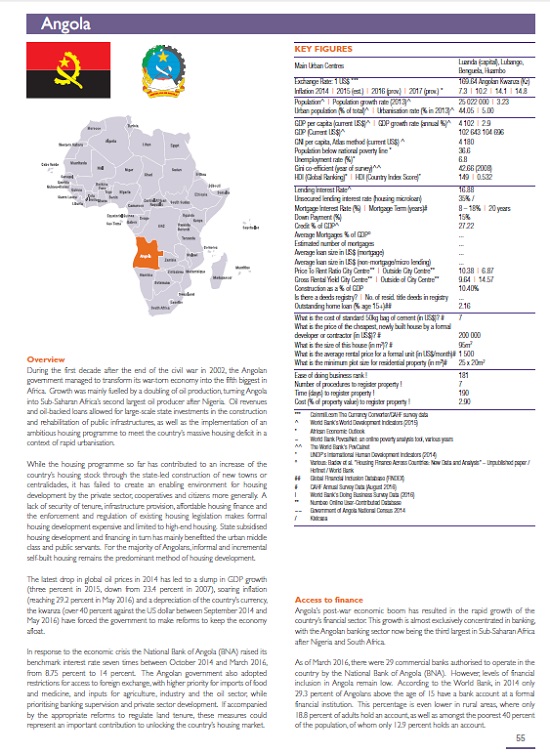
Angola is an oil-rich nation located in southern Africa, on the Atlantic coast of Africa, and bordered by Namibia, Zambia and the Democratic Republic of the Congo. President Jose Eduardo dos Santos’ ruling party, the People’s Movement for the Liberation of Angola, won a further term at August 2012 elections, having taken 72% at the polls. The country has come a long way since its civil war ended in 2002. In 11 years, Angola has managed to transform its economy with a real GDP estimated at 7.2% in 2013 and 7.5% in 2014 respectively. This is an impressive increase in real GDP from 3.5% in 2011, due to the rise in oil prices (oil production is expected to increase to over two million barrels a day) and the growth of 7.7% of other non-oil sectors. The growth in GDP is also attributed to the star t of the Angola Liquefied Natural Gas project that will cost US$9 billion. The economy has a huge structural dependence on oil.

Angola Chapter – CAHF Housing Finance in Africa Yearbook

During the first decade after the end of the civil war in 2002, the Angolan
government managed to transform its war-torn economy into the fifth biggest in
Africa. Growth was mainly fuelled by a doubling of oil production, turning Angola
into Sub-Saharan Africa’s second largest oil producer after Nigeria. Oil revenues
and oil-backed loans allowed for large-scale state investments in the construction
and rehabilitation of public infrastructures, as well as the implementation of an
ambitious housing programme to meet the country’s massive housing deficit in a
context of rapid urbanisation.

Angola Chapter – 2015 CAHF Yearbook

Angola is an oil-rich nation located in southern Africa, on the Atlantic coast of Africa, and bordered by Namibia, Zambia and the Democratic Republic of Congo. President Jose Eduardo dos Santos’ ruling party, the People’s Movement for the Liberation of Angola (MPLA), holds a strong majority, having taken 72 percent at the August 2012 polls. The country has come a long way since its civil war ended in 2002. In 12 years, Angola has managed to transform its war-torn economy into the fifth biggest in Africa. This growth has been mainly fuelled by a doubling of oil production, turning Angola into Sub-Saharan Africa’s second largest oil producer after Nigeria. Rising oil revenues have allowed for large-scale state investments, mainly in the construction and rehabilitation of public infrastructures, leading to a massive construction boom and double digit GDP growth rates which reached 23.4 percent in 2007 up from 3.3 in 2003.

  • « Go to Previous Page
  • Page 1
  • Interim pages omitted …
  • Page 147
  • Page 148
  • Page 149
  • Page 150
  • Page 151
  • Interim pages omitted …
  • Page 287
  • Go to Next Page »

Primary Sidebar

Resources

  • Angolan Media Scan
  • Online Library
  • Land Library
  • Community-Led Total Sanitation
  • Community Water – MoGeCA
  • KixiCrédito
  • HabiTec
  • LUPP
  • Urban Forum on AngoNet
  • AngoNet Webmail
  • Audio Archive
  • Africa-China Urban Initiative

Follow us on...

Sign up for E-Alerts

© 2026 Development Workshop Angola | Log in Built by PeaceWorks

  • Home
  • About DW
  • Programs
  • Partners
  • Publications
  • Community Media
  • Forums
  • Events
  • Contact