• Skip to primary navigation
  • Skip to main content
  • Skip to primary sidebar
DW Angola

DW Angola

Development Workshop Angola

  • About DW
    • About DW Angola
    • Timeline
    • Articles About DW
    • About Angola
    • Key Members & Staff
  • Programs
    • Water & Sanitation
    • Land Rights & Settlements
    • Climate Change
    • Informal Economy
    • Microfinance
    • Research
    • Voices of Citizens for Urban Change
    • Decentralisation & Governance
    • Natural Resources, Mining & Development
    • Peacebuilding & Citizenship
    • Urban Transport
    • AngoNet
  • Partners
  • Publications
    • Books by DW
    • Papers by DW
    • Articles about DW
    • DW Developments
    • Compendium of Angolan laws
  • Community Media
    • Ondaka
    • A Voz de Cacuaco
    • Boletim Informativo
    • Ecos do Heneda
    • Inforsambila
    • Journal Humbi-Humbi
    • Reconversáo
  • Forums
    • Friday Debates
    • Housing Finance
    • Urban Debates
    • Social & Economic Rights Forum
    • Sustainable Urban Planning
    • Training Courses
    • Espaço Sociedade Civil
    • Fórum Urbano no AngoNet
    • Fórum Cazenga
    • Fórum Cacuaco
    • Staff Blog
  • Events
    • COVID-19 Actions
  • Contest
  • Contact
  • English
    • English
    • Português
  • Show Search
Hide Search

Lei 8-11 Regime Jurídico do Notariado

Devido ao exponencial crescimento económico e social de Angola nos últimos anos, o sistema notarial vigente não se mostra capaz de abranger todas as necessidades do País, impondo-se, assim, o aumento significativo do número de notários públicos e privados, de modo a corresponder às exigências dos cidadãos e dos agentes sociais e económicos e a proporcionar um serviço mais célere, mais eficiente e moderno. A Assembleia Nacional aprova, nos termos das disposições combinados do nº 2 do artigo 165º e da alínea d) do artigo 116º, ambos da Constituição da República de Angola: LEI Nº 8-11 DE 16 DE FEVEREIRO SOBRE O REGIME JURÍDICO DO NOTARIADO.

Urban Governance and Turning African Cities Around Luanda Case Study

This working paper presents the findings of the study on the process that has taken place over
the past decade to turn around the city of Luanda, the capital of Angola. It is part of a broader
research project that examines the case of Luanda, alongside Johannesburg and Lagos, to
shed light on the governance practices that have started to emerge on the continent in an era
that has been marked by rapid economic growth.
Luanda has been the main beneficiary of Angola’s economic boom that started in 2002
fuelled by oil revenue. Two projects were undertaken as part of efforts to turn the city around:
the redevelopment of the Bay of Luanda and the construction of the New City of Kilamba. The
Bay of Luanda work included the redevelopment of the waterfront to create pedestrian spaces,
cycle lanes, sports fields and spaces for cultural events, while the New City of Kilamba
consisted of the construction of 710 buildings, kindergartens and schools, along with water
and electricity infrastructure.

Decreto Presidencial 51-11 Regime Notario

Considerando que o notariado constitui um dos elementos integrantes do sistema de justiça que configura e dá suporte ao funcionamento de uma economia de mercado, enquanto instrumento ao serviço da segurança e da certeza das relações jurídicas. Houve a necessidade de se fazer uma reforma na actividade notarial afim de se conferir ainda maior relevância a esta figura que é delegatária pública. O Presidente da República decreta, nos termos da alínea I) do artigo 120º e do nº 3 do artigo 125º da Constituição da República. O Decreto Presidencial nº 51/11, DO REGIME JURIDICO DO NOTARIADO.

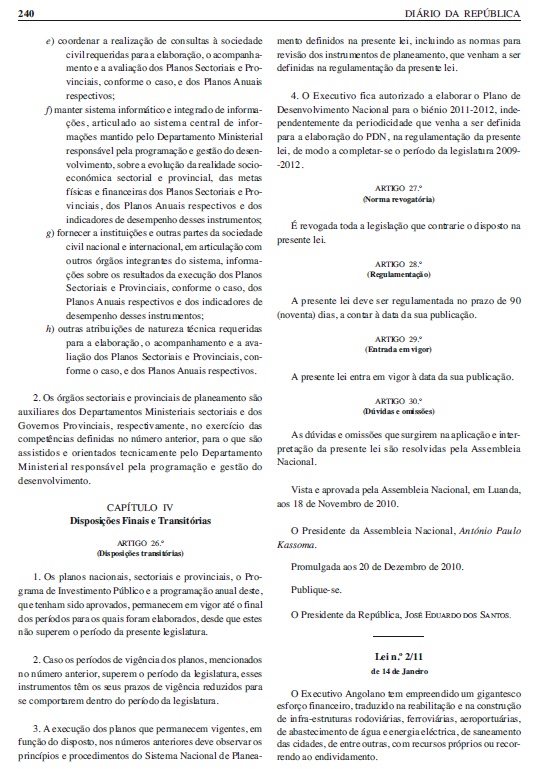
Lei 02-11 Parcerias Publico-Privadas

O Executivo Angolano tem empreendido um gigantesco esforço financeiro, traduzido na reabilitação e na construção de infra-estruturas, com recursos próprios ou recorrendo ao endividamento. Muitas das infra-estruturas podiam ser desenvolvidas pelo sector privado, em estreita colaboração com o sector público, sendo que o arranque e mesmo o desenvolvimento e a conclusão dos projectos seriam financiados pelo sector privado e a recuperação dos investimentos por parte destes seria a posterior, através da exploração, durante determinado tempo, em regime de concessão. A Assembleia Nacional aprova nos termos das disposições combinadas da alínea b) do artigo 161º e da alínea d) nº 2 do artigo 166º, ambos da Constituição da Republica de Angola, Lei nº 02/11 de 14 de Janeiro, LEI DE PARCERIAS PUBLICAS-PRIVADAS.

Decreto Presidencial n.º 266-10 de 29 de Novembro – sobre Gabinete Tecnico Reconversão Urbana Cazenga Sambizanga

O Decreto Legislativo Presidencial nº 8/10 de 29 de Novembro de “Regime Especial de Reconversão das Áreas Urbanas do Cazenga e Sambizanga” Cazenga e Sambizanga, bem como nossos sistemas de acompanhamento e coordenação administrativa, técnica e financeira para a execução dos projetos de reconversão.


  • « Go to Previous Page
  • Page 1
  • Interim pages omitted …
  • Page 165
  • Page 166
  • Page 167
  • Page 168
  • Page 169
  • Interim pages omitted …
  • Page 287
  • Go to Next Page »

Primary Sidebar

Resources

  • Angolan Media Scan
  • Online Library
  • Land Library
  • Community-Led Total Sanitation
  • Community Water – MoGeCA
  • KixiCrédito
  • HabiTec
  • LUPP
  • Urban Forum on AngoNet
  • AngoNet Webmail
  • Audio Archive
  • Africa-China Urban Initiative

Follow us on...

Sign up for E-Alerts

© 2026 Development Workshop Angola | Log in Built by PeaceWorks

  • Home
  • About DW
  • Programs
  • Partners
  • Publications
  • Community Media
  • Forums
  • Events
  • Contact