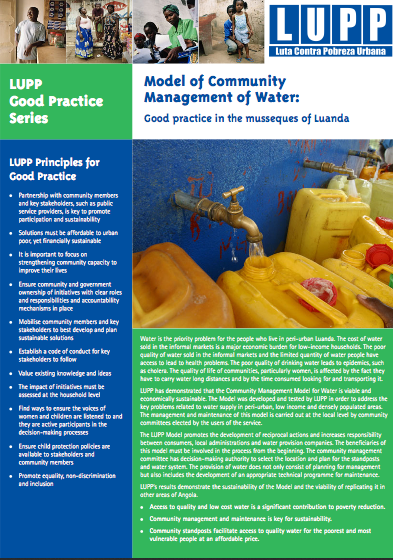
The Luanda Urban Poverty Programme (LUPP) has demonstrated that the
Community Management Model for Water is viable and economically
sustainable. The Model was developed and tested by LUPP in order to
address the key problems related to water supply in peri-urban, low
income and densely populated areas. The management and maintenance of
this model is carried out at the local level by community committees
elected by the users of the service.
The interest underpinning
this research deals with development a better understanding of the
informal supply of water and how it has evolved since DW research in
1995 – and how it is likely to evolve and react to improved formal,
regular water supply systems; understand better how institutional
capacity can best be developed, especially at the interface between
water companies and community; and provide lessons and understanding of
the sector that can feed policy advocacy and promote pro-poor poverty
reduction strategies.

