In July 1997 Development Workshop carried out a study on scavenging
activities in the city of Luanda. The study was performed to gather
concrete and accurate information on scavenging activities and to dispel
misconceptions. No previous studies of this nature are known. The
objective of the study was to identify which items are being scavenged,
who is scavenging and under what circumstances, where scavenging is
occurring, and what is the life-cycle of the scavenged items.
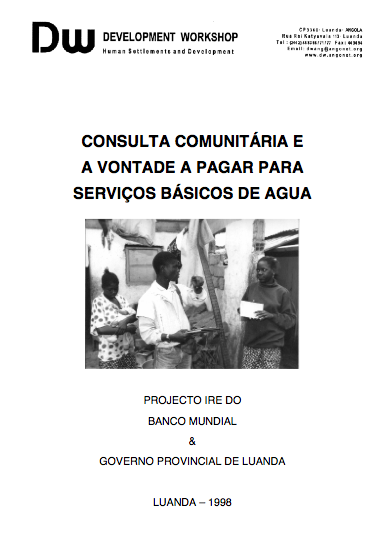
Consulta Comunitaria e a Vontade a Pagar Para Serviços Básicos de Água
DW foi sub-contratada em 1998 para desenvolver o componente de
“Community Water” do projeto atual da Água e Saneamento de Luanda
Reabilitação de infra-estrutura e Engenharia de Projetos (IRE) pelo
Banco Mundial e do Governo Provincial de Luanda. Este relatório é sobre o
programa de trabalho de campo, um questionário quantitativo e Consulta
Comunitária realizado pela DW.
Community Consultation & Willingness to Pay for Basic Water Services
DW was sub-contracted in 1998 to develop the “Community Water” component of the current project of the Luanda Water and Sanitation Infrastructure Rehabilitation and Engineering (IRE) Project by the World Bank and the Provincial Government of Luanda. This report is on the Field Work Programme, a Quantitative Questionnaire Survey and Community Consultation carried out by DW.
Turning on the Taps – lessons in service delivery and democracy in Luanda, Angola
This is a report based on a seminar hosted by One World Action in May 2001 which brought together some 50 participants- practitioners from local and international non-governmental organisations working in Angola, and representatives from European government agencies, research institutions and private companies. The central purpose of the seminar was to discuss the challenge of ‘how to strengthen civil society and local democracy in situations of urban poverty where the poor lack access to basic services and the political influence to effect change?’ The experiences presented at the seminar were from the Luanda Urban Poverty Programme (LUPP) in particular.
DW Occasional Paper No. 3: War and Water – Evolution and Impact of Water Supply Interventions in Huambo Since 1985
DW “inherited” an emergency water project in Angola from the
International Committee of the Red Cross at the beginning of 1997. We
deliberately use the word “inherit” because the transfer of
responsibility for the project included the transfer of trained staff,
vehicles and equipment. A common donor, Swiss Humanitarian Aid,
facilitated the transfer of project management from the ICRC to DW. When
SHA requested DW to assume continued management of the project, it
clearly indicated that it attributed major importance to the
introduction of strategies which would ensure sustainable management of
the water points in the long term.