O Espaço de Debate à Sexta feira, teve como prelector o Docente Universitário Maurício Ganduglia, Arquitecto – Post-master em Culturas construtivas e desenvolvimento sustentável, Membro Associado CRATERRE, Chaire UNESCO, e Coordenador de Projetos e Programas de Formação em construção com materiais locais nas comunidades. A sua apresentação focou-se nas experiências de formação e construção com materiais locais para criar capacidades e conhecimentos para desenvolver a vida de uma maneira segura e sustentável. As experiências a apresentar, desenvolveu-se em vários continentes países e culturas; com actividades adaptadas à formação profissional, técnicos médios, engenheiros, arquitectos e técnicos superiores de construção civil.
Angola Chapter – Africa Housing Finance Yearbook 2020
Angola is a vast country covering an area of 1.247 million square kilometres
with a long coastline and central plateau that borders Namibia, Botswana,
Zambia and the Democratic Republic of Congo. Its total population was
estimated at 32 971 101 inhabitants in 2020,1 representing an increase of
more than two million people compared to 2018 (30.81 million). The main
cities are Luanda (the capital), Huambo, Benguela, Lobito and Lubango. The
country is renowned for its status as the second largest oil producer in Africa.

Angola Chapter – Africa Housing Finance Yearbook 2018
Angola’s economy is highly concentrated around the oil industry, which comprises
about a third of its GDP and around 95 percent of exports, despite the global
downturn and decrease in oil prices.1 Oil revenues and oil-backed loans have
allowed for large-scale state investments in the construction and rehabilitation of
public infrastructure, including the implementation of an ambitious housing
programme to meet the country’s massive housing deficit, which is growing rapidly
in a context of rapid urbanisation. Currently Angola is said to be one of the fastest
urbanising countries in Africa with more than 62 percent of its population living in
cities.

Angola Chapter – Africa Housing Finance Yearbook 2017
Angola’s economy is highly concentrated around the oil industry, comprising about
45 percent of its GDP and around 95 percent of exports1. Oil production
continues to be the catalyst for growth in Angola. Oil revenues and oil-backed
loans have allowed for large-scale state investments in the construction and
rehabilitation of public infrastructures, as well as the implementation of an
ambitious housing programme to meet the country’s massive housing deficit in a
context of rapid urbanisation. Currently Angola is said to be one of the fastest
urbanising countries in Africa with about 62 percent of its population living in
cities2.

Angola Chapter – Africa Housing Finance Yearbook 2016
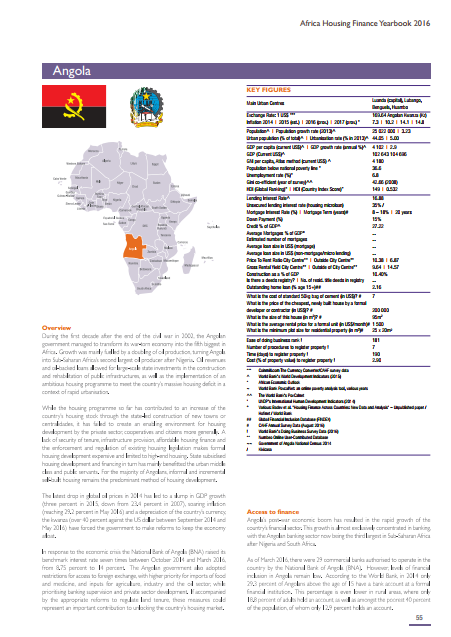
Angola is an oil-rich nation located in southern Africa, on the Atlantic coast of
Africa, and bordered by Namibia, Zambia and the Democratic Republic of the
Congo. President Jose Eduardo dos Santos’ ruling party, the People’s Movement
for the Liberation of Angola (MPLA), holds a strong majority, having taken 72
percent at the August 2012 polls. The country has come a long way since its civil
war ended in 2002. In 12 years, Angola has managed to transform its war-torn
economy into the fifth biggest in Africa. This growth has been mainly fuelled by a
doubling of oil production, turning Angola into Sub-Saharan Africa’s second largest
oil producer after Nigeria. Rising oil revenues have allowed for large-scale state
investments, mainly in the construction and rehabilitation of public infrastructures
such as roads, schools, hospitals as well as housing, leading to a massive
construction boom and double digit GDP growth rates which reached 23.4
percent in 2007 up from 3.3 in 2003. Growth has in turn been enhanced by
economic reforms and prudent macro-economic policymaking.