• Skip to primary navigation
  • Skip to main content
  • Skip to primary sidebar
DW Angola

DW Angola

Development Workshop Angola

  • About DW
    • About DW Angola
    • Timeline
    • Articles About DW
    • About Angola
    • Key Members & Staff
  • Programs
    • Water & Sanitation
    • Land Rights & Settlements
    • Climate Change
    • Informal Economy
    • Microfinance
    • Research
    • Voices of Citizens for Urban Change
    • Decentralisation & Governance
    • Natural Resources, Mining & Development
    • Peacebuilding & Citizenship
    • Urban Transport
    • AngoNet
  • Partners
  • Publications
    • Books by DW
    • Papers by DW
    • Articles about DW
    • DW Developments
    • Compendium of Angolan laws
  • Community Media
    • Ondaka
    • A Voz de Cacuaco
    • Boletim Informativo
    • Ecos do Heneda
    • Inforsambila
    • Journal Humbi-Humbi
    • Reconversáo
  • Forums
    • Friday Debates
    • Housing Finance
    • Urban Debates
    • Social & Economic Rights Forum
    • Sustainable Urban Planning
    • Training Courses
    • Espaço Sociedade Civil
    • Fórum Urbano no AngoNet
    • Fórum Cazenga
    • Fórum Cacuaco
    • Staff Blog
  • Events
    • COVID-19 Actions
  • Contest
  • Contact
  • English
    • English
    • Português
  • Show Search
Hide Search

Research and Practice as Advocacy Tools to Influence Angola’s Land Policies

Author: Allan Cain. Published in Environment & Urbanization, Volume 22, Number 2. This paper discusses how research on urban land promoted the need to formalize the poor’s informal occupation rights as the government developed a new land policy. The research looked at both formal and informal mechanisms to access land by poor and war-affected populations and at the institutions that influence this. Its findings helped persuade the government of the need for consultation, and promoted more awareness of how upgrading and basic service provision could improve land tenure.

DOWNLOAD PDF:

Luanda’s Post-War Land Markets: Reducing Poverty by Promoting Inclusion

Author: Allan Cain. Published in Urban Forum (2013) 24:11–31. This paper presents the results of work on property markets in Luanda that permit a better understanding of the nature and economic value of land and identify the problems and potentials the market has to offer. The paper argues for a major reform in public land policy, recognising the legitimacy of common practices in land acquisition and long-term occupation in good faith. Inclusive land management, adapting to both formal and existing informal markets, can contribute to the improvement of urban settlement conditions and economic wellbeing of the poor in post-war Luanda.

DOWNLOAD PDF:

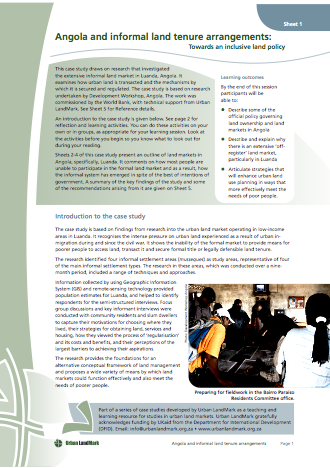
Teaching case study: Angola and informal land tenure arrangements

Author: Development Workshop & Urban LandMark. This teaching case study draws on research that investigated the extensive informal land market in Luanda, Angola. It 
examines how urban land is transacted and the mechanisms by which it is secured and regulated. It recognises the intense pressure on urban land experienced as a result of urban in-migration during and since the civil war. It shows the inability of the formal market to provide means for poorer people to access land, transact it and secure formal title or legally defensible land tenure. The case study is based on research undertaken by DW. The work was commissioned by the World Bank, with technical support from Urban LandMark.

DOWNLOAD PDF:

Angola: Land Resources and Conflict

Author: Allan Cain. Published in PCNRM, Vol. 2-014. Angola is often cited as a classic case of natural resources sustaining a conflict (Hodges 2001). Angola’s protracted civil war (1975–2002) was mainly financed through the wholesale extraction of oil and diamonds. The armed struggle for liberation from Portuguese rule started in 1961, but resistance had begun earlier due to the wide-scale expropriation by the colonial regime of another key resource, land.

DOWNLOAD PDF:

Incrementally Securing Tenure

Author: Urban LandMark & Cities Alliance. This publication reflects on promising practices that have emerged through the work of the Tenure Security Facility Southern Africa (TSFSA), funded by the Cities Alliance and UKaid. and which signal new approaches to securing tenure in informal settlements. It is intended to provide guidance to practitioners, officials and communities who are involved in informal settlement upgrading and who see the value of finding more routes into tenure security than the dominance of an ownership paradigm currently allows.

The project operated in six sites in Southern Africa with different partners:

•  Angola: Development Workshop, an NGO based in Luanda
•  Mozambique:  Associação Nacional dos Municípios de Moçambique
(ANAMM) (the national association of municipalities) and the Cities
Alliance Country Programme
•  eMalahleni, South Africa: Planact, an NGO working with the
Springvalley community
•  Cape Town, South Africa: Sun Development Services, an NGO that has
been providing development support in Monwabisi Park
•  Johannesburg, South Africa: Urban LandMark has provided support
over several years to the city’s Regularisation programme
•  Malawi: CCODE, an NGO based in Lilongwe that works to improve the
quality of life of the poor.

DOWNLOAD PDF:

  • « Go to Previous Page
  • Page 1
  • Interim pages omitted …
  • Page 239
  • Page 240
  • Page 241
  • Page 242
  • Page 243
  • Interim pages omitted …
  • Page 287
  • Go to Next Page »

Primary Sidebar

Resources

  • Angolan Media Scan
  • Online Library
  • Land Library
  • Community-Led Total Sanitation
  • Community Water – MoGeCA
  • KixiCrédito
  • HabiTec
  • LUPP
  • Urban Forum on AngoNet
  • AngoNet Webmail
  • Audio Archive
  • Africa-China Urban Initiative

Follow us on...

Sign up for E-Alerts

© 2026 Development Workshop Angola | Log in Built by PeaceWorks

  • Home
  • About DW
  • Programs
  • Partners
  • Publications
  • Community Media
  • Forums
  • Events
  • Contact