• Skip to primary navigation
  • Skip to main content
  • Skip to primary sidebar
DW Angola

DW Angola

Development Workshop Angola

  • About DW
    • About DW Angola
    • Timeline
    • Articles About DW
    • About Angola
    • Key Members & Staff
  • Programs
    • Water & Sanitation
    • Land Rights & Settlements
    • Climate Change
    • Informal Economy
    • Microfinance
    • Research
    • Voices of Citizens for Urban Change
    • Decentralisation & Governance
    • Natural Resources, Mining & Development
    • Peacebuilding & Citizenship
    • Urban Transport
    • AngoNet
  • Partners
  • Publications
    • Books by DW
    • Papers by DW
    • Articles about DW
    • DW Developments
    • Compendium of Angolan laws
  • Community Media
    • Ondaka
    • A Voz de Cacuaco
    • Boletim Informativo
    • Ecos do Heneda
    • Inforsambila
    • Journal Humbi-Humbi
    • Reconversáo
  • Forums
    • Friday Debates
    • Housing Finance
    • Urban Debates
    • Social & Economic Rights Forum
    • Sustainable Urban Planning
    • Training Courses
    • Espaço Sociedade Civil
    • Fórum Urbano no AngoNet
    • Fórum Cazenga
    • Fórum Cacuaco
    • Staff Blog
  • Events
    • COVID-19 Actions
  • Contest
  • Contact
  • English
    • English
    • Português
  • Show Search
Hide Search

Luanda’s New Frontier: The PeriUrban Growth in Angola

In order to address such challenges a general reconstruction strategy, which particularly emphasizes
the need to mitigate the lack of housing and related social problems, has been put in place.
Understanding and rehabilitating the country’s built environment, particularly within urban areas,
represents a paramount but much needed task to rebuild Angola as a whole. The complexity of this
task is further enhanced by the many difficulties currently affecting the poorer fringe of the population
-those who have been failing to sustainably accompany the emerging economic development of
Angola.

Designing ‘Dream Houses’ in the fringe of development: occupan perception of low-cost housing in Luanda’s urban periphery

This paper explores issues associated with perceptions of low-cost housing in Luanda, which
despite being considered one of the fastest developing and more prospective growing cities in
Africa, is struggling to cope with a growing population putting extra pressure on an already
saturated urban infrastructure. A renewed Luanda is taking shape, whilst the periphery is being
gradually populated with thousands of new houses destined to the low-income population,
absorbing some of the people displaced from informal settlements (musseques) but also open to
those who would not otherwise be able to afford living closer to Luanda’s centre. Amongst
promises of fulfilment of a “dream” of ownership and adequate living conditions, this research
investigates the low-cost housing sector of Luanda as experienced and perceived by the
inhabitants/occupants themselves. Using a Participatory Post-Occupancy (PPOA) framework, it
combines the technical arrangement of a building appraisal tool with a participatory approach
intending to provide an accurate insight into the occupants’ satisfaction and the performance of
low-cost housing in an informal settlement as well as in a newly built low-cost mass housing
development located in the outskirts of Luanda.

Strategies of Urban Inclusion in the Imagined Modern Luand

Luanda, the capital of Angola, has recently been subjected to
extraordinary changes, supported by increased wealth and investments associated with the end of the war. The ideas of modernity that clearly stand out
are deeply rooted in the city’s configuration and reconfiguration over the
years. They inform not only the modernising perspectives and philosophy
of policymakers and investors but also those of the urban dwellers. Often,
however, the imagined modernity and its benefits do not match the lived
realities. This chapter makes reference to the evolution of the city, emphasising the differences between main periods and identifying the underlining
strategies in terms of inclusions and exclusions. The conclusions presented,
based on empirical and documentary research, point to shifting strategies of
urban inclusion and changing categories of the excluded.

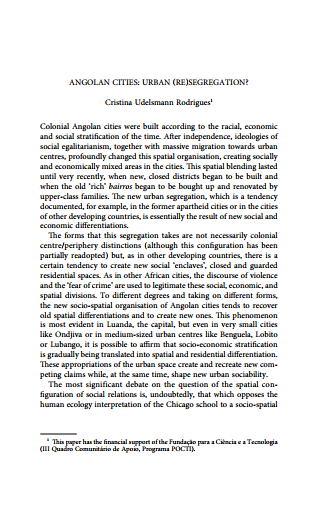
Angolan Cities: Urban (Re)Segregation

Colonial Angolan cities were built according to the racial, economic
and social stratification of the time. After independence, ideologies of
social egalitarianism, together with massive migration towards urban
centres, profoundly changed this spatial organisation, creating socially
and economically mixed areas in the cities. This spatial blending lasted
until very recently, when new, closed districts began to be built and
when the old ‘rich’ bairros began to be bought up and renovated by
upper-class families. The new urban segregation, which is a tendency
documented, for example, in the former apartheid cities or in the cities
of other developing countries, is essentially the result of new social and
economic differentiations.

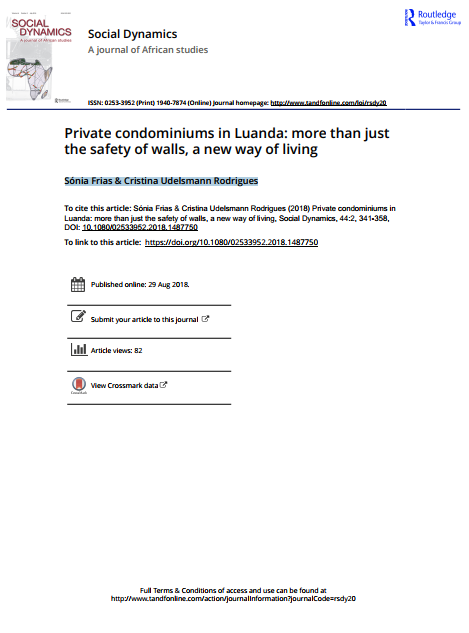
Private condominiums in Luanda: more than just the safety of walls, a new way of living

Since its independence in 1975, Angola’s capital Luanda has been
going through deep processes of demographic, economic, social
and physical transformations. In this article, apart from introducing
the case study of private condominiums in the general discussion
on urban studies in the Global South, we focus on the dynamics of
transformations regarding housing for the mid/upper strata, providing the background for the emergence and recent expansion of
gated communities/condominiums, a phenomenon that has
acquired major importance in the recent decades in Luanda. The
specialised literature relates the demand for and multiplication of
these residential structures in Africa with issues such as the search
for safety associated with demonstrations of exclusive lifestyles. In
the case of Luanda, the authors found––through a case study and
qualitative data collected among residents and non-residents of
condominiums––that, contrary to the results from other studies,
condominiums in Luanda are essentially sought after primarily for
functional reasons such as access to infrastructure and better living

  • « Go to Previous Page
  • Page 1
  • Interim pages omitted …
  • Page 64
  • Page 65
  • Page 66
  • Page 67
  • Page 68
  • Interim pages omitted …
  • Page 287
  • Go to Next Page »

Primary Sidebar

Resources

  • Angolan Media Scan
  • Online Library
  • Land Library
  • Community-Led Total Sanitation
  • Community Water – MoGeCA
  • KixiCrédito
  • HabiTec
  • LUPP
  • Urban Forum on AngoNet
  • AngoNet Webmail
  • Audio Archive
  • Africa-China Urban Initiative

Follow us on...

Sign up for E-Alerts

© 2026 Development Workshop Angola | Log in Built by PeaceWorks

  • Home
  • About DW
  • Programs
  • Partners
  • Publications
  • Community Media
  • Forums
  • Events
  • Contact