• Skip to primary navigation
  • Skip to main content
  • Skip to primary sidebar
DW Angola

DW Angola

Development Workshop Angola

  • About DW
    • About DW Angola
    • Timeline
    • Articles About DW
    • About Angola
    • Key Members & Staff
  • Programs
    • Water & Sanitation
    • Land Rights & Settlements
    • Climate Change
    • Informal Economy
    • Microfinance
    • Research
    • Voices of Citizens for Urban Change
    • Decentralisation & Governance
    • Natural Resources, Mining & Development
    • Peacebuilding & Citizenship
    • Urban Transport
    • AngoNet
  • Partners
  • Publications
    • Books by DW
    • Papers by DW
    • Articles about DW
    • DW Developments
    • Compendium of Angolan laws
  • Community Media
    • Ondaka
    • A Voz de Cacuaco
    • Boletim Informativo
    • Ecos do Heneda
    • Inforsambila
    • Journal Humbi-Humbi
    • Reconversáo
  • Forums
    • Friday Debates
    • Housing Finance
    • Urban Debates
    • Social & Economic Rights Forum
    • Sustainable Urban Planning
    • Training Courses
    • Espaço Sociedade Civil
    • Fórum Urbano no AngoNet
    • Fórum Cazenga
    • Fórum Cacuaco
    • Staff Blog
  • Events
    • COVID-19 Actions
  • Contest
  • Contact
  • English
    • English
    • Português
  • Show Search
Hide Search

An Overview of Scavenging in Luanda 2005 Final Report

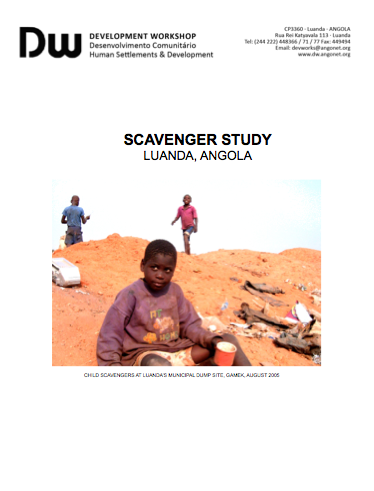
The 2005 DW Scavenger Study was conducted in August of 2005 and set out to examine whether scavenging still occurs in urban Luanda and on its periphery. While illustrating that scavenging activities have shifted to the periphery of the city, this report will also analyze the positions of ELISAL, urban waste management, VIDRUL, as well as multinational and domestic beverage manufacturers in terms of sustainable waste management as it relates to recycling. The trajectory of recycling has been altered since Development Workshops’ 1997 Scavenger Study. The death of UNITA’s rebel leader in 2002 effectively ended Angola’s civil war. This has resulted in Luanda’s economy to be able to receive commerce and global flows, in this process many partnerships within recycling have been formed within the informal and formal sector. This 2005 diagnostic study will also detail the process of recycling in the informal sector and formal sector.

The DW 2005 Scavenger Study followed the 1997 DW Scavenger Study’s framework in terms of accumulating data. Data derived from the periphery sites of Mulenvos, Soares de Costas, and Golfe II. (Gamek) was gathered during two afternoon field visits (weekday only). Data collected from the urban center was accumulated during morning and afternoons field site visits over a five-day period (weekday only). Elisal told DW that their contracted waste agencies pick up waste on the three following routes; Isle; Cidade Baixa; Cidade Alta, hence those spaces were chosen by DW to observe the scavenging activity. DW’s 1997 Scavenger Study Questionnaire4 was used for all interviews conducted with scavengers at the urban and peri-urban sites. The Development Workshop Policy & Monitoring staff created two more questionnaires in August 2005 for interviews conducted with employees and senior staff of Elisal, Vidrul, Aguas Bom Jesus and other national and multinational companies.

DOWLOAD PDF:
Soares de Costas, de-activated municipal dumpsite, Luanda, August 2005:

An Overview of Scavenging in Luanda 1997 Final Report

In July 1997 Development Workshop carried out a study on scavenging activities in the city of Luanda. The study was performed to gather concrete and accurate information on scavenging activities and to dispel misconceptions. No previous studies of this nature are known. The objective of the study was to identify which items are being scavenged, who is scavenging and under what circumstances, where scavenging is occurring, and what is the life-cycle of the scavenged items. With this information one could a) assess possibilities of reducing the volume of household waste through enhanced removal of the scavenged items; b) create jobs in the informal market; and c) provide information to assess the potential for future project interventions.

The study covered three areas, including:

  • peri-urban – informal dumpsites in the peri-urban area of Luanda;
  • city – container locations in Luanda; and
  • landfill locations – the major landfills of Luanda.

This study formed one of the components of Development Workshop’s pilot project in solid waste (referred to as ANG-466, April 1997-April 1998). The project was active in Luanda’s peri-urban area, specifically in the area of Hoje-Ya-Henda in the municipality of Cazenga. A map of the project areas is presented as Figure 1, Appendix A.

DOWNLOAD PDF:

Mozambique Land, Housing & Decentralisation Final Report

There are a number of implications of the informality of land use rules in Mozambican cities. It is difficult to provide services to these areas as there has been construction in roadways and drainage lines and on land reserved for services. There is an increasing tendency for informal settlements to occupy environmentally sensitive areas and, in the larger cities, for relocation of lower income residents from land close to the urban core out to the fringe, though their survival strategies depend on being close to the core. Lower income residents tend to be pushed towards land that is more susceptible to flooding and erosion. There is also declining security of tenure: this discourages residents of informal settlements from investing in their properties, though some residents respond to insecurity by building in more durable materials as they assume this will make it more difficult to remove them. So, although the formal land access process is a barrier, it has been overcome by being ignored. However this leads to widespread unplanned occupation, often in inappropriate locations, which will have long term social, economic and environmental consequences.

PDF DOWNLOAD:

SOS Habitat Conferencia da Imprensa: Direito a Habitação e o Acesso a Terra Em Luanda

No dia 23 de Julho do 2013, SOS HABITAT-ANGOLA apresentou em conferencia de imprensa, a situacao dos direitos humanos em Luanda durante o primeiro semestre de 2013, com realce o direito a habitacao e o acesso a terra na capital do pais. Falaram sobre as vitimas de demolicoes das comunidades da Baghdad na Kilamba Kiaxi e na Areia Branca localizada Bairro da Coreia na zona B no Distrito urbano da Samba Comuna da Kinanga provincia de Luanda – Angola. Essa Comunidade foi cercada a madrugada do dia 29 de Maio pela policia nacional e demolida no dia 1 de Junho do 2013. Tambem falaram sobre os demolicoes e realogamento no Zango-4.

PDF DOWNLOAD:


Nota Imprensa Sobre Kilamba, 2013/07/20 – SOS Habitat

SOS Habitat – Conferencia de Imprensa Parte 1


SOS Habitat – Conferencia de Imprensa Parte 2


SOS Habitat – Conferencia de Imprensa Parte 1


SOS Habitat – Conferencia de Imprensa Parte 2


Vitimas das demolições do Bairro Areia Branca Luanda


Vitimas das demolições fala em realojamento de roubo no Zango 4

Video fonte Canal SOS Habitat:
www.youtube.com/user/soshabitatangola
www.facebook.com/pages/Centro-Comunit%C3%A1rio-Wenji-Maka-SOS-Habitat/345635705518707

Silvia Croese – Fazer Pesquisa em Luanda, Experiência e Reflexão

Sílvia Croese, pesquisadora esteve presente nas nossas instalações da Development Workshop, na sexta-feira passada dia 15 de Novembro de 2013 fazendo uma dissertação a volta do tema: Pesquisas em Luanda e passando as suas experiencia e reflexões tiradas do mesmo. A sua apresentação esteve focalizada na área habitacional do Zango, onde no contexto do que é uma pesquisa a primeira das inúmeras perguntas que pairavam em sua mente foi: Tendo em conta o quadro politico em Angola, o que é que um estudo do Projecto Zngo revela sobre o tipo, a implementação e o resultado das políticas desenvolvimentistas em Angola pós-guerra?

Constatou-se que as administrações locais e cidadãos não são reconhecidos como “agentes de desenvolvimento”, mas desempenham papeis importantes que só revelados através de uma pesquisa antropóloga por outro lado criando um desenvolvimento pouco sustentável, não se resolvem questões de segurança legal, e nem existe uma representação e participação local.

Também considerou-se que os pesquisadores ainda têm encontrado muitas dificuldades para desenvoltura das suas técnicas de pesquisa e logo isto constitui um problema grave a nível do levantamento de dados, e informação adquirida pelos mesmos. Sylvia croese referenciou exemplificando como pode-se melhorar o papel do pesquisador e quais tem sido as vantagens e desvantagens de fazer um trabalho de pesquisa em Angola especificamente (Luanda).

Em suma concluiu-se que há ainda pouco esclarecimento em relação as metodologias de pesquisa e do papel do pesquisador perante a elas baseando-se no profissionalismo e seriedade do trabalho, mas podemos verificar que muitos têm desempenhado um papel importantíssimo nos diferentes estudos realizados adquirindo material necessário para crescimento intelectual e profissional de cada angolano.

Sylvia Croese em Zango, 2012.


Arial mapa do Zango.

  • « Go to Previous Page
  • Page 1
  • Interim pages omitted …
  • Page 257
  • Page 258
  • Page 259
  • Page 260
  • Page 261
  • Interim pages omitted …
  • Page 287
  • Go to Next Page »

Primary Sidebar

Resources

  • Angolan Media Scan
  • Online Library
  • Land Library
  • Community-Led Total Sanitation
  • Community Water – MoGeCA
  • KixiCrédito
  • HabiTec
  • LUPP
  • Urban Forum on AngoNet
  • AngoNet Webmail
  • Audio Archive
  • Africa-China Urban Initiative

Follow us on...

Sign up for E-Alerts

© 2026 Development Workshop Angola | Log in Built by PeaceWorks

  • Home
  • About DW
  • Programs
  • Partners
  • Publications
  • Community Media
  • Forums
  • Events
  • Contact