• Skip to primary navigation
  • Skip to main content
  • Skip to primary sidebar
DW Angola

DW Angola

Development Workshop Angola

  • About DW
    • About DW Angola
    • Timeline
    • Articles About DW
    • About Angola
    • Key Members & Staff
  • Programs
    • Water & Sanitation
    • Land Rights & Settlements
    • Climate Change
    • Informal Economy
    • Microfinance
    • Research
    • Voices of Citizens for Urban Change
    • Decentralisation & Governance
    • Natural Resources, Mining & Development
    • Peacebuilding & Citizenship
    • Urban Transport
    • AngoNet
  • Partners
  • Publications
    • Books by DW
    • Papers by DW
    • Articles about DW
    • DW Developments
    • Compendium of Angolan laws
  • Community Media
    • Ondaka
    • A Voz de Cacuaco
    • Boletim Informativo
    • Ecos do Heneda
    • Inforsambila
    • Journal Humbi-Humbi
    • Reconversáo
  • Forums
    • Friday Debates
    • Housing Finance
    • Urban Debates
    • Social & Economic Rights Forum
    • Sustainable Urban Planning
    • Training Courses
    • Espaço Sociedade Civil
    • Fórum Urbano no AngoNet
    • Fórum Cazenga
    • Fórum Cacuaco
    • Staff Blog
  • Events
    • COVID-19 Actions
  • Contest
  • Contact
  • English
    • English
    • Português
  • Show Search
Hide Search

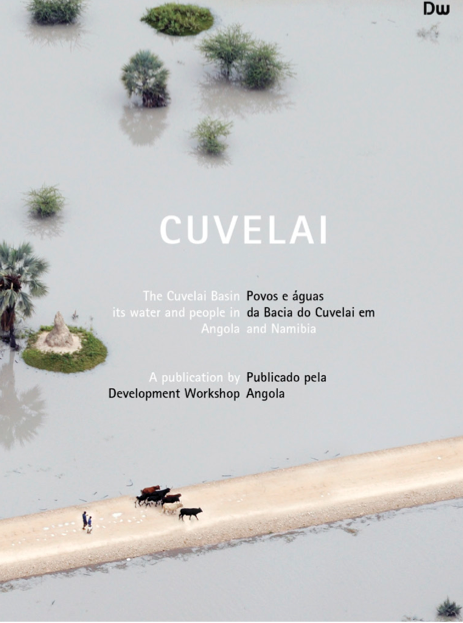
The Cuvelai Basin, it’s water and it’s people in Angola and Namibia

The Cuvelai Basin, it’s water and it’s people in Angola and Namibia, written by John Mendelsohn and Beat Weber, was published in 2011 by Development Workshop (in Portuguese and English), with special recognition to BP Angola and Google Earth. The Cuvelai Basin is perhaps unique in the world as a drainage system that consists of hundreds of channels that join and separate thousands of times. This is an inland drainage with no outlet to the sea. Compared to surrounding areas and much of southern Africa, the Cuvelai is home to a very large number of people, largely because of the presence of shallow groundwater and relatively fertile soils in many areas.

It is hoped that the information provided here will allow public servants in Angola and Namibia to understand the nature and potential consequences of flooding in new ways. Likewise, members of civil society organisations, and of disaster and development agencies should have more information on which to base their planning and humanitarian work.

DOWNLOAD PDF
Urban Environmental Risk Assessment Proposal

The overcrowded peri-urban slums of Luanda (where over two-thirds of the population of Angola now lives) are clearly unhealthy places to live. However, very little information on environmental health is available which might be used to plan rehabilitation programmes, and whatever information there is tends to be dispersed, inaccessible and difficult to use. This proposal is for the development of a database, and a Geographical Information System, of appropriate environmental health indicators for a significant, representative area of peri-urban Luanda. This is the first phase of a programme to develop national capacity to collect and use data, through GIS, on environmental health that can assist in the planning of national reconstruction.

Development Workshop already has extensive experience in the peri-urban areas of Luanda, has access to what little information exists, and includes information collection as part of its existing programmes in peri-urban areas. It is already providing technical assistance to a GIS mapping project for the Angolan Government’s landmines survey, and is training a senior technician from the Institute of Physical Planning in GIS. Spatial data from paper maps, airphotos and satellite images will be transformed to a digitised form by the GIS. This will be linked with information on the natural environment, infrastructure, human settlements, demography and public health; these kinds of information will come from routine and project reports, technical archives, existing maps and reports and from data collection by the project team.

The present proposal covers the first phase of the programme, which will last nine month and which will cover procurement of GIS equipment, the training of a team, data collection, the creation of a map-base and preliminary data dissemination. This will serve as a laboratory for the development of tools and a model database, and the formation of a team of five national technicians with a working knowledge of GIS and assessment skills (drawn from existing partner organisations of Development Workshop).

Later phases of the programme (for which funding is being sought from other sources) will cover the creation of an environmental assessment network for peri-urban Luanda, made up of organisations who will share compatible GIS system tools and data gathering formats, who will be able to share information on peri-urban Luanda, jointly create an effective monitoring system and be able to monitor the impact of individual programmes.

Urban Environmental Risk Assessment Final Report

Development Workshop has undertaken the Environmental Risk Assessment project in a pilot district in peri-urban Luanda. This is the first project of its type in Angola, applying geographic information systems (GIS) tools in an urban / peri-urban area of Angola. The project was initiated in the second quarter of 1998 and was planned to be executed in two phases. The first phase was extended from 15 to 21 months and is complete at the present time. The second phase overlaps with the present project and integrates it into a major three year Sustainable Urban Services Project funded by the British Department for International Development (DFID) as a monitoring component.

A project evaluation was undertaken in June 1999 by a GIS expert who recommended some modifications in the programme strategy and a refocusing of some of the project objectives with the aim of directing the project toward producing practical more immediate outputs. The project is supported by the International Development Research Centre’s Southern Africa Regional Office and by Ranger Oil a Canadian petroleum exploration company working in Angola.


DOWNLOAD PDF:

Luanda Environmental Risk Assessment Map No. 1:

GIS GeoReferencing Guide

Maps after being scanned, would be opened in Photoshop. There the map
would first be blown up to its 100% size so as to be able to see
whether the map needed modifying in any way. Using the Rectangular
Marquee Tool, I selected the top left hand corner of the drawn map and
scrolled across to the top right hand side of the map. The scanning
process was often done very sloppily and the map page would come out on
an angle. Using the doted line created by the Rectangular Marquee Tool
as a perfect horizontal line, I could then go up to Image in the task
bar, down to Rotate Canvas, across to Arbitrary, and then select the
amount I wanted to rotate the canvas. The process could be repeated
until the top of the map was at a horizontal.

DOWNLOAD PFDS:

Mapframing & Geo-Referencing Guidelines

BASE MAP showing referencing matrix

INE Spreadsheet – Geo-coding of Municipalities

Urban Environmental Risk Assessment Evaluation Reports

Development Workshop has been involved for a number of years in
developing programmes of community service provision, water, sanitation,
school facilities upgrading and women’s micro-economic activities in
the peri-urban ‘musseques’ of Luanda, Angola. DW wishes to develop
monitoring tools to measure the impact of its programme interventions
and other external and environmental factors on the well-being of
communities in the areas of programme intervention. DW is therefore
developing information tools appropriate for rehabilitation and
policy-making in marginalised peri-urban communities of Luanda through
the design of a Geographical Information System for monitoring
environmental and social impact:

This report is the result of an expert mission on GIS for Development
Workshop Angola, on funding arranged by NIZA, Netherlands. The main
objective of the mission was to assess DW proposals for the introduction
of Geographic Information Systems within their offices in Luanda and
Huambo. The mission stayed in Angola from 22 June to 7 July 1999. A
scheduled visit to Huambo (on the central plateau) had to be cancelled
for security reasons, so the mission has remained in Luanda throughout
the whole period. Most work was carried out at DW’s Luanda office, with
visits to relevant organisations, and one field trip to the peri-urban
areas where most of DW’s activities take place:

Overall recommendations for Database Management, Tony Moloney, 2002: I have
spent the past few weeks doing a practical exercise of taking field data
from a live project and attempting to spatially represent the data
outputs and summaries it in a GIS program called Mapinfo. The objective
was to see the practical problems that I would have in doing so and also
see why DW has so far failed to successfully exploit the tool. I won’t
attempt to make any long term objectives in this document but will
rather concentrate on a realistic 3 month shock action plan (called ‘I
want GIS now’) to kick start the process. At the end of that three
month, if the objectives are realised, then I suggest the hiring of an
expert consultant to make a further 1 year action plan:

Project Actual Achievements against Planned and Modified Objectives:

Projeto Ficha de Dados 2000:

Sistema de informação para a reabilitação e elaboração de políticas nas
comunidades peri-urbanas marginalizadas de Luanda. Desenvolvimento de um
Sistema de Informação Geográfica para controle  do risco ambiental.
Avaliação do risco ambiental urbano:

  • « Go to Previous Page
  • Page 1
  • Interim pages omitted …
  • Page 230
  • Page 231
  • Page 232
  • Page 233
  • Page 234
  • Interim pages omitted …
  • Page 287
  • Go to Next Page »

Primary Sidebar

Resources

  • Angolan Media Scan
  • Online Library
  • Land Library
  • Community-Led Total Sanitation
  • Community Water – MoGeCA
  • KixiCrédito
  • HabiTec
  • LUPP
  • Urban Forum on AngoNet
  • AngoNet Webmail
  • Audio Archive
  • Africa-China Urban Initiative

Follow us on...

Sign up for E-Alerts

© 2026 Development Workshop Angola | Log in Built by PeaceWorks

  • Home
  • About DW
  • Programs
  • Partners
  • Publications
  • Community Media
  • Forums
  • Events
  • Contact