• Skip to primary navigation
  • Skip to main content
  • Skip to primary sidebar
DW Angola

DW Angola

Development Workshop Angola

  • About DW
    • About DW Angola
    • Timeline
    • Articles About DW
    • About Angola
    • Key Members & Staff
  • Programs
    • Water & Sanitation
    • Land Rights & Settlements
    • Climate Change
    • Informal Economy
    • Microfinance
    • Research
    • Voices of Citizens for Urban Change
    • Decentralisation & Governance
    • Natural Resources, Mining & Development
    • Peacebuilding & Citizenship
    • Urban Transport
    • AngoNet
  • Partners
  • Publications
    • Books by DW
    • Papers by DW
    • Articles about DW
    • DW Developments
    • Compendium of Angolan laws
  • Community Media
    • Ondaka
    • A Voz de Cacuaco
    • Boletim Informativo
    • Ecos do Heneda
    • Inforsambila
    • Journal Humbi-Humbi
    • Reconversáo
  • Forums
    • Friday Debates
    • Housing Finance
    • Urban Debates
    • Social & Economic Rights Forum
    • Sustainable Urban Planning
    • Training Courses
    • Espaço Sociedade Civil
    • Fórum Urbano no AngoNet
    • Fórum Cazenga
    • Fórum Cacuaco
    • Staff Blog
  • Events
    • COVID-19 Actions
  • Contest
  • Contact
  • English
    • English
    • Português
  • Show Search
Hide Search

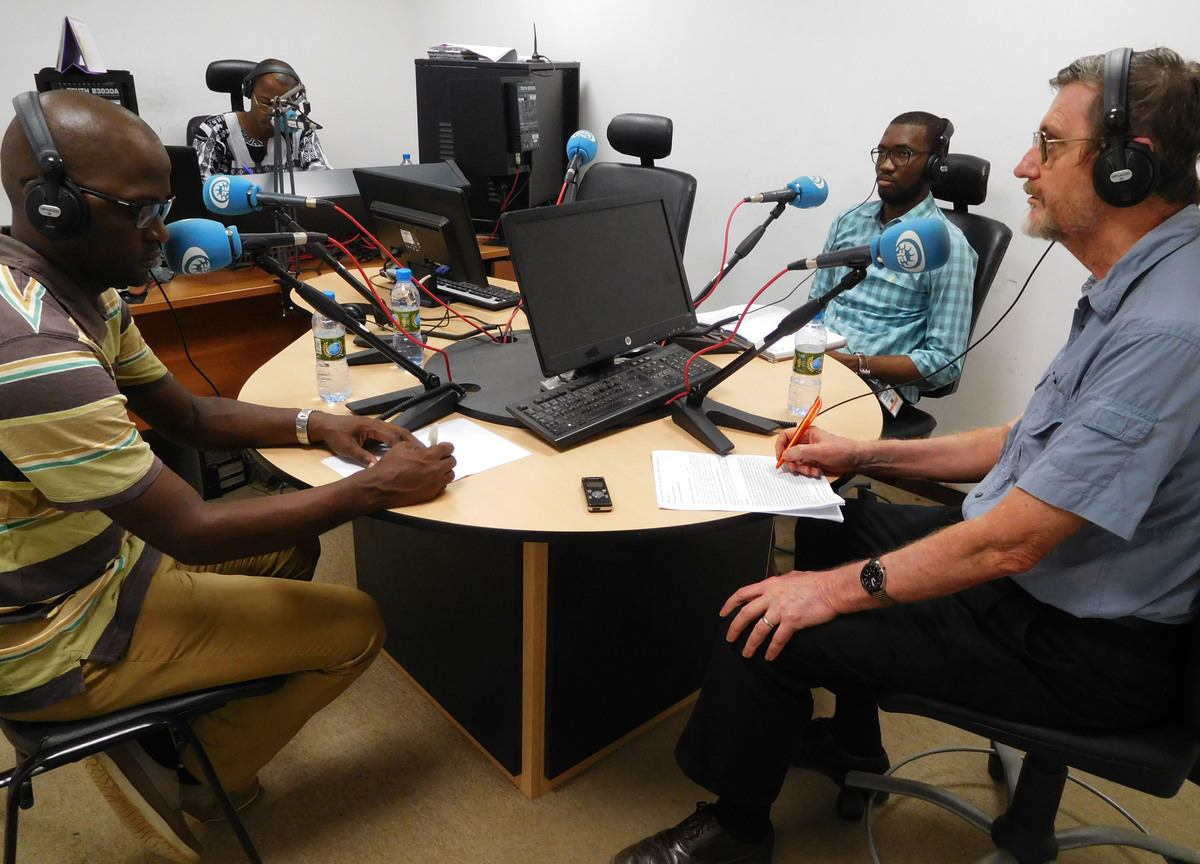
Allan Cain – Intervista sobre Plano de Luanda e Saneamento – Radio Ecclesia

O diretor da DW foi entrevistado em 16 janeiro de 2016 no programa ao vivo Radio Ecclesia de duas horas sábado de manhã. O tema do programa focado em desafios urbanos na cidade de Luanda, o novo plano diretor metropolitano e os problemas de saneamento basico. O novo Plano Diretor Metropolitano Luanda, lançado publicamente em dezembro de 2015, oferece uma oportunidade para os cidadãos e as autoridades locais para entrar agora em um processo de desenvolvimento de planos de participação para cada município. Planos sustentáveis locais deve agora ser desenvolvido para a reforco de resiliência, adaptação aos fenómenos das alterações climáticas nos assentamentos urbanos do litoral e melhoria dos serviços básicos de água e saneamento.

Allan Cain reiterou a necessidade de uma reforma mais completa na descentralização municipal, para dotar as administrações locais, não só a responsabilidade de prestar serviços, mas a autoridade fiscal para gerar, e gastar a renda local a partir de taxas de serviços básicos, sem reverter todos os rendimentos para o orçamento central do Estado. Declínio de renda petrolífera de Angola resultou em uma redução do Orçamento Geral do Estado. Novas fontes sustentáveis de financiamento para serviços devem ser provenientes de taxas de usuário. Mais da metade das famílias de Luanda ainda são excluídos porque estão “fora da rede” e comprar água e outros serviços, a preços elevados no mercado informal aos preços dez vezes mais elevados. Há uma necessidade de estender os serviços urbanos para todos equitativamente, mas ao mesmo tempo para os municípios para recuperar os verdadeiros valores econômicos desses serviços a partir de todos. Desta forma, o custo do saneamento pode ser subvencionadas dentro de taxas de água ou electricidade e pago aos municipios. A provisão de serviços equitativa, mas os custos também se recuperando de abastecimento e manutenção vontade é mais social e economicamente justa. O encargo será reduzido para grupos vulneráveis, que gastam hoje mais por serviços básicos do que os bem-servido.

ENGLISH: On 16th of January 2016, DW’s director was interviewed on Radio Ecclesia’s two-hour Saturday morning live-program. The theme of the program focused on urban challenges in the city of Luanda, the new metropolitan master plan and the problems of urban sanitation. The new Luanda Metropolitan Master Plan, launched publicly in December, provides an opportunity for citizens and local authorities to now enter into a process of developing participatory plans for each municipality. Local sustainable plans for building resilience, adapting to the phenomena of climate change in the coastal urban settlements and upgrading basic water and sanitation services must now be developed. Allan Cain reiterated the need for a more complete reform in municipal decentralisation, to give local administrations, not only the responsibility to deliver services, but the fiscal authority to generate, and spend local income from service fees and basic services, without reverting all earnings to the central state budget. Angola’s declining petroleum income has resulted in a reduction of the general budget of the state. New sustainable sources of financing services must come from user fees for basic services. More than half of Luanda’s families are still excluded because they are “off the network” and buy water and other services, at high prices on the informal market and ten times higher prices. There is a need to extend urban services to everyone equitably, but at the same time for municipalities to recover the true economic values of these services from everyone. In this way, the cost of sanitation can be cross-subsidised within water or electricity fees and paid to the municipalities. Providing services equitably but also recovering costs of supply and maintenance will is more “just” socially and economically and will reduce to burden of most vulnerable groups, who today spend more for basic services than the well-served.
   

Felisberto Capamba – O Empreededorismo Social

Felisberto Capamba, Director Executivo da Habitec, esteve no passado dia 08 de Janeiro de 2016 no Espaço de Debate à Sexta Feira, onde abordou o tema: O Empreendedorismo Social.

Na sua abordagem, começou por falar da trajectória e estratégias de desenvolvimento da HABITEC e por fim fez uma abordagem sobre a participação no concurso sobre empreendedorismo social promovido pelo grupo CHIVAS no qual arrebatou o prémio de eficácia, inovação e sustentabilidade.


Communications Initiative Network – Water Resource Management under Changing Climate in Angola’s Coastal Settlements Project

The Communications Initiative recently featured Development Workshop’s “Water Resource Management under Changing Climate in Angola’s Coastal Settlements” on their website. DW’s researchers are working with communities, reviewing archived materials, and using satellite imagery to assess and map flooding risks in Angola’s economically poor coastal communities.

In the context of the fact that a prolonged civil war has destroyed the
majority of Angola’s meteorological and hydrological monitoring systems, the overall objective is to strengthen Angola’s efforts in climate change adaptation by developing tools and providing information to address knowledge gaps about rainfall patterns and hydrology and their likely impact on environmental risks and water-supply issues in Angola’s coastal urban areas, with a focus on 4 coastal cities.

A total of 5000 interviews have been conducted in the coastal cities of Cabinda, Luanda, Benguela and Lobito. By mapping areas and populations at risk, the project sought to provide
evidence and information needed by planners and local governments in
developing municipal plans and upgrading social infrastructure.

Find out more about DW’s work on “Water Resource Management under Changing Climate in Angola’s Coastal Settlements” on the Communications Initiative Website here. DW’s research project is funded by the The International Development Research Centre. 

Joaquim Catinda – KixiCasa Financiamento Habitacional

– Executive Director, KixiCredito

KixiCredito is a micro-credit company, licensed by the National Bank of Angola under Law 13/05 of September 30 (a new law that supersedes Law 13/05 has taken effect this year; it covers the area of microfinance institutions).

KixiCredito started in the 1990’s as a project of the non-profit organization Development Workshop Angola. It was the result of  research that was done on the main survival
strategies of entrepreneurs who had very limited access to finance.

The research results showed that at the time, displaced persons migrated to the cities to seek refuge from the war. However, these individuals and families found great difficulty in integrating into life in the cities because they lacked access to finance. Hence, a pilot project was created to provide credit to families and individuals who normally had no tangible assets that can serve as collaterals.  The results of the study also showed that the main survival strategy of these refugees was to engage in petty trade in the informal markets.

From its inception, the number of our clients has steadily grown, and in the year 2000, we had 3,500 customers. Currently, we have about 30,000 active clients of which 60% are women. Historically, women have always been the majority of our clients because from the very start, we worked with refugees in the IDP camps, of which the majority of the population was made up of women.

In the last 10 years, we have provided about 250,000 loans valued at about US$ 230 million. We now have a portfolio of 50,000 customers and we have the widest geographic coverage of any financial institution in Angola. Today we are present in 17 out of the 18 provinces in our country (the remaining province we need to cover is Cunene).

Our customers are basically small entrepreneurs, small-scale producers, producers of informal taxi services, intermediaries of farmers and city-dweller consumers, home-based business owners such as canteens, etc.

We now want to diversify our product base.

In this meeting, it is important to talk about KixiCasa, our housing finance product, which is one of the latest products that were made available to our clients.  KixiCredito decided to offer KixiCasa to its clients after an analysis was made of how clients spent the proceeds of the loans they obtained. It was found that about 30% of the loans clients received were channeled into home-building and home improvement in many ways (e.g., painting and repairing homes, purchasing land to build on or have built on, etc.). It was also found that part of the profits
from their business enterprise was spent on 


Antonio Lutango – Cooperativa de Habitação – Lar do Patriota

– Manager, Cooperative Lar do
Patriota (CLP)

The Cooperative Lar do Patriota is funded by the contributions from its members, and when it comes to housing, the cooperative is trying to build low-income homes instead of homes for the middle-income earners. This is to give access to affordable housing to people who do not have the purchasing power of the middle class. Our members have an income, but their salary is not enough to acquire homes designed for the middle-income earner.

The Cooperative Lar do Patriota has problems that similar organizations face — initially when the housing project started, it was considered one of the first housing projects in the country and the members considered it a good idea. Members are required to make a downpayment equivalent to 20% of the value of the house being constructed, and then continue to make monthly payments. What happened was that when the houses were turned over to the prospective owners, and after they have moved in to their homes, some members automatically ceased to make their monthly payments. This is completely contrary to the cooperative principles – as a mutual association, the members are expected to continue to contribute until the end of the project.

The situation is complicated because there are no legal mechanisms to deal with the person who does not agree today to continue to make the payments as agreed in the beginning. In the absence of these legal mechanisms, the cooperative has no way to repossess the house from the individual who considers himself the rightful owner, after  having paid 30% or 40% of the value of the house.

There are serious repercussions – for instance, there are other members of the cooperative who have paid the down payments and are waiting for a house to be turned over to them.  What will stop them from doing the same?Understandably, the banks are also reluctant to finance such projects, and the
cooperative is placed in a difficult situation because there is no legal recourse.

Within a legal system that works, contracts are signed, rules are set, and the parties who are in default will be sanctioned and made to fulfill their obligations.

We have a population without the financial ability to afford a house that costs US$ 60,000 to US$ 70,000 dollars.  Without a legal system that enforces contracts, and without adequate loan collaterals that reduce the risk to the banks, it is extremely difficult to continue this type of project. The state should create conditions that will facilitate all transactions so that the
banks could recover funds loaned plus interest, the cooperatives 

  • « Go to Previous Page
  • Page 1
  • Interim pages omitted …
  • Page 191
  • Page 192
  • Page 193
  • Page 194
  • Page 195
  • Interim pages omitted …
  • Page 287
  • Go to Next Page »

Primary Sidebar

Resources

  • Angolan Media Scan
  • Online Library
  • Land Library
  • Community-Led Total Sanitation
  • Community Water – MoGeCA
  • KixiCrédito
  • HabiTec
  • LUPP
  • Urban Forum on AngoNet
  • AngoNet Webmail
  • Audio Archive
  • Africa-China Urban Initiative

Follow us on...

Sign up for E-Alerts

© 2026 Development Workshop Angola | Log in Built by PeaceWorks

  • Home
  • About DW
  • Programs
  • Partners
  • Publications
  • Community Media
  • Forums
  • Events
  • Contact