• Skip to primary navigation
  • Skip to main content
  • Skip to primary sidebar
DW Angola

DW Angola

Development Workshop Angola

  • About DW
    • About DW Angola
    • Timeline
    • Articles About DW
    • About Angola
    • Key Members & Staff
  • Programs
    • Water & Sanitation
    • Land Rights & Settlements
    • Climate Change
    • Informal Economy
    • Microfinance
    • Research
    • Voices of Citizens for Urban Change
    • Decentralisation & Governance
    • Natural Resources, Mining & Development
    • Peacebuilding & Citizenship
    • Urban Transport
    • AngoNet
  • Partners
  • Publications
    • Books by DW
    • Papers by DW
    • Articles about DW
    • DW Developments
    • Compendium of Angolan laws
  • Community Media
    • Ondaka
    • A Voz de Cacuaco
    • Boletim Informativo
    • Ecos do Heneda
    • Inforsambila
    • Journal Humbi-Humbi
    • Reconversáo
  • Forums
    • Friday Debates
    • Housing Finance
    • Urban Debates
    • Social & Economic Rights Forum
    • Sustainable Urban Planning
    • Training Courses
    • Espaço Sociedade Civil
    • Fórum Urbano no AngoNet
    • Fórum Cazenga
    • Fórum Cacuaco
    • Staff Blog
  • Events
    • COVID-19 Actions
  • Contest
  • Contact
  • English
    • English
    • Português
  • Show Search
Hide Search

Land Markets for Housing in Angola Policy Paper

Access to land markets for housing and urban development continues to be both a challenge and an opportunity. Since its independence in 1975, and most notably since the end of the war, in 2002, Angola has undertaken to create a suitable legal framework to address the complex issues related to land access in the country. In 2004, the country promulgated a new law on land that has sought to strengthen areas taken as weakness in previous legislation. During the following decade a set of new legislation and regulations was published, covering issues such as concessions, and the functions of the local levels of government in the administration of land. However, ten years later, in December 2014, a national consultation on issues of land, led by private organizations came to the conclusion that the Land Law 9/04, did not deliver the expected results. Two key areas that have not been addressed in the legislation are the administration of land in peri-urban areas where the majority of the urban population live without the formal ownership and the regulation of customary land rights, particularly in rural areas.

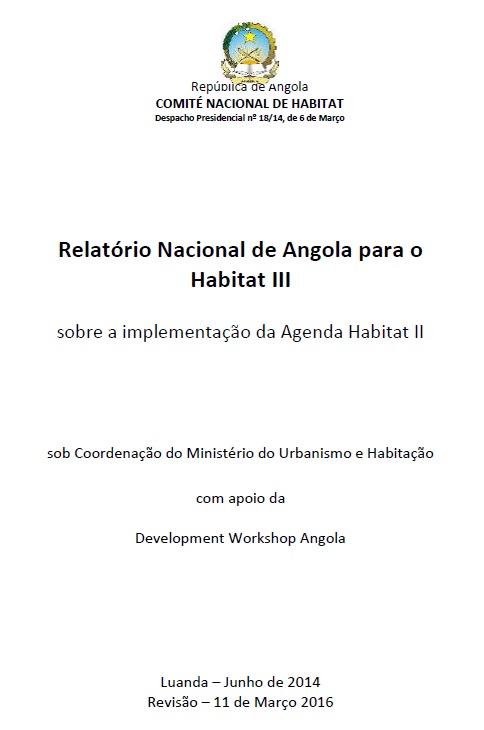
Relatório Nacional de Angola para o Habitat III

O Relatório Nacional de Angola para o Habitat III tem como referência os anos de 1996 (Aprovação da Agenda Habitat II em Istambul), 2002 (Alcance da paz efectiva em Angola) e 2008 (Lançamento do Programa Nacional do Urbanismo e Habitação), para monitorar os progressos alcançados pelo país no cumprimento das metas estabelecidas na Agenda Habitat II.

Angolan National Report for Habitat III

In the Habitat Agenda adopted in 1996, heads of state and governments committed themselves to two main goals, i.e., “Adequate Shelter for All” and “Sustainable Human Settlements in an Urbanizing World”, and to implement a plan of action based on these goals. In the Millennium Declaration, heads of state and governments committed themselves to improve the lives of at least 100 million slum dwellers by 2020. They also committed themselves to halve, by 2015, the proportion of the population without adequate sustainable access to drinking water and basic sanitation.

Council of Ministers Decree Number 1/01 Of 5 January 2001

Norma on the Resettlement of Displaced Populations with a view to facilitate the resettlement and, where the conditions permit, the return of lDPs to their areas of origin, in an organized manner, in the respect to the will of the citizen. To regulate and define thoroughly the responsibilities and attributions of the Institutions intervening in the implementation of the resettlement and return process of lDPs, as well as the methodologies and the reference standards that should be used in this process. “Displaced Persons” are those persons or groups of persons who have been forced or obliged to flee or to leave their houses or their places of habitual residence, in particular as a result of or in order to avoid the effects of the armed conflict, in accordance with the United Nations document E/CN.4/1998/53/Add.2, entitled ”Guiding Principles on Internal Displacement.” If temporary resettlement occurs, this should not prejudice the right of lDPs to return voluntarily to their areas of origin when conditions are conducive and cannot undermine their right to choose to fix permanent residence in an area different than the one of his/her origin.

Decreto Presidencial 19/00

  • « Go to Previous Page
  • Page 1
  • Interim pages omitted …
  • Page 132
  • Page 133
  • Page 134
  • Page 135
  • Page 136
  • Interim pages omitted …
  • Page 287
  • Go to Next Page »

Primary Sidebar

Resources

  • Angolan Media Scan
  • Online Library
  • Land Library
  • Community-Led Total Sanitation
  • Community Water – MoGeCA
  • KixiCrédito
  • HabiTec
  • LUPP
  • Urban Forum on AngoNet
  • AngoNet Webmail
  • Audio Archive
  • Africa-China Urban Initiative

Follow us on...

Sign up for E-Alerts

© 2026 Development Workshop Angola | Log in Built by PeaceWorks

  • Home
  • About DW
  • Programs
  • Partners
  • Publications
  • Community Media
  • Forums
  • Events
  • Contact