• Skip to primary navigation
  • Skip to main content
  • Skip to primary sidebar
DW Angola

DW Angola

Development Workshop Angola

  • About DW
    • About DW Angola
    • Timeline
    • Articles About DW
    • About Angola
    • Key Members & Staff
  • Programs
    • Water & Sanitation
    • Land Rights & Settlements
    • Climate Change
    • Informal Economy
    • Microfinance
    • Research
    • Voices of Citizens for Urban Change
    • Decentralisation & Governance
    • Natural Resources, Mining & Development
    • Peacebuilding & Citizenship
    • Urban Transport
    • AngoNet
  • Partners
  • Publications
    • Books by DW
    • Papers by DW
    • Articles about DW
    • DW Developments
    • Compendium of Angolan laws
  • Community Media
    • Ondaka
    • A Voz de Cacuaco
    • Boletim Informativo
    • Ecos do Heneda
    • Inforsambila
    • Journal Humbi-Humbi
    • Reconversáo
  • Forums
    • Friday Debates
    • Housing Finance
    • Urban Debates
    • Social & Economic Rights Forum
    • Sustainable Urban Planning
    • Training Courses
    • Espaço Sociedade Civil
    • Fórum Urbano no AngoNet
    • Fórum Cazenga
    • Fórum Cacuaco
    • Staff Blog
  • Events
    • COVID-19 Actions
  • Contest
  • Contact
  • English
    • English
    • Português
  • Show Search
Hide Search

African Struggles For the Right to the City – Allan Cain & Agnes Midi

Africa has some of the world’s most unequal cities. Informal settlements in African cities, and the struggles that are fought in their defense, are evidence of deep-rooted exclusion. They have inherited colonial segregated planning laws that are socio-economically exclusive, resulting in cement cities and slums. In many African former colonial countries, a struggle for a right to the city formed an integral part of the fight against colonialism and apartheid. In the decades since independence, few African states have been able to develop and implement reforms governing urban development to effectively improve these characteristics of their cities.


Decreto nº 208/17 Regulamenta os Princípios e as Normas de Organização e de Funcionamento dos Orgãos da Administração Local do Estado

Decreto nº 208/17 Regulamenta os princípios e as normas de organização e de funcionamento dos orgãos da administração local do estado, fixando as respectivas estruturas organizacionais, bem como os mecanismos de operacionalização. Revoga o Decreto nº9/08 de 25 de Abril, que estabelece o paradigma dos estatutos dos governos proviciais , administrações municipais e comunais.

Policiamento Comunitário. Estudo de Caso em Comunidades de Luanda

António Frank, Mestre em Estudo de Conflitos, Professor na Universidade de Haia e Investigador as questão de segurança pública na África Lusófona; foi a convidada para o espaço do Debate à Sexta feira da Development Workshop do dia 22 de Setembro de 2017 onde o tema em foi: “Policiamento comunitário. Estudo de caso em comunidades de Luanda ”. Ao longo da sua abordagem, falou das principais ideias da pesquisa que fará em Luanda sobre a relação da polícia e a comunidade.


Desenvolvimento Urbano Sustentável na Esfera Local: Experiencial de Formação em Singapura

Ema Samali Henriques da Silva Guimarães, licenciado em Arquitectura, Membro da Ordem dos Arquitectos de Angola e Portugal Manuel, Participou do Pequeno almoço urbano com o lema :Transformando as nossas cidades :Implementando a nova agenda urbana e os objectivos de desenvolvimento sustentável. Onde a prelector falou sobre as Experiência de Formação em Singapura.


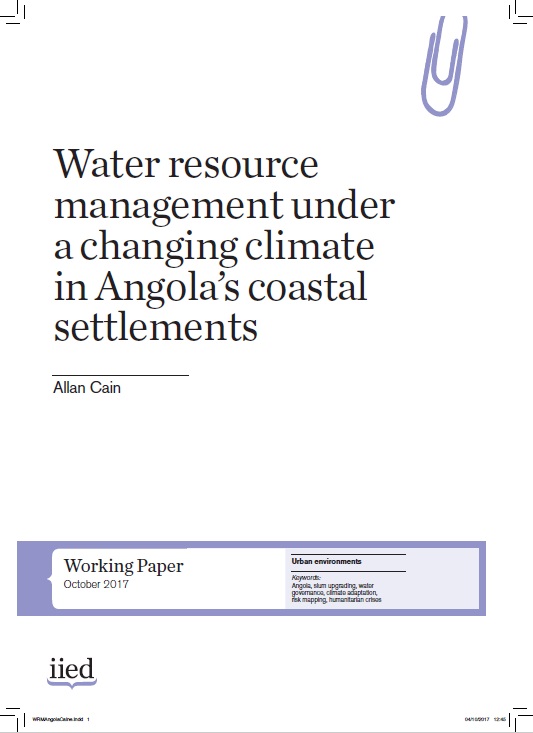
Water Resource Management Under a Changing Climate in Angola’s Coastal Settlements

Angola’s civil war caused a massive population movement from rural conflict areas to low-lying coastal zones between 1975 and 2002. More than half of Angola’s 27 million people now live in urban coastal settlements, floodplains and steep ravines vulnerable to climate extremes. Climaterelated risks are worsening and it is important to understand and prepare for them. Angola’s coastal areas are experiencing increasingly variable rainfall and pressure on water supplies and markets. But a dearth of relevant data has made it difficult to assess these risks. This paper demonstrates innovative methods in filling the information gap and how changes were introduced in how water is governed in four Angolan coastal cities.

  • « Go to Previous Page
  • Page 1
  • Interim pages omitted …
  • Page 123
  • Page 124
  • Page 125
  • Page 126
  • Page 127
  • Interim pages omitted …
  • Page 287
  • Go to Next Page »

Primary Sidebar

Resources

  • Angolan Media Scan
  • Online Library
  • Land Library
  • Community-Led Total Sanitation
  • Community Water – MoGeCA
  • KixiCrédito
  • HabiTec
  • LUPP
  • Urban Forum on AngoNet
  • AngoNet Webmail
  • Audio Archive
  • Africa-China Urban Initiative

Follow us on...

Sign up for E-Alerts

© 2026 Development Workshop Angola | Log in Built by PeaceWorks

  • Home
  • About DW
  • Programs
  • Partners
  • Publications
  • Community Media
  • Forums
  • Events
  • Contact