Development Workshop worked with ARD and its partner, the Rural Development Institute (RDI) to implement a program supported by USAID called “Strenghtening Land Tenure and Property Rights in Angola”. The program implemented between 2006 and 2008 aimed at helping the Angolan Government to address land tenure and property rights issues early on in the post-conflict strategy of national development. Land access, land possession, and land rights (land tenure) are among the most significant issues confronting post-conflict Angola, as they typically affect displaced peoples and returning combatants. The sequence of land reforms leading to secure land tenure and property rights contributes to good local governance, economic growth, and sustainable natural resources use.The project has set the groundwork for land concessions, eventual land tenure regularisation, land markets, sustainable agricultural development, and economic growth.
Estudo de Linha de Base
O projecto “Gestão de Terras no Planalto Central de Angola”, financiado pela União Europeia
e comuma duração de três anos (Maio 2014- Abril 2017), é implementado pelas Organizações
Não Governamentais Visão Mundial Angola (WVA), e Development Worwshop (DW). O
projecto tem como objectivo geral “assegurar a posse de terras, florestas, recursos
pesqueiros e outros recursos naturais para pequenos produtores, indivíduos e comunidades
vulneráveis, para alcançar a segurança alimentar e a erradicação da pobreza”. Este
objectivo pretende ser alcançado através do empoderamento dos governos aos níveis nacional,
provincial e municipal, actores não estatais locais e comunidades. O projecto é implementado
em 10 municípios: Chinguar e Kuito (Província do Bié); Huambo, Katchiungo, Bailundo,
Tchicala Tcholohanga, Caála, Ekunha e Longonjo (Província do Huambo); e Cubal (Província
de Benguela).


Desafios em torno da Nova Lei Geral do Trabalho – Josefa Webba Neto
Mestre em Direito do Trabalho e Professora de direito do trabalho da Faculdade de Direito na Universidade Agostinho Neto. Trouxe ao espaço do Debate o tema sobre os Desafios em torno da Nova Lei Geral do Trabalho; alusiva ao lançamento da Nova Lei Trabalhista que será promulgada no dia 13 de Setembro de 2015. Na sua abordagem destacou elementos importantes que devem ser levados em consideração sobre o impacto que a referida lei terá na vida dos empregados e das famílias a nível do País. E no entanto, fê-la em duas perspectivas, na vertente jurídica (alcance dos objectivos da política), em que o executivo pretende atrair mais o investimento externo, aumento da produtividade por parte dos empregados, dar resposta a actual situação económica, política e social do país; E na vertente social, realçou que não se mediu as consequências que podem surgir na vida socio-económica das famílias angolanas, por não conter elementos analisados numa visão sociológica e antropológica.


Strengthening Land Tenure and Property Rights in Angola
Development Workshop worked with ARD and its partner, the Rural Development Institute (RDI) to implement a program supported by USAID called “Strenghtening Land Tenure and Property Rights in Angola”. The program implemented between 2006 and 2008 aimed at helping the Angolan Government to address land tenure and property rights issues early on in the post-conflict strategy of national development. Land access, land possession, and land rights (land tenure) are among the most significant issues confronting post-conflict Angola, as they typically affect displaced peoples and returning combatants. The sequence of land reforms leading to secure land tenure and property rights contributes to good local governance, economic growth, and sustainable natural resources use.The project has set the groundwork for land concessions, eventual land tenure regularisation, land markets, sustainable agricultural development, and economic growth.

LAND RIGHTS FORMALIZATION IN RURAL AND PERI-URBAN SETTINGS IN ANGOLA
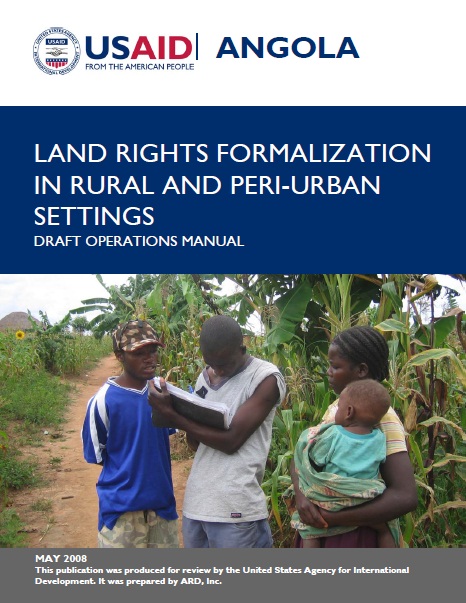
Development Workshop worked with ARD and its partner, the Rural Development Institute (RDI) to implement a program supported by USAID called “Strenghtening Land Tenure and Property Rights in Angola”. The program implemented between 2006 and 2008 aimed at helping the Angolan Government to address land tenure and property rights issues early on in the post-conflict strategy of national development. Land access, land possession, and land rights (land tenure) are among the most significant issues confronting post-conflict Angola, as they typically affect displaced peoples and returning combatants. The sequence of land reforms leading to secure land tenure and property rights contributes to good local governance, economic growth, and sustainable natural resources use.The project has set the groundwork for land concessions, eventual land tenure regularisation, land markets, sustainable agricultural development, and economic growth.